







HMG (Humaan Menopauzaal Gonadotropine / Menotropine) — Onderzoekskwaliteit
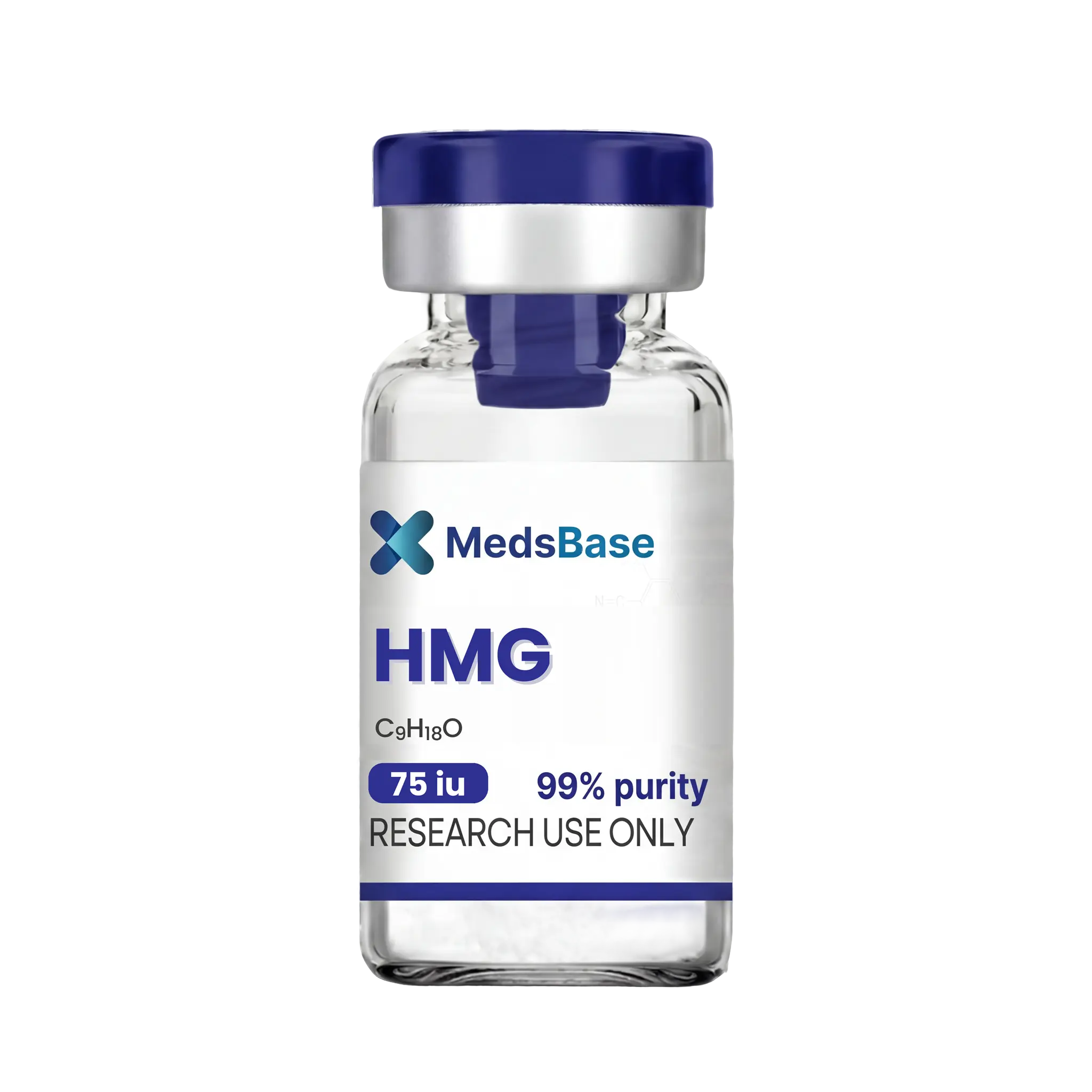
✅ Dubbele LH + FSH glycoproteïne-hormoonbereiding — 1:1 bioactiviteitsverhouding (75 IE elk)
✅ Canonieke LHCGR + FSHR dubbele gonadotropine-receptoragonist
✅ Urine-geëxtraheerde menotropine uit postmenopauzale gepoolde urine (CAS 61489-71-2)
✅ Twee-cel twee-gonadotropine model — activeert Leydig+Sertoli of theca+granulosa
✅ Standaardtool voor spermatogenese-inductie & ovariële stimulatieonderzoek
HMG (Onderzoekskwaliteit) bevat urine-geëxtraheerd Humaan Menopauzaal Gonadotrofine (menotropine).
✓ Medisch beoordeeld door Morgan Ellis — Apotheekonderzoeker · 8 jaar ervaring · Laatst beoordeeld: mei 2026
Kort antwoord — Wat is HMG (onderzoekskwaliteit)?
HMG (Humaan Menopauzaal Gonadotropine, ook bekend als menotropine; CAS 61489-71-2) is een urine-afgeleide glycoproteïne-hormoonpreparaat met gelijke LH- en FSH-bioactiviteit (75 IU LH + 75 IU FSH per vial, de standaard 1:1 verhouding). Gezuiverd uit de urine van postmenopauzale vrouwen — bij wie de gonadotropine-afgifte van de hypofyse van nature verhoogd is door het ontbreken van negatieve feedbackremming — is hMG de klassieke dubbele LHCGR + FSHR agonist in de endocriene farmacologie en het referentie-onderzoeksinstrument voor protocollen die gelijktijdige Leydig-cel / theca-cel steroidogenese (LH-kant) en Sertoli-cel / granulosa-cel activiteit (FSH-kant) nodig hebben. Het geleverde onderzoeksmateriaal is de urine-geëxtraheerde glycoform met ≥99% HPLC-zuiverheid. Alleen voor laboratoriumonderzoek. Verschilt van klinische menotropinepreparaten (Menopur, Menogon, Repronex).
📦 Elke bestelling is gedekt door onze Reshipment Assurance-beleid — als uw pakket niet binnen 20 werkdagen arriveert, sturen wij het opnieuw.
| Specificatie | Detail |
|---|---|
| Compound Class | Glycoproteïne-hormoonpreparaat — vaste 1:1-mengsel van LH- en FSH-biologische activiteit; dubbele LH/CG-receptor (LHCGR) + FSH-receptor (FSHR) agonist; peptidehormoonpreparaat |
| Chemical Name | Humaan menopauzaal gonadotropine (Menotropine; urine-geëxtraheerd preparaat; synoniemen: hMG, urofollitropine-met-LH, menopauzaal gonadotropine) |
| CAS-nummer | 61489-71-2 (menotropine / hMG gemengd preparaat) |
| Actieve componenten | LH (luteïniserend hormoon, ~30 kDa heterodimeer; α 92 aa + β 121 aa, geglycosyleerd) — 75 IE per flesje; FSH (follikelstimulerend hormoon, ~30 kDa heterodimeer; α 92 aa + β 111 aa, geglycosyleerd) — 75 IE per flesje. Het α-subunit wordt gedeeld tussen LH, FSH, HCG en TSH; de β-subunits bepalen de receptorspecificiteit. Beide gonadotropines zijn uitgebreid N- en O-geglycosyleerd. |
| Biologische activiteitsverhouding | LH:FSH-activiteit = 1:1 (de standaard hMG-verhouding sinds de standaardisering van de potentie in de late jaren 1990; beide activiteiten gemeten door WHO-bioassay tegen internationale referentiestandaarden) |
| HCG Co-Purificatie (relevant voor onderzoek) | Een kenmerk van urine-afgeleide hMG-preparaten: gepubliceerde samenstellingsanalyses melden dat ongeveer 95% van de in-vivo LH-receptor-gemedieerde biologische activiteit toe te schrijven is aan sporen HCG die meegezuiverd zijn uit postmenopauzale urine (Wolfenson et al. 2005 en anderen). HCG en LH binden aan dezelfde LHCGR met vergelijkbare affiniteit, maar HCG heeft een halfwaardetijd van 33–37 uur versus ~20 minuten voor LH — dus zelfs kleine hoeveelheden HCG domineren het in-vivo LH-equivalente signaal. Onderzoekers moeten zich hiervan bewust zijn bij het vergelijken van hMG met pure recombinant LH (Luveris) preparaten. |
| Werkingsmechanisme | Dubbele GPCR-agonisme. LHCGR (Gs-gekoppeld, Leydig-/theca-/granulosacellen/corpus luteum-cellen) → cAMP-PKA-StAR-CYP17A1-cascade → androgenenbiosynthese. FSHR (Gs-gekoppeld, Sertoli-cellen bij mannen/granulosacellen bij vrouwen) → cAMP-PKA-CYP19A1/aromatase-cascade → ondersteuning van spermatogenese (mannen) of conversie van androgenen naar oestrogenen + folliculaire rijping (vrouwen). De dubbele activering is wat hMG onderscheidt van pure-LH (Luveris/rLH) of pure-FSH (Gonal-F/Puregon/rFSH) preparaten. |
| Sequentie | Gemengd preparaat — zowel LH als FSH zijn heterodimere glycoproteïnen. α-subeenheid (gedeeld) ~92 aa, identiek voor LH/FSH/HCG/TSH. LH β-subeenheid ~121 aa, FSH β-subeenheid ~111 aa. Volledige sequenties beschikbaar via UniProt: LHβ (P01229), FSHβ (P01225), GPHα (P01215). |
| Molecuulformule | Gemengd urine-geëxtraheerd glycoproteïne preparaat — FSH (α 92aa + β 111aa) + LH (α 92aa + β 121aa) heterodimeren in ~1:1 bioactiviteitsverhouding. Geen enkele moleculaire formule vanwege heterogeen glycosyleringspatroon in het preparaat. |
| Plasma Half-Life | FSH-activiteit: terminale halfwaardetijd ~30–40 uur (sialylering-gestuurd, vergelijkbaar met andere glycoproteïnehormonen). LH-activiteit in hMG: nominaal ~10–20 uur (maar in de praktijk bepaald door de meegezuiverde HCG-fractie met 33–37 uur halfwaardetijd — zie HCG co-zuiveringsopmerking hierboven). |
| Form | Gevriesdroogd wit tot off-wit amorfe poeder met mannitol- of lactose-stabiliserende matrix; eenmalig gebruik onderzoeksflesjes |
| Zuiverheid | ≥99% (HPLC-geverifieerd); WHO-bioassay bevestigt LH- en FSH-activiteit op de gelabelde 75 IE elk. COA op aanvraag beschikbaar. |
| Oplosbaarheid | Reconstitueer in bacteriostatisch water met 1,0 mL per flesje → 75 IE LH + 75 IE FSH per mL werkvoorraad; andere verdunningen volgens protocol. Het poeder lost snel op bij voorzichtig zwenken. Niet schudden; niet vortexen — hoog-shear mengen dissocieert de α/β heterodimeren van zowel LH- als FSH-componenten. |
| Opslag | Gevriesdroogd: 2–8 °C ongeopend voor kortetermijnwerkvoorraad; −20 °C voor langdurige opslag (stabiel ≥36 maanden bij −20 °C; ≥18 maanden bij 2–8 °C). Gereconstitueerd: 2–8 °C, gebruik binnen ~30 dagen. Beschermen tegen licht. Vries gereconstitueerd materiaal niet in — vries-ontdooicycli dissociëren de LH- en FSH α/β heterodimeren en vernietigen de bioactiviteit. |
| Onderzoeksgebruik | Alleen voor laboratoriumonderzoek. Niet voor menselijke of veterinaire diagnostische of therapeutische toepassingen. hMG / menotropine staat op de Verboden Lijst van het Wereldantidopingagentschap (WADA) (klasse S2, Peptidehormonen, Groeifactoren en Verwante Stoffen) en is te allen tijde verboden voor mannelijke atleten. Onderzoekers in menselijke onderzoekscontexten moeten zich bewust zijn van deze regelgevende status. |
Wat Is HMG (Menotropine)?
HMG — Humaan Menopauzaal Gonadotropine, ook bekend als menotropine (CAS 61489-71-2) — is een urine-afgeleide glycoproteïne-hormoonpreparaat dat gelijke hoeveelheden LH (luteïniserend hormoon) en FSH (follikelstimulerend hormoon) bioactiviteit bevat, gestandaardiseerd op 75 IE van elk per flesje. Het wordt gezuiverd door ionenuitwisseling en gel-filtratie chromatografie uit de gecombineerde urine van postmenopauzale vrouwen, die van nature een verhoogde hypofyse-gonadotropine-afgifte hebben (LH en FSH typisch 50–100+ mIE/mL elk) door het verlies van ovariële negatieve feedbackremming die gepaard gaat met de menopauze.
De “menopauzaal” in de naam verwijst naar deze bron: postmenopauzale urine is de meest geconcentreerde natuurlijke bron van LH en FSH beschikbaar voor industriële zuivering, en hMG wordt sinds de vroege jaren 1960 uit deze bron geproduceerd (het oorspronkelijke Cesare Serono-ontwikkelde Pergonal-preparaat). De samenstellingsverfijning van hMG is aanzienlijk geëvolueerd door de decennia heen — eerdere preparaten hadden sterk variërende LH:FSH-verhoudingen en aanzienlijke eiwitverontreinigingen; moderne preparaten (de basis van ons onderzoeksmateriaal) zijn gestandaardiseerd op 75:75 IE bioactiviteit per flesje met ≥99% HPLC-zuiverheid.
hMG is het canonieke dubbele-gonadotropine farmacologische hulpmiddel. Waar HCG selectief de LHCGR activeert, waar puur-LH (recombinant Luveris) selectief de LHCGR activeert met fysiologische halfwaardetijd, waar puur-FSH (recombinant Gonal-F / Puregon) selectief de FSHR activeert, activeert hMG beide receptoren gelijktijdig in een vaste 1:1-verhouding. De twee receptoren worden uitgedrukt op verschillende celpopulaties binnen de geslachtsklier — LHCGR op Leydig-cellen / theca-cellen / geluteïniseerde granulosa / corpus luteum; FSHR op Sertoli-cellen / muraal granulosa — dus dubbele activatie produceert een volledige fysiologische gonadotropineprikkel die meer lijkt op endogene middencyclus hypofyse-afgifte dan elk receptor alleen geactiveerd.
Een onderzoeksrelevant detail: HCG copurificatie. Gepubliceerde samenstellingsanalyses van urine-afgeleide hMG-preparaten melden dat het grootste deel van de in-vivo LH-receptorbioactiviteit eigenlijk toe te schrijven is aan sporen HCG die meegezuiverd zijn uit postmenopauzale urine — ongeveer 95% van de LH-receptor-gemedieerde bioactiviteit volgens sommige analyses (Wolfenson et al., 2005). Dit komt omdat HCG en LH dezelfde LHCGR binden met vergelijkbare affiniteit, maar HCG heeft een plasma-halfwaardetijd van 33–37 uur versus ~20 minuten voor LH, dus zelfs kleine hoeveelheden HCG domineren het cumulatieve in-vivo LH-equivalente signaal. Dit is deels waarom hMG aanhoudende Leydig-celstimulatie produceert ondanks dat de nominale “LH-activiteit” van LH zelf kortstondig is. Voor onderzoeksprotocollen waar dit onderscheid ertoe doet (pure-LH farmacologie vs HCG-verontreinigd gemengd-LH signaal), is recombinant LH (Luveris) het schonere hulpmiddel; voor protocollen waar dubbele LHCGR + FSHR-activatie in fysiologische 1:1-verhouding het doel is, is hMG de canonieke referentie.
Werkingsmechanisme — Dubbele LHCGR + FSHR-activatie
Het werkingsmechanisme van hMG is de dubbele som van de twee componentactiviteiten, beide goed gekarakteriseerd in de endocriene farmacologie:
- LH (en mee-gezuiverde HCG) → LHCGR-activering — De LH-component (en de sporen HCG die mee-gezuiverd worden uit postmenopauzale urine) bindt aan de LH/CG-receptor op Leydig-cellen (testis) en theca-/granulosa-/luteale cellen (ovarium). Gs-koppeling verhoogt cAMP, activeert PKA, reguleert StAR-gemedieerd mitochondriaal cholesteroltransport op en induceert CYP11A1/CYP17A1/3β-HSD/17β-HSD steroïdogene enzymen — wat de novo testosteronbiosynthese (mannelijk) of androstenedionbiosynthese (vrouwelijk) aandrijft.
- FSH → FSHR-activering — De FSH-component bindt aan de FSH-receptor op Sertoli-cellen (testis) en muraal granulosa-cellen (ovarium). FSHR is ook Gs-gekoppeld, maar het downstream-programma is verschillend: in Sertoli-cellen drijft FSHR-activering androgeenbindend eiwit (ABP), inhibine B en het structurele ondersteuningsprogramma aan dat de spermatogenese ondersteunt; in granulosa-cellen drijft FSHR-activering CYP19A1 (aromatase) aan, waarbij androgenen afkomstig van theca-cellen worden omgezet in oestrogenen, en bevordert het folliculaire rijping door de antraal- en pre-ovulatoire stadia.
- Gecombineerd twee-cel twee-gonadotropinemodel — Het klassieke endocriene kader. In de mannelijke testis produceren LH-gestimuleerde Leydig-cellen testosteron, dat diffundeert naar aangrenzende Sertoli-cellen waar FSH-geïnduceerd androgeenbindend eiwit en Sertoli-celmetabolisme het omzetten in de hoge intratesticulaire testosteronmicro-omgeving die spermatogenese vereist. In het vrouwelijke ovarium produceren LH-gestimuleerde theca-cellen androgenen, die diffunderen naar aangrenzende granulosa-cellen waar FSH-geïnduceerde aromatase ze omzet in oestrogenen. Het twee-cel twee-gonadotropinemodel is het canonieke kader, en hMG is het canonieke farmacologische hulpmiddel om beide helften tegelijkertijd te activeren.
- Receptordesensibilisatie en tachyfylaxie — Zowel LHCGR als FSHR ondergaan arrestine-gemedieerde desensibilisatie na langdurige agonistblootstelling. Herhaalde hoge doses hMG kunnen receptordownregulatie veroorzaken — een goed gedocumenteerd fenomeen in gepubliceerd gonadotropinefarmacologieonderzoek relevant voor chronische doseringsprotocollen.
- Hypothalamus-hypofyse-feedback — Net als bij HCG, geeft hMG-gestuurde gonadale steroïdproductie feedback aan de hypothalamus en hypofyse om endogene GnRH- en LH/FSH-secretie te onderdrukken. In de context van HPG-onderdrukkingsonderzoek (testosteronsuppletie, AAS-blootstelling, farmacologische GnRH-antagonisme), omzeilt hMG de hypothalamus-hypofyse-blokkade door direct in te werken op de gonadale receptoren — wat zowel Leydig-celfunctie (LH-kant) als Sertoli-cel-/spermatogenese-ondersteunende functie (FSH-kant) tegelijkertijd behoudt, wat hMG onderscheidt van pure-HCG-protocollen in deze onderzoekscontext.
Het farmacokinetische profiel van hMG weerspiegelt grofweg dat van zijn componenten: FSH-activiteit blijft bestaan met een terminale halfwaardetijd van 30–40 uur, LH-equivalente activiteit wordt gedomineerd door de lang-halfwaardetijd mee-gezuiverde HCG (33–37 uur), en de gecombineerde preparatie produceert een langdurige 24–72 uur durende dubbele gonadotropinestimulatie per dosis. Typische onderzoeksprotocoldosering is 75–225 IE SC dagelijks in onderzoek met knaagdieren of menselijke proefpersonen — equivalent aan 1–3 flesjes van de 75 IE sterkte.
Gepubliceerde onderzoeksapplicaties
hMG wordt gebruikt in laboratoriumonderzoekcontexten die onderzoeken:
- Gonadotropinefarmacologie — de canonieke dubbele-receptorreferentie — meest geciteerde dubbele LHCGR + FSHR-agonist in gepubliceerd gonadotropineonderzoek; standaardreferentieverbinding voor het ontleden van LH-only vs FSH-only vs gecombineerde gonadotropinesignalering
- Onderzoek naar inductie van spermatogenese — in hypogonadotroop-hypogonadisme knaagdier modellen is hMG (met of zonder aanvullende HCG) het standaardinstrument voor het induceren van spermatogenese door zowel de testosteronproductie van Leydig-cellen als de FSH-ondersteuning van Sertoli-cellen te herstellen; het standaard onderzoeksprotocol bestaat uit 75–150 IE SC drie keer per week gedurende 6–24 maanden in klinisch translationeel onderzoek
- Onderzoek naar ovariële stimulatie bij vrouwen — het historische basisinstrument van in-vitrofertilisatieonderzoek; hMG stimuleert de folliculaire ontwikkeling door de antrale en pre-ovulatoire fasen in gepubliceerde ovulatie-inductieprotocollen, meestal gecombineerd met HCG als ovulatietrigger; veel gebruikt in onderzoek naar polycysteus ovariumsyndroom (PCOS), onverklaarde onvruchtbaarheid en geassisteerde voortplantingstechnologieën
- Onderzoek naar het twee-cellen twee-gonadotropine model — het standaardkader van farmacologie van gonadale steroïdogenese; hMG is het standaardinstrument voor het gelijktijdig activeren van beide helften van het model; gepubliceerd onderzoek naar Sertoli-Leydig co-culturen en theca-granulosa co-culturen gebruikt hMG om de fysiologische dubbele receptorstimulatie na te bootsen
- Onderzoek naar onderdrukking en herstel van de HPG-as — in gepubliceerde onderzoeksmodellen waarbij endogeen LH/FSH is onderdrukt (door exogeen testosteron, AAS-blootstelling of GnRH-antagonisme), behoudt hMG zowel de functie van Leydig-cellen als Sertoli-cellen door directe activering van gonadale receptoren — wat het onderscheidt van HCG-only protocollen die alleen de LH-zijde behouden en het risico lopen op Sertoli-celatrofie
- Vergelijkende farmacologie versus puur-LH / puur-FSH / HCG — gepubliceerde head-to-head vergelijkingen van hMG versus recombinant LH (Luveris), recombinant FSH (Gonal-F / Puregon), recombinant HCG (Ovidrel) en diverse combinaties zijn uitgebreid; hMG is de urine-afgeleide 1:1 gemengde referentie waartegen al deze worden afgezet
- Follikelontwikkeling en granulosa-celbiologie — gepubliceerd ex-vivo follikelkweek- en primair granulosa-celonderzoek gebruikt hMG om gelijktijdige theca-cel androgenproductie en granulosa-cel aromatase-inductie te stimuleren — de meest fysiologisch relevante in-vitro stimulus beschikbaar
- Corpus luteum-biologie — aanhoudende LHCGR-activatie door de LH-component (en meegezuiverde HCG) handhaaft corpus luteum-functie en progesteronproductie; gebruikt in onderzoek naar de luteale fase en luteo-placentale overgang
Voor bredere context over HPG-as- en voortplantingssysteem-onderzoekspeptiden in deze catalogus, zie HCG (Humaan Choriongonadotrofine) (pure LHCGR-agonist — directe vergelijking; alleen LH-activiteit), Kisspeptine-10 (de upstream hypothalamische Kiss1R-agonist — stimuleert endogene GnRH-pulsatie), PT-141 (Bremelanotide) (melanocortine-receptorfarmacologie — seksuele-functieonderzoek), en Oxytocine Acetaat (posterieure hypofyse peptidehormoon). Bekijk het volledige onderzoekspeptiden & verbindingen catalogus.
Beschikbare sterktes en concentraties
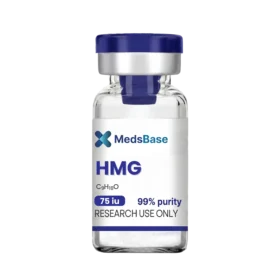
MedsBase stocks HMG (urinary-extracted menotropin) in a single lyophilized vial strength calibrated to the standard 1:1 LH:FSH bioactivity unit. The vial is available in 10-vial, 20-vial, or 30-vial pack formats:
| Vulsterkte | Typisch Onderzoeksgebruik | Verpakkingsgroottes |
|---|---|---|
| 75 IE LH + 75 IE FSH | Standaard onderzoekssterkte (de internationale referentie-eenheidsdosis) — enkelvoudige dosis dubbele gonadotropine-stimulatie, spermatogenese-inductieprotocollen (75–225 IE SC drie keer per week), ovariële stimulatieonderzoek, twee-cel twee-gonadotropine co-cultuurstimulatie, vergelijkende farmacologie versus recombinante pure-LH en pure-FSH preparaten | 10, 20 of 30 vialen |
The 75:75 IU vial is the international-reference dose unit and the format used in essentially all published gonadotropin research and clinical practice. Multiple-vial dosing (150 IU, 225 IU per administration) is standard for higher-dose protocols. The 30-vial pack is the more economical purchase per-IU for extended-cycle or multi-cohort protocols.
Vergelijking — HMG versus HCG
HCG en hMG zijn de twee urine-afgeleide gonadotropinepreparaten in deze catalogus, en ze richten zich op het gonadotropine-receptorsysteem op mechanistisch verschillende manieren. HCG is een puur LH/CG-receptoragonist — alleen Leydig-cel / theca-cel activering. hMG is het duale LH + FSH-preparaat — activeert beide helften van het twee-cel twee-gonadotropinemodel gelijktijdig. De keuze tussen beide in onderzoek hangt af van of het protocol alleen LH-zijde activering nodig heeft of gecombineerde LH-zijde + FSH-zijde activering.
| Criterium | HMG (Menotropine) | HCG |
|---|---|---|
| Samenstelling | Vaste 1:1 mengsel: LH 75 IE + FSH 75 IE per flesje (+ sporen HCG die het LH-equivalente in-vivo signaal domineert) | Pure HCG (urine-geëxtraheerd) — enkel glycoproteïne |
| Receptoren betrokken | LHCGR en FSHR — duale gonadotropine-receptor activering | Alleen LHCGR — enkele receptor |
| Source | Postmenopauzale urine | Urine van zwangere vrouwen (uHCG) of recombinante CHO-cellen (rHCG) |
| Beste onderzoeksapplicaties | Inductie van spermatogenese (behoudt Sertoli-celfunctie), ovariële folliculaire stimulatie, onderzoek naar twee-cel twee-gonadotropinemodel, duale-receptorfarmacologie | Alleen Leydig-celstimulatie, ovulatietriggering (LH-piek nabootsing), onderzoek naar HPG-onderdrukking-herstel specifiek voor Leydig-cellen, LHCGR-farmacologie |
| Plasma-halfwaardetijd | FSH ~30–40 uur; LH-equivalente activiteit gedomineerd door gezuiverde HCG (33–37 uur) | 33–37 uur (terminal fase) |
| Typische onderzoeksdosis | 75–225 IE SC (1–3 flesjes) per toediening; 3×/week in chronische protocollen | 500–5.000 IE SC/IM (enkele bolus); 250–500 IE/dag in chronische protocollen |
| Flesje doseringseenheid | 75 IE bioactiviteit (de internationale referentiedosis) | 5.000 of 10.000 IE bioactiviteit |
| WADA-status | Te allen tijde verboden voor mannelijke atleten (S2 — Peptide Hormonen) | Te allen tijde verboden voor mannelijke atleten (S2 — Peptide Hormonen); uitzondering voor vrouwelijke atleten |
Voor onderzoek gericht op dubbele LHCGR + FSHR-activering, inductie van spermatogenese of het canonieke twee-cel twee-gonadotropine model, is hMG de standaard referentieverbinding. Voor onderzoek gericht op uitsluitend Leydig-celstimulatie, ovulatietriggering of HCG-specifieke LHCGR-farmacologie, HCG is het meer gerichte hulpmiddel. Zie ook Kisspeptine-10 voor upstream hypothalamische Kiss1R / GnRH-pulsatiliteitsonderzoek.
Opslag en Reconstituering
Voor reconstituering: bewaar lyofiliseerde flesjes gekoeld bij 2–8 °C in de originele verpakking voor kortdurende werkvoorraad. Voor langdurige opslag, vries ongeopende flesjes in bij −20 °C (stabiel ≥36 maanden bij −20 °C; ≥18 maanden bij 2–8 °C). Het lyofiliseerde poeder is gestabiliseerd met mannitol of lactose en is redelijk bestand tegen kortdurende blootstelling aan kamertemperatuur tijdens hantering, maar moet direct teruggeplaatst worden in de koeling. Bescherm tegen licht.
Reconstitueringsprocedure: voor elk 75 IU-flesje, injecteer 1,0 mL bacteriostatisch water langs de zijkant van het flesje (niet direct op het lyofiliseerde poeder) — dit resulteert in een werkvoorraad van 75 IU LH + 75 IU FSH per mL. Voor onderzoeksprotocollen die hogere concentraties nodig hebben (meerdere flesjes samenvoegen voor een hogere enkele dosis), reconstitueer 2–3 flesjes met hetzelfde totaal van 1,0 mL oplosmiddel om 150–225 IU/mL te verkrijgen. Draai voorzichtig om op te lossen — niet schudden, niet vortexen. Hoog-schuurmenging dissocieert de α/β heterodimeren van zowel LH- als FSH-componenten en vernietigt de bioactiviteit van gonadotropine-receptoren. Het mannitol-gebaseerde lyofiliseerde poeder lost meestal binnen 30–60 seconden op bij voorzichtig draaien.
Kritieke opslagregels voor gereconstitueerd materiaal: na reconstitutie, bewaar bij 2–8 °C en gebruik binnen 30 dagen. Vries gereconstitueerde hMG niet in — vries-ontdooicycli dissociëren de LH- en FSH α/β heterodimeren (dezelfde fysisch-chemische beperking als HCG) en vernietigen onomkeerbaar de bioactiviteit. Bescherm tegen licht. Gooi weg als troebelheid, deeltjes of duidelijke kleurverandering optreedt. Voor onderzoeksprotocollen die meerdere aliquots vereisen, bereid aliquots op het moment van reconstitutie en bewaar ze apart bij 2–8 °C in plaats van in te vriezen.
Veelgestelde vragen
Wat is het verschil tussen HMG en HCG?
HCG is een pure LH/CG-receptoragonist — enkelvoudig glycoproteïne hormoon (CAS 9002-61-3) dat alleen de LHCGR bindt en activeert op Leydig / theca / granulosa / luteale cellen. hMG is een 1:1 mengsel van LH- en FSH-bioactiviteit — verschillende glycoproteïne hormonen (gecombineerd CAS 61489-71-2) die zowel de LHCGR (LH-kant) als de FSHR (FSH-kant) binden. Het klinische en onderzoeksgevolg is dat hMG dubbele receptorstimulatie produceert die beide helften van het twee-cel twee-gonadotropine model activeert (Leydig + Sertoli bij mannen; theca + granulosa bij vrouwen), terwijl HCG enkelvoudige receptorstimulatie van alleen de LHCGR-kant produceert.
Wat is de HCG-co-purificatie in hMG, en waarom is dit belangrijk voor onderzoek?
Gepubliceerde compositionele analyses van urine-afgeleide hMG-preparaten melden dat ongeveer 95% van de in-vivo LH-receptor-gemedieerde bioactiviteit is eigenlijk toe te schrijven aan sporen van HCG die samen met LH uit postmenopauzale urine worden gezuiverd, in plaats van aan LH zelf (Wolfenson et al., 2005). Dit komt omdat HCG en LH beide aan dezelfde LHCGR binden met vergelijkbare affiniteit, maar HCG heeft een plasma-halfwaardetijd van 33–37 uur tegenover ~20 minuten voor LH — dus zelfs kleine hoeveelheden meegezuiverde HCG domineren het cumulatieve in-vivo LH-equivalente signaal. Voor onderzoeksprotocollen waarbij dit onderscheid van belang is (bijv. vergelijking van pure LH-farmacologie versus HCG-verontreinigd gemengd LH-signaal), recombinant LH (Luveris) is het schonere gereedschap. Voor protocollen waarbij dubbele LHCGR + FSHR-activatie in een vaste 1:1-verhouding het doel is, is hMG de klassieke referentie.
Waarom wordt hMG gewonnen uit urine van postmenopauzale vrouwen?
Postmenopauzale vrouwen verliezen de ovariële negatieve feedbackremming van de hypothalamus-hypofyse-as, wat de hypofysaire LH- en FSH-productie aanzienlijk verhoogt — typische postmenopauzale serum-LH en -FSH zijn elk 50–100+ mIU/mL, een orde van grootte hoger dan premenopauzale waarden. Beide hormonen worden vervolgens via de nieren in geconcentreerde vorm in de urine uitgescheiden. Gepoolde postmenopauzale urine is daarom de meest geconcentreerde natuurlijke bron van LH + FSH voor industriële extractie op grote schaal. De hMG-industrie is in de vroege jaren 1960 op dit inzicht gebouwd (Pergonal was het oorspronkelijke Serono-preparaat) en bestaat nog steeds, hoewel een groot deel van de klinische markt is verschoven naar recombinant pure-LH- en pure-FSH-preparaten.
Welke gepubliceerde doseringsbereiken zijn gebruikt in onderzoek?
Enkelvoudige dosis voor onderzoeksprotocollen is typisch 75–225 IE SC per toediening (1–3 flesjes van de 75 IE-sterkte), met 3×/week of dagelijkse dosering in chronische protocollen. Spermatogenese-inductieprotocollen in gepubliceerd onderzoek naar hypogonadotroop hypogonadisme gebruiken typisch 75–150 IE 3×/week gedurende 6–24 maanden in combinatie met HCG (de HCG zorgt voor extra Leydig-celstimulatie). In-vitro Sertoli-cel- of granulosacelcultuurprotocollen gebruiken typisch 1–10 IE/mL in groeimedium. Onderzoekers moeten de primaire literatuur raadplegen die relevant is voor de soort, het model en het eindpunt.
Wat is het verschil tussen hMG en puur recombinant FSH (Gonal-F / Puregon)?
Puur recombinant FSH (follitropine alfa / Gonal-F; follitropine bèta / Puregon; geproduceerd in CHO-cellen uit gekloonde FSH α- en β-cDNA's) bevat alleen FSH-biologische activiteit — geen LH, geen HCG. hMG bevat zowel LH- als FSH-biologische activiteit in een 1:1-verhouding (plus sporen HCG). Voor onderzoeksprotocollen die pure FSHR-activatie nodig hebben, geïsoleerd van LHCGR-signalering, is recombinant FSH het juiste gereedschap. Voor protocollen die gecombineerde dubbele receptoractivatie bij fysiologische verhouding nodig hebben, is hMG het juiste gereedschap. Gepubliceerde head-to-head-onderzoeken in ovarieel stimulatieonderzoek hebben de twee vergeleken met grofweg equivalente folliculaire ontwikkelingsuitkomsten, maar met subtiel verschillende oestradiolresponsprofielen (hMG produceert meestal iets hogere mid-cycle oestradiol vanwege het LH-gerelateerde androgeensubstraat dat het levert voor granulosacelaromatase).
Waarom kan gereconstitueerde hMG niet worden ingevroren?
Dezelfde reden als HCG — zowel LH als FSH zijn heterodimeren van twee niet-covalent geassocieerde subeenheden (α + β elk). De α/β-interactie is stabiel in de lyofiliseercake (geen water om de interactie te verstoren) en stabiel in gekoelde waterige oplossing bij 2–8 °C (kinetiek van dissociatie is traag bij lage temperatuur). Maar ijskristalvorming tijdens het invriezen trekt de subeenheden fysiek uit elkaar, en ze associëren na ontdooien slechts inefficiënt weer. Het resultaat is dat ingevroren en ontdooide hMG een groot deel van de immunoreactiviteit behoudt, maar een groot deel van de biologische activiteit verliest. Lyofiliseerde hMG kan worden ingevroren en is stabiel bij −20 °C; gereconstitueerde hMG kan dat niet.
Wat is de WADA-regulatorische status van hMG?
hMG / menotropine staat op de Verboden Lijst van het Wereldantidopingagentschap (WADA) onder klasse S2 (Peptidehormonen, groeifactoren, verwante stoffen en mimetics). Het is te allen tijde verboden — zowel in- als buiten competitie — voor mannelijke atleten. Onderzoekers die menselijk onderzoek met hMG uitvoeren, moeten zich bewust zijn van deze regulatorische status. Voor laboratorium in-vitro en knaagdier in-vivo onderzoek is de WADA-status slechts informatief.
Hoe verhoudt dit onderzoeksgrade hMG zich tot de merkgebonden klinische preparaten (Menopur, Menogon, Repronex)?
De merkgebonden klinische preparaten zijn urine-geëxtraheerde menotropine (Menopur, Menogon, Repronex; het historische Pergonal-preparaat is grotendeels uitgefaseerd) verpakt onder verschillende fabrikant-SKU's voor klinisch gebruik in geassisteerde reproductieve technologieën. Het onderzoeksgrade hMG dat hier wordt geleverd, is hetzelfde urine-geëxtraheerde preparaat met ≥99% HPLC-puurheid, geleverd zonder klinisch gebruiketiket en uitsluitend bestemd voor laboratoriumonderzoek. Onderzoekers die klinisch gebruikte menotropine zoeken, moeten deze via een klinische toeleveringsketen verkrijgen; onderzoekers die onderzoeksgrade materiaal zoeken voor in-vitro receptorfarmacologie, knaagdier in-vivo werk of andere laboratoriumtoepassingen kunnen het hier geleverde materiaal gebruiken.
Kan hMG worden gecombineerd met HCG, Kisspeptin-10 of testosteron in onderzoeksprotocollen?
Ja — deze verbindingen richten zich op verschillende lagen van de HPG-as en worden vaak gecombineerd in gepubliceerd onderzoek. De meest gepubliceerde combinaties zijn hMG + HCG (het standaard klinische en onderzoeksprotocol voor spermatogenese-inductie in hypogonadotrope-hypogonadismemodellen — hMG biedt FSH-ondersteuning, aanvullende HCG zorgt voor extra LH-stimulatie); hMG + Kisspeptine-10 (upstream + downstream dissectie — kisspeptin stimuleert endogene GnRH terwijl hMG directe gonadale stimulatie biedt); hMG + exogeen testosteron (voor HPG-onderdrukkingsherstelonderzoek, waarbij het testosteron endogene LH/FSH onderdrukt en hMG de onderdrukking omzeilt door direct op de gonaden in te werken). Reconstitueer elk apart en volg de specifieke opslagregels van elke verbinding — noch hMG noch HCG mag bevroren worden na reconstitutie.
Andere onderzoekspeptiden voor HPG-as en voortplantingsonderzoek
- HCG (Humaan Choriongonadotrofine) — Pure LH/CG-receptoragonist — directe vergelijking; alleen LH-activiteit
- Kisspeptine-10 — Hypothalamische Kiss1R-agonist — upstream HPG-as regulator, stimuleert GnRH-pulsatie
- PT-141 (Bremelanotide) — Melanocortine-4 receptoragonist — onderzoek naar seksuele functie
- Oxytocine Acetaat — Posterior hypofyse nonapeptide — onderzoek naar voortplanting en sociale binding
- Tesamorelin — GHRH-analoog — verschillende endocriene as, vaak samen onderzocht
- BAC Water (Bacteriostatisch Water) — Benodigd voor het reconstitueren van elk lyofiliseerd flesje — steriel, 0,9% benzylalcohol-geconserveerd oplosmiddel
Meer opties in Peptiden
Gerangschikt op recente bestelvolumes van MedsBase — wat andere klanten in deze categorie kiezen.
| Sterkte | 75 IU |
|---|---|
| Hoeveelheid | 10 flacons, 20 flacons, 30 flacons |
 HMG (Humaan Menopauzaal Gonadotropine / Menotropine) — Onderzoekskwaliteit
Vragen & antwoorden
HMG (Humaan Menopauzaal Gonadotropine / Menotropine) — Onderzoekskwaliteit
Gerelateerde producten
Beoordelingen
Er zijn nog geen beoordelingen