







AHK-Cu
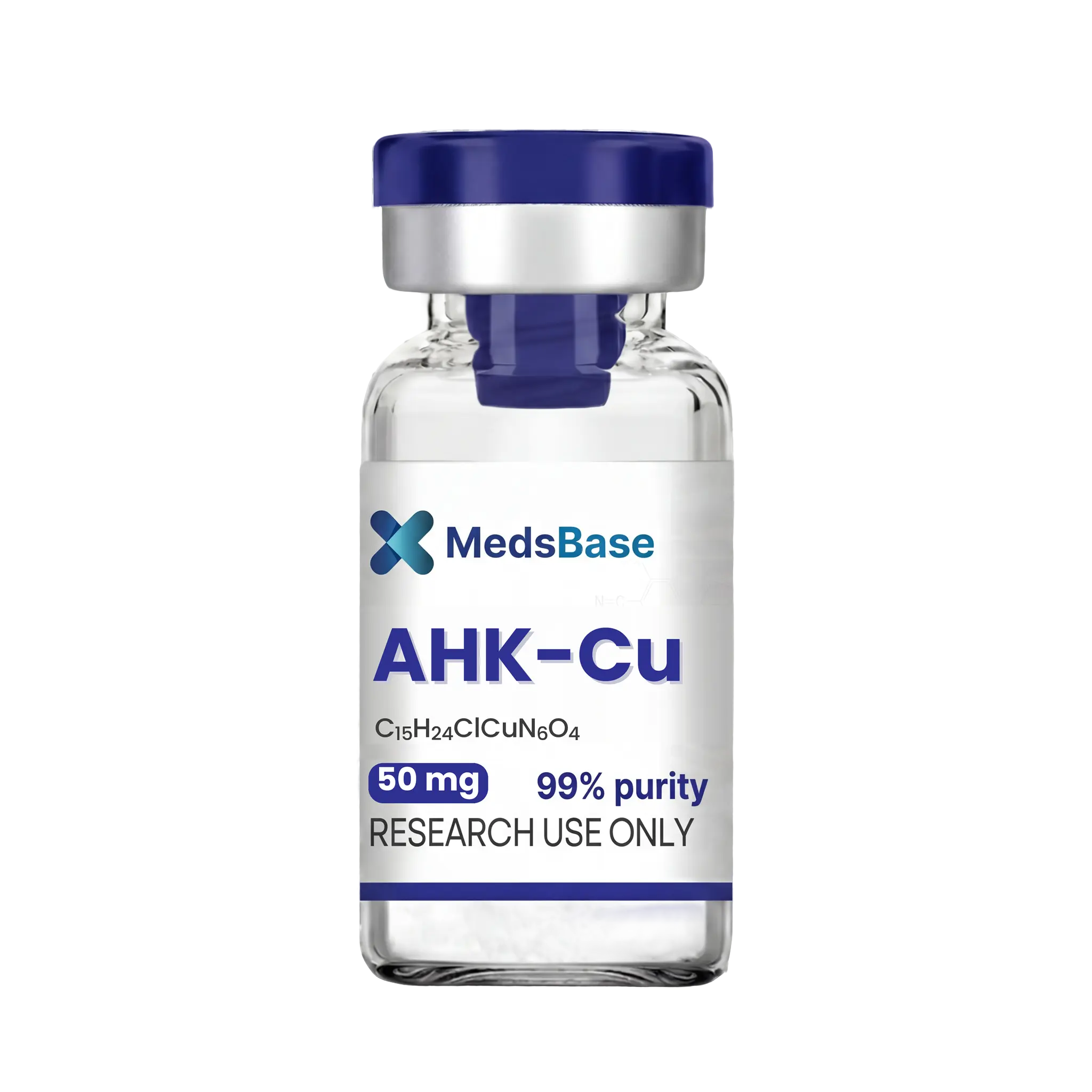
✅ Alanyl-Histidyl-Lysine Koper(II) tripeptide
✅ Zustermolecuul van GHK-Cu
✅ Onderzoeksstof voor haarfollikelbiologie
✅ Stimulatie van dermale papillacellen, verlenging van de anagene fase
✅ Orthogonaal aan finasteride/minoxidil-mechanismen
AHK-Cu bevat synthetisch koper-peptidecomplex.
✓ Medisch beoordeeld door Morgan Ellis — Apotheekonderzoeker · 8 jaar ervaring · Laatst beoordeeld: mei 2026
Kort antwoord — Wat is AHK-Cu?
AHK-Cu (Alanyl-Histidyl-Lysine Koper(II) complex) is een synthetisch koperbindend tripeptide en het zustermolecuul van GHK-Cu. Terwijl GHK-Cu het klassieke huid- en wondgenezende koperpeptide is, is het onderzoekssignaal van AHK-Cu geconcentreerd in haarfollikelbiologie — gepubliceerd preklinisch werk documenteert stimulatie van dermale papillacellen, vergroting van follikels, toegenomen follikelvascularisatie en verlenging van de anagene groeifase. Leverbaar in 20 mg en 50 mg lyofilisatievials uitsluitend voor laboratoriumonderzoek.
📦 Elke bestelling is gedekt door onze Reshipment Assurance-beleid — als uw pakket niet binnen 20 werkdagen arriveert, sturen wij het opnieuw.
| Specificatie | Detail |
|---|---|
| CAS-nummer | 110374-12-4 (AHK-Cu); 71567-06-1 (AHK vrij peptide) |
| Molecuulformule | C15H25CuN6O4 (1:1 kopercomplex) |
| Moleculair gewicht | ~417 Da (kopercomplex) |
| Sequentie | Ala-His-Lys (AHK, 3 aminozuren) gecoördineerd aan een enkel Cu2+ ion via de imidazolestikstof van His, de aminoterminus van Ala, en de gedeprotoneerde peptidebinding tussen Ala en His |
| Form | Gevriesdroogd koper-peptidecomplex (blauw tot blauwviolet poeder; de kleur komt van de d-d overgangen van gebonden Cu2+) |
| Zuiverheid | ≥99% (HPLC geverifieerd, COA op aanvraag) |
| Opslag | Lyofiliseerd: 2–8 °C (koelkast) voor werkvoorraad; −20 °C voor langdurige opslag van ongeopende flesjes. Gereconstitueerd: 2–8 °C, gebruik binnen ~30 dagen. Bescherm tegen licht. Vries de gereconstitueerde oplossing niet in en ontdooi deze niet. |
| Oplosbaarheid | Bacteriostatisch water (aanbevolen) of steriel water voor korter gebruik. Oplosbaar in water; de opgeloste oplossing behoudt de karakteristieke blauwe kleur van het gebonden Cu2+. |
| Onderzoeksgebruik | Alleen voor laboratoriumonderzoek. Niet voor humaan of veterinair diagnostisch of therapeutisch gebruik. |
Wat Is AHK-Cu?
AHK-Cu (Alanyl-Histidyl-Lysine Koper(II) complex) is een synthetisch koperbindend tripeptide samengesteld uit de drie aminozuren Ala, His en Lys, gecoördineerd aan een enkel Cu2+ ion. Het is het zustermolecuul van het uitgebreider bestudeerde GHK-Cu — beide behoren tot de “koperpeptide” klasse, beide delen dezelfde Cu-coördinatiearchitectuur met een histidineresidu, en beide worden bestudeerd in dermatologische onderzoekscontexten. Waar ze verschillen is in het primaire onderzoekssignaal: GHK-Cu is het klassieke onderzoekspeptide voor huidremodellering, wondgenezing en bindweefselherstel, terwijl AHK-Cu’s meest geciteerde onderzoeksapplicaties zijn in haarfollikelbiologie.
De goed gekarakteriseerde moleculaire samenstelling is C15H25CuN6O4, molecuulgewicht ongeveer 417 Da. Het Cu2+ ion coördineert met het tripeptide via de imidazolestikstof van histidine, de aminoterminus van alanine, en de gedeprotoneerde peptidebinding tussen Ala en His — dezelfde vierkant-planaire coördinatiegeometrie als in GHK-Cu. Het gebonden koper geeft beide verbindingen hun karakteristieke blauw-violette kleur in vaste en opgeloste vorm — onderzoekers die AHK-Cu reconstitueren, kunnen een zichtbaar blauwe werksolutie verwachten.
AHK-Cu wordt geleverd als een hoogzuiver gevriesdroogd koper-peptidecomplex voor reconstitutie met bacteriostatisch water. De verbinding is niet goedgekeurd door de FDA, EMA, MHRA of een andere belangrijke regelgevende instantie voor menselijk therapeutisch gebruik. Het hier verkochte onderzoeksgrade AHK-Cu wordt geleverd uitsluitend voor laboratoriumonderzoek en is niet bedoeld voor menselijke of veterinaire toediening. Voor het zusterproduct voor huidonderzoek met koperpeptide, zie onze GHK-Cu productpagina.
Werkingsmechanisme — Koperafgifte aan Haarfollikel Papillacellen
Wat AHK-Cu mechanistisch onderscheidend maakt onder koperpeptiden is zijn voorkeurssignalering bij dermale papillacellen in de haarfollikel — de mesenchymale cellen aan de basis van elke follikel die de haarschachtproductie reguleren en doorlopen de groei- (anagene), regressie- (catagene) en rustfase (telogene fase). Gepubliceerd onderzoek heeft drie hoofdmechanismen gedocumenteerd:
- Koperafgifte aan dermale papillacellen — Het Cu2+ ion is de actieve lading van AHK-Cu (en van GHK-Cu in huidonderzoek). Het tripeptide is een voertuig dat het metaalion naar doelweefsel transporteert, waar koper deelneemt aan meerdere enzymcofactorrollen, waaronder lysyloxidase (crosslinking van collageen en elastine) en superoxidedismutase (buffering van oxidatieve stress). In de haarfollikel nemen dermale papillacellen koper op uit AHK-Cu en gebruiken het om de folliculaire extracellulaire matrix en oxidatieve stressbeheersing te ondersteunen die de anagene fase vereist.
- VEGF-upregulatie en folliculaire vascularisatie — AHK-Cu stimuleert de expressie van vasculaire endotheliale groeifactor (VEGF) in dermale papillacellen. Het downstream-effect is een verhoogde folliculaire perfusie — nieuwe haarvatenvorming aan de basis van de follikel die de metabole behoeften ondersteunt van de snel prolifererende keratincellen in de haarmatrix tijdens de anagene fase. Dit perfusiebevorderende mechanisme overlapt met het minoxidil-mechanisme maar werkt via een fundamenteel ander pad (directe koperpeptide-signalering in plaats van ATP-gevoelige kaliumkanaalmodulatie).
- Verlenging van de anagene fase en folliculaire vergroting — In gepubliceerd onderzoek naar de haargroeicyclus bij knaagdieren verlengt AHK-Cu-toediening de duur van de anagene groeifase en vergroot het de algehele folliculaire omvang. Het gecombineerde effect is meer haarschachtproductie per follikel per cyclus. Het mechanisme lijkt downstream te liggen van de koperafgifte en VEGF-upregulatiestappen — gezonde, goed doorbloede follikels in een koperrijke omgeving behouden langer de anagene fase voordat ze overgaan in catagen.
Het mechanisme is fundamenteel verschillend van de twee door de FDA goedgekeurde haarverliesverbindingen: finasteride blokkeert 5-alfa-reductase om hoofdhuid-DHT te verlagen (hormonaal mechanisme); minoxidil opent ATP-gevoelige kaliumkanalen om folliculaire vaten te vasodilateren (vasculair mechanisme). AHK-Cu biedt directe mesenchymale celsignalering en koper-cofactorafgifte, werkend op een ander punt in de folliculaire biologie dan beide FDA-goedgekeurde verbindingen — wat het een nuttig onderzoeksinstrument maakt voor het ontrafelen van folliculaire celbiologie onafhankelijk van androgeenas- of vasodilatatie-gemedieerde mechanismen. Subcutane, topische en intrafolliculaire injectieroutes zijn allemaal gedocumenteerd in gepubliceerd onderzoek.
Gepubliceerde onderzoeksapplicaties
AHK-Cu wordt gebruikt in laboratoriumonderzoekscontexten die onderzoeken:
- Onderzoek naar haarfollikelbiologie — proliferatie-assays van dermale papillacellen, meting van folliculaire grootte, analyse van haarschachtdiameter, onderzoek met in vitro gekweekte haarfollikels; canonieke koperpeptide-onderzoeksverbinding voor de haaras (Pyo et al., J Korean Med Sci 2007; Uno & Kurata, J Investig Dermatol)
- Onderzoek naar haargroeicyclus — duur van anagene/catagene/telogene fase, inductie van anagene fase in telogene follikels, vergelijkende dosis-respons met gevestigde haaras-vergelijkerverbindingen
- Onderzoek naar folliculaire vascularisatie — VEGF-expressie, capillaire dichtheid aan de follikelbasis, meting van peri-folliculaire perfusie
- Vergelijkend koperpeptideonderzoek — directe vergelijking met GHK-Cu voor dermatologisch onderzoek; AHK-Cu heeft de voorkeur voor haaras-eindpunten, GHK-Cu heeft de voorkeur voor huid/wond/anti-aging-eindpunten
- Onderzoek naar topische en intradermale formuleringen — AHK-Cu is een van de best bestudeerde koperpeptiden voor topische en intradermale toediening; gepubliceerd onderzoek onderzoekt huidpenetratiediepte, folliculair targeten via verschillende voertuigformuleringen
- Ontrafeling van haaruitvalmechanismen — naast finasteride (androgene-as) en minoxidil (vasculaire-as) biedt AHK-Cu een derde orthogonaal onderzoeksmechanisme (mesenchymale cel + koper-cofactor + VEGF-as); nuttig voor onderzoeksontwerpen naar werkingsmechanismen
- Onderzoek naar collageen en elastine — de rol van koper als cofactor voor lysyloxidase maakt koperpeptiden relevant voor onderzoek naar crosslinking van de extracellulaire matrix; AHK-Cu deelt dit mechanisme met GHK-Cu op een breder niveau, hoewel effecten op de haaras overheersen.
Voor een bredere context over waar AHK-Cu past binnen het landschap van koperpeptide- en dermatologisch onderzoek, zie GHK-Cu als het klassieke koperpeptide voor huidonderzoek, BPC-157 voor onderzoek naar weefselherstel, en TB-500 voor onderzoek naar systemisch herstel. Bekijk het volledige onderzoekspeptiden catalogus voor gerelateerde verbindingen.
Beschikbare sterktes en concentraties
MedsBase stocks AHK-Cu in two lyophilized vial sizes calibrated to typical research protocol lengths. Each strength is available in 10-vial, 20-vial, or 30-vial pack formats with full reconstitution guidance:
| Vulsterkte | Typisch Onderzoeksgebruik | Verpakkingsgroottes |
|---|---|---|
| 20 mg | Standaard onderzoekssterkte — topische formulering en kortdurende protocollen | 10, 20 of 30 vialen |
| 50 mg | Grootverpakking voor onderzoek, langdurige cycli, laagste kosten per mg, onderzoek met meerdere follikelcohorten | 10, 20 of 30 vialen |
Beide sterktes zijn dezelfde chemische vorm (gevriesdroogd koper-peptidecomplex, 99%+ HPLC-puur). Hogere mg-vials zijn vooral nuttig voor AHK-Cu vanwege de relatief grote doses die typisch zijn in onderzoek naar topische formuleringen vergeleken met systemische peptiden in het microgrambereik. Hogere mg-vials vereisen kleinere reconstitutievolumes per eenheidsdosis.
Vergelijking — AHK-Cu vs GHK-Cu
AHK-Cu en GHK-Cu zijn zuster-koperbindende tripeptiden die dezelfde Cu-coördinatiechemie delen maar verschillen in het eerste aminozuurresidu (Ala vs Gly). Dit kleine structurele verschil leidt tot kwalitatief verschillende onderzoekssignalen: GHK-Cu domineert in huid/wond/anti-aging onderzoek terwijl AHK-Cu's sterkste signaal ligt in de biologie van haarzakjes.
| Criterium | AHK-Cu | GHK-Cu |
|---|---|---|
| Lengte | 3 aminozuren (tripeptide) | 3 aminozuren (tripeptide) |
| Sequentie | Ala-His-Lys | Gly-His-Lys |
| Kopercoördinatie | 1:1 Cu2+ via His + N-terminus | 1:1 Cu2+ via His + N-terminus |
| Primair onderzoekssignaal | Haarfollikelbiologie, anagenverlenging | Huidremodellering, wondgenezing, anti-aging |
| Doelceltype | Dermale papilcellen (haarfollikel) | Dermale fibroblasten, keratinocyten (huid) |
| VEGF-signalering | Sterk — folliculaire vascularisatie | Matig — wondbedangiogenese |
| Endogeen voorkomen | Synthetisch (geen significant endogene pool) | Endogeen (neemt af met de leeftijd in plasma) |
| Typische onderzoeksdosis | 2–10 mg topicaal / 1–5 mg subcutaan | 1–5 mg topicaal / 0,5–2 mg subcutaan |
Voor haar-asonderzoek is AHK-Cu de canonieke eerste keuze vanwege de selectiviteit voor dermale papilcellen en het gedocumenteerde signaal voor anagenverlenging. Voor huidremodellering, wondgenezing en anti-agingonderzoek, GHK-Cu is de canonieke referentie. Sommige onderzoeksopzetten gebruiken beide in parallelle armen om koperpeptide-effecten die gedeeld zijn (algemene Cu-cofactortoevoer) te onderscheiden van effecten die sequentiespecifiek zijn (celtype-selectiviteit).
Opslag en Reconstituering
Voor reconstituering: bewaar lyofilisatieflessen gekoeld bij 2–8 °C in de originele verpakking voor kortetermijnwerkvoorraad. Voor ongebruikte langetermijnopslag, vries in bij −20 °C. Lyofiliseer AHK-Cu is stabiel onder koeling tot 24 maanden en bij −20 °C tot 36 maanden. Vermijd vries-ontdooicycli van het lyofilisatiepoeder. De Cu-2+ coördinatie is stabiel in de lyofiliseervorm; eenmaal gereconstitueerd kan langdurige blootstelling aan licht of reductiemiddelen de koperoxidatietoestand beïnvloeden.
Reconstitueringsprocedure: injecteer bacteriostatisch water langs de zijkant van het peptideflesje (niet rechtstreeks op de lyofilisatiecake). Voor een flesje van 20 mg levert 2,0 mL bacteriostatisch water een werkconcentratie van 10 mg/mL op — 0,1 mL levert 1 mg; 0,5 mL levert 5 mg. Draai voorzichtig — schud niet niet — en laat 2–5 minuten staan voor volledige oplossing. Een correct gereconstitueerde oplossing moet helder zijn met de karakteristieke blauwe kleur van het gebonden Cu-2+. Troebelheid of neerslag duidt op een probleem met de reconstitutie; gooi weg en probeer opnieuw.
Na reconstitutie: bewaar gekoeld bij 2–8 °C en gebruik binnen 30 dagen voor optimale stabiliteit. Vries de gereconstitueerde oplossing niet in — vries-dooicycli tasten de peptide-integriteit aan. Bescherm te allen tijde tegen direct licht. Voor onderzoek naar topische formuleringen kan AHK-Cu worden verwerkt in een breed scala aan dragers (crèmes, gels, serums) voor toediening aan follikels; gepubliceerd onderzoek naar dragers omvat liposomale en micro-emulsieformuleringen voor verbeterde follikelpenetratie.
Veelgestelde vragen
Waar wordt AHK-Cu voor gebruikt in onderzoek?
AHK-Cu wordt gebruikt in laboratoriumonderzoek naar de biologie van haarzakjes, proliferatie van dermale papilcellen, verlenging van de anagene fase, vascularisatie van follikels, diameter van de haarschacht, vergelijkende farmacologie van koperpeptiden, onderzoek naar topische en intradermale formuleringen, en ontrafeling van het werkingsmechanisme van haaruitvalbiologie dat verschilt van de androgeenas (finasteride) en vasculaire (minoxidil) mechanismen. Het is het standaard koperpeptide-onderzoeksmiddel voor de haaras. Het onderzoeksgrade AHK-Cu dat hier wordt verkocht is niet FDA-goedgekeurd en wordt strikt geleverd voor laboratoriumonderzoek alleen.
Hoe verschilt AHK-Cu van GHK-Cu?
Beide zijn koperbindende tripeptiden die dezelfde Cu-coördinatiestructuur delen (His-gemedieerde 1:1 Cu2+ binding). Ze verschillen in het eerste aminozuurresidu — alanine in AHK-Cu, glycine in GHK-Cu — wat resulteert in verschillende celtype-selectiviteit in gepubliceerd onderzoek. Het sterkste onderzoekssignaal van AHK-Cu is in dermale papilcellen van het haarzakje; GHK-Cu‘het sterkste signaal is in huidfibroblasten en keratinocyten. De twee worden vaak parallel bestudeerd om gedeelde koperpeptide-effecten te onderscheiden van sequentiespecifieke effecten.
Wat is de typische onderzoeksdosis van AHK-Cu?
Gepubliceerde preklinische protocollen gebruiken typisch 1–5 mg per toediening voor subcutane toediening en 2–10 mg voor onderzoek naar topische formuleringen, 1–3 keer per dag gedurende onderzoekscycli van 4–12 weken. Een flesje van 20 mg gereconstitueerd met 2,0 mL bacteriostatisch water levert 10 mg/mL — 0,1 mL komt overeen met 1 mg, 0,5 mL komt overeen met 5 mg.
Is AHK-Cu goedgekeurd door de FDA?
Nee. AHK-Cu is niet goedgekeurd door de FDA, EMA, MHRA of enige andere grote regelgever voor humaan therapeutisch gebruik. Koperpeptiden zijn opgenomen in sommige cosmetische producten onder cosmetische regelgevingskaders, maar AHK-Cu heeft specifiek geen therapeutische goedkeuring. Alle AHK-Cu die door leveranciers voor onderzoeksgebruik wordt verkocht, is bedoeld voor laboratoriumonderzoek en mag niet aan mensen worden toegediend.
Hoe moet AHK-Cu worden opgeslagen?
Gevriesdroogde flesjes: gekoeld bij 2–8 °C voor kortdurende werkvoorraad, of −20 °C voor langdurige opslag van ongeopende flesjes. Gereconstitueerde oplossing: gekoeld bij 2–8 °C, gebruik binnen 30 dagen. Vries de gereconstitueerde oplossing niet in — vries-dooicycli tasten het peptide aan en kunnen de kopercoördinatie beïnvloeden. Bescherm te allen tijde tegen direct licht om de oxidatietoestand van het koper te behouden.
Hoe reconstitueer ik AHK-Cu?
Volg de hierboven beschreven reconstitutieprocedure. Voeg bacteriostatisch water toe langs de zijkant van het flesje (niet rechtstreeks op het gevriesdroogde poeder), draai voorzichtig en laat 2–5 minuten staan voor volledige oplossing. Schud niet schud het flesje. Een correct gereconstitueerde oplossing is helder met de karakteristieke blauwe kleur van het gebonden Cu2+ — de kleur zelf bevestigt succesvolle reconstituering en intacte kopercoördinatie. Voor een flesje van 20 mg + 2,0 mL verdunningsmiddel is de werkconcentratie 10 mg/mL.
Welke sterktes heeft MedsBase op voorraad?
MedsBase carries AHK-Cu in 20 mg and 50 mg lyophilized vials. Each strength is available in 10-vial, 20-vial, or 30-vial pack sizes. All vials are supplied at 99%+ HPLC purity with a certificate of analysis available on request.
Waarom is AHK-Cu blauw van kleur?
De karakteristieke blauw-violette kleur van AHK-Cu (en GHK-Cu) komt voort uit de d-d elektronentransities van gebonden koper2+ in het vierkant-vlakke coördinatie-omgeving gevormd door het histidineresidu en de peptidebackbone. De kleur is een nuttige kwalitatieve indicator van succesvolle kopercoördinatie — een goed gereconstitueerde blauwe oplossing bevestigt intacte Cu2+ binding, terwijl een kleurloze of bleke oplossing wijst op koperverlies of degradatie. Dit is uniek onder kleine peptiden — de meeste synthetische peptiden leveren kleurloze oplossingen op bij reconstitutie.
Hoe verhoudt AHK-Cu zich tot finasteride of minoxidil?
De drie richten zich via volledig verschillende mechanismen op de biologie van haaruitval. Finasteride blokkeert 5-alpha-reductase om de dihydrotestosteron (DHT)-niveaus in de hoofdhuid te verlagen — een androgeen-asmechanisme. Minoxidil opent ATP-gevoelige kaliumkanalen om folliculaire vaten te vasodilateren — een vasculair mechanisme. AHK-Cu biedt directe kopercofactorlevering en VEGF-gemedieerde folliculaire vascularisatie op het niveau van dermale papilcellen — een mesenchymcelmechanisme. De drie mechanismen staan los van elkaar, wat AHK-Cu een nuttig onderzoeksinstrument maakt voor het bestuderen van folliculaire biologie onafhankelijk van androgeen-as- of vasodilatatie-gemedieerde effecten.
Veroorzaakt AHK-Cu bijwerkingen in onderzoek?
Gepubliceerd preklinisch onderzoek heeft een opmerkelijk schoon veiligheidsprofiel gerapporteerd bij typische onderzoeksdoseringen, met als belangrijkste doelwit-effect folliculaire stimulatie. Off-target bevindingen kunnen lokale irritatie op de injectieplaats omvatten en (bij langdurige blootstelling aan hoge doses topicaal) bescheiden huidverkleuring door koperafzetting — beide omkeerbaar na staken. Systemische bijwerkingen door topische toepassingen zijn zeldzaam vanwege beperkte transcutane absorptie.
Wat is de halfwaardetijd van AHK-Cu?
In preklinisch onderzoek heeft AHK-Cu een relatief korte plasmahalfwaardetijd (~1–2 uur) na subcutane toediening. De korte halfwaardetijd wordt gecompenseerd door retentie van gebonden koper in doelweefsels — zelfs na klaring uit het plasma blijft het aan de dermale papillacellen afgegeven koper de folliculaire biologie ondersteunen via zijn enzym-cofactorrollen. Topicale formuleringen zorgen voor een langdurige lokale blootstelling die relevanter is voor haaronderzoek dan het systemische plasmaprofiel.
Kunnen AHK-Cu en GHK-Cu in onderzoek gecombineerd worden?
Ja. De twee koperpeptiden richten zich op verschillende celtypen (dermale papillacellen voor AHK-Cu, dermale fibroblasten voor GHK-Cu) en behandelen verschillende onderzoeksdomeinen (haar vs. huid), dus co-administratie is farmacologisch niet redundant. Onderzoeksprotocollen die gecombineerde huid- en haareindpunten bestuderen — bijvoorbeeld uitgebreid dermatologisch remodeleringsonderzoek — gebruiken soms beide benaderingen.
Hoe lang duurt het voordat AHK-Cu effecten laat zien in preklinisch onderzoek?
Acute effecten op VEGF-expressie in dermale papillacellen zijn detecteerbaar binnen 24–72 uur in celkweekonderzoek. Effecten op folliculaire grootte en anagenverlenging in rodent hair-cycle modellen worden doorgaans statistisch significant na 4–8 weken van regelmatige behandeling en blijven toenemen tot 12–16 weken — in lijn met de natuurlijke haargroeicyclus.
Kan ik AHK-Cu bestellen voor internationale verzending?
Ja. MedsBase verzendt AHK-Cu wereldwijd vanuit ons toegewijde peptideverzendnetwerk. Bestellingen van alleen peptiden komen in aanmerking voor onze standalone peptideverzendservice. Alle bestellingen worden verzonden in temperatuurgecontroleerde verpakkingen met volledige tracking en zijn gedekt door onze Reshipment Assurance-beleid.
Andere peptiden voor haar-, huid- en weefselregeneratieonderzoek
- GHK-Cu — Zuster koperbindend tripeptide — canonieke huidremodelerings- en wondgenezingsonderzoeksverbinding
- BPC-157 — Body Protection Compound — weefselregeneratie- en herstelonderzoek
- TB-500 (Thymosin Beta-4) — Systemisch helend fragment — weefsel- en vasculair herstelonderzoek
- Epitalon — AEDG-pineale tetrapeptide — onderzoek naar levensduur en circadiaan ritme
- Semax — Nootroop heptapeptide — CNS-onderzoeksverbinding
Verder lezen
📖 Verken het koperpeptide-onderzoekslandschap
Bekijk het volledige onderzoekspeptiden catalogus, met verwante dermatologie- en weefselregeneratieverbindingen inclusief GHK-Cu (sister copper peptide voor huidonderzoek), BPC-157 (weefselregeneratie), en TB-500 (systemisch herstel).
Meer opties in Peptiden
Gerangschikt op recente bestelvolumes van MedsBase — wat andere klanten in deze categorie kiezen.
| Sterkte | 20 mg, 50 mg |
|---|---|
| Hoeveelheid | 10 flacons, 20 flacons, 30 flacons |
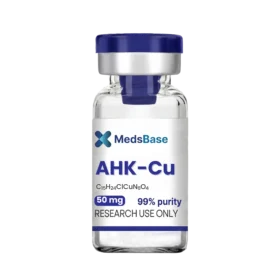 AHK-Cu
Vragen & antwoorden
AHK-Cu
Gerelateerde producten
Beoordelingen
Er zijn nog geen beoordelingen