







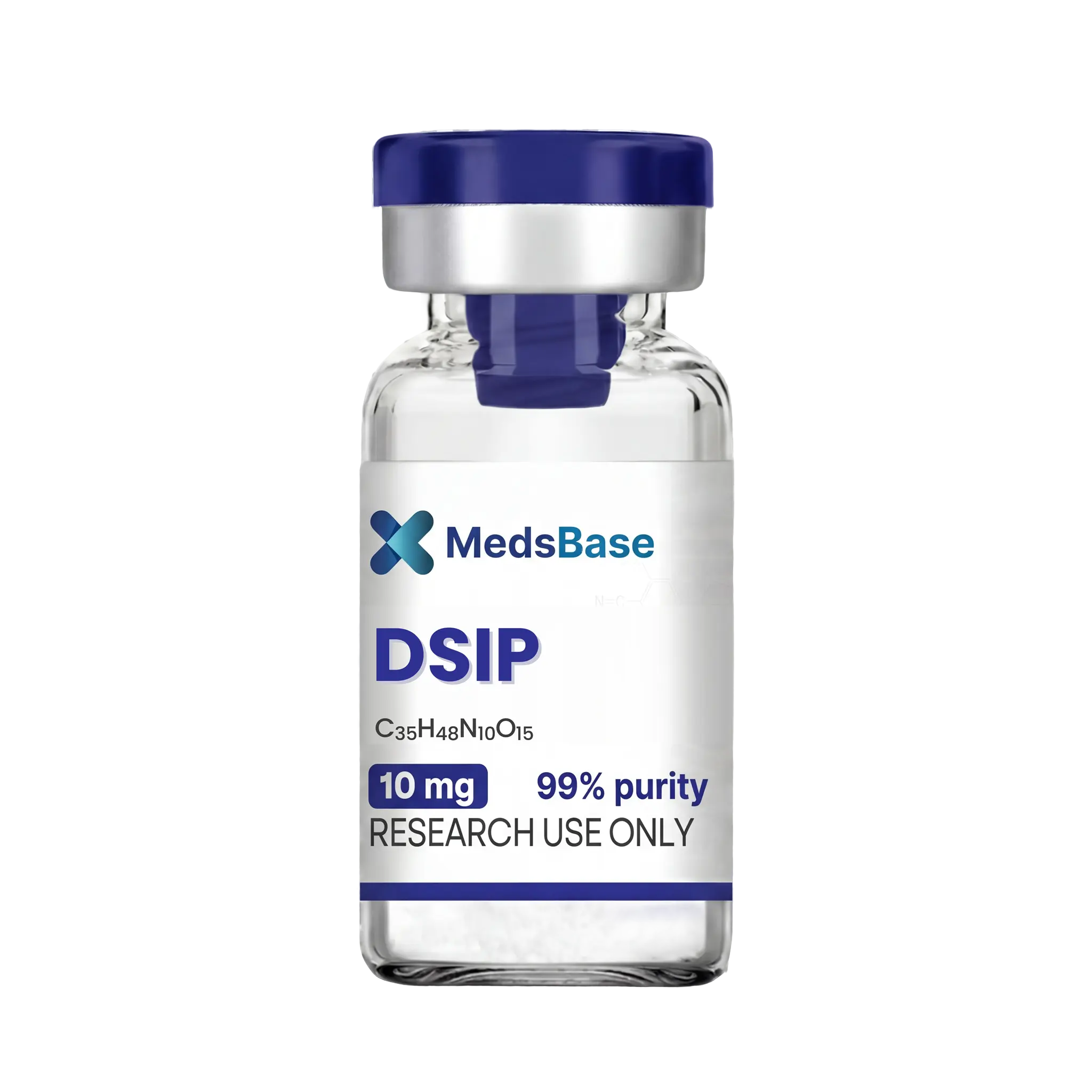
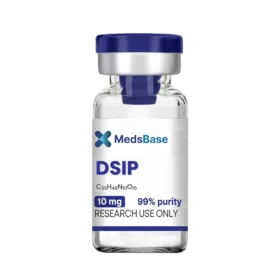
DSIP
✅ Delta Sleep-Inducing Peptide (ontdekking uit 1977)
✅ Moduleert de architectuur van slow-wave slaap
✅ Onderzoek naar HPA-as stressreactiviteit
✅ Anti-ontwenningsverschijnselen & niet-opioïde pijnstilling
✅ Passeert de bloed-hersenbarrière
DSIP bevat synthetisch peptideverbinding.
✓ Medisch beoordeeld door Morgan Ellis — Apotheekonderzoeker · 8 jaar ervaring · Laatst beoordeeld: mei 2026
Kort antwoord — Wat is DSIP?
DSIP (Delta Sleep-Inducing Peptide) is een neuropeptide van 9 aminozuren dat voor het eerst werd geïsoleerd uit het cerebrale veneuze bloed van konijnen tijdens elektrische stimulatie van thalamische slaapbevorderende regio's in 1977. In gepubliceerd onderzoek moduleert het de slaaparchitectuur — specifiek slow-wave (delta) slaap — naast gedocumenteerde effecten op stressreactiviteit, onthoudingssyndromen en nociceptie. Wordt geleverd in lyofiliseerbuisjes van 5 mg tot 15 mg uitsluitend voor laboratoriumonderzoek.
📦 Elke bestelling is gedekt door onze Reshipment Assurance-beleid — als uw pakket niet binnen 20 werkdagen arriveert, sturen wij het opnieuw.
| Specificatie | Detail |
|---|---|
| CAS-nummer | 62568-57-4 |
| Molecuulformule | C35H48N10O15 |
| Moleculair gewicht | 848.81 Da |
| Sequentie | Trp-Ala-Gly-Gly-Asp-Ala-Ser-Gly-Glu (WAGGDASGE, 9 aminozuren; lineair, ongemodificeerde uiteinden) |
| Form | Lyofiliseerd poeder (wit tot off-white) |
| Zuiverheid | ≥99% (HPLC geverifieerd, COA op aanvraag) |
| Opslag | Lyofiliseerd: 2–8 °C (koelkast) voor werkvoorraad; −20 °C voor langdurige opslag van ongeopende flesjes. Gereconstitueerd: 2–8 °C, gebruik binnen ~30 dagen. Bescherm tegen licht. Vries de gereconstitueerde oplossing niet in en ontdooi deze niet. |
| Oplosbaarheid | Bacteriostatisch water (aanbevolen) of steriel water voor kortere gebruiksperioden |
| Onderzoeksgebruik | Alleen voor laboratoriumonderzoek. Niet voor humaan of veterinair diagnostisch of therapeutisch gebruik. |
Wat Is DSIP?
DSIP (Delta Sleep-Inducing Peptide) is een lineair neuropeptide van 9 aminozuren dat voor het eerst werd geïsoleerd door Schoenenberger en Monnier aan de Universiteit van Basel in 1977. Het peptide werd geïdentificeerd door dialyse van cerebrale veneuze bloed van konijnen tijdens elektrische stimulatie van de intralaminaire thalamus — een regio die bekend staat om het opwekken van delta-golf (slow-wave) slaap in de cortex — en het concentreren van de bioactieve fractie. DSIP werd genoemd naar het dominante elektro-encefalografische signaal dat het produceerde wanneer het werd toegediend aan ontvangende dieren: een verhoogd aandeel delta-golfactiviteit tijdens de slaap.
De goed gekarakteriseerde sequentie is WAGGDASGE, molecuulgewicht 848.81 Da, empirische formule C35H48N10O15. DSIP is structureel ongebruikelijk onder kleine CNS-actieve peptiden — het is lineair, ongemodificeerd aan beide uiteinden en bevat geen proline- of cysteïneresiduen. Het peptide wordt geleverd als een hoogzuiver lyofiliseerpoeder voor reconstitutie met bacteriostatisch water. DSIP is niet goedgekeurd door de FDA, EMA, MHRA of enige andere grote regelgever voor humaan therapeutisch gebruik. Het onderzoekskwaliteit DSIP dat hier wordt verkocht, wordt geleverd uitsluitend voor laboratoriumonderzoek en is niet bedoeld voor menselijke of veterinaire toediening. Voor gerelateerd onderzoek naar circadiane en slaap-as peptiden, zie onze Epitalon en Selank productpagina's.
Werkingsmechanisme — Slaaparchitectuur, Stressreactiviteit en Neuroprotectie
Wat DSIP ongebruikelijk maakt onder onderzoekspeptiden is de breedte van effecten die zijn gedocumenteerd voor zo'n klein, lineair peptide zonder een duidelijk geïdentificeerde primaire receptor. Gepubliceerd onderzoek heeft zijn activiteit in kaart gebracht over drie overlappende domeinen, elk draagt bij aan het waargenomen fenotype:
- Modulatie van slaaparchitectuur — delta-golf (slow-wave) slaap — DSIP verhoogt het aandeel slow-wave (fase 3–4 / N3) slaap in kwantitatieve EEG-metingen bij onderzoek bij knaagdieren, konijnen en mensen, zonder proportioneel de REM-slaap te verminderen. Het effect is het meest uitgesproken wanneer DSIP wordt toegediend aan proefpersonen met gefragmenteerde of verkorte slaap, wat suggereert dat het peptide werkt als een homeostatische slaapdrukmodulator in plaats van een primair sedativum. Belangrijk is dat DSIP bij niet-slaapgedepriveerde proefpersonen niet direct de totale slaaptijd verhoogt — het reorganiseert de slaaparchitectuur naar een hoger aandeel SWS.
- Modulatie van de HPA-as en stressreactiviteit — Meerdere gepubliceerde studies documenteren een vermindering van stress-geïnduceerde cortisol- en ACTH-afgifte in knaagdier-restraint-stressmodellen, naast een vermindering van corticotropine-releasing hormone (CRH) signalering in de hypothalamus. Het stress-buffereffect werkt op een langere tijdschaal dan benzodiazepine-sedativa en veroorzaakt geen acute gedragssedatie, wat wijst op modulatie van de HPA-as-tonus in plaats van acute anxiolyse.
- Anti-nociceptie, neuroprotectie en anti-ontwenningsverschijnselen — DSIP vertoont analgetische effecten in knaagdier thermische en chemische-nociceptiemodellen, inclusief opioïde-naïeve proefpersonen (wat wijst op een niet-opioïde mechanisme). Russisch en Oost-Europees onderzoek heeft een vermindering van opioïde- en alcoholontwenningssyndromen in preklinische modellen gedocumenteerd. Neuroprotectieve effecten tegen oxidatieve stress, ischemie en excitotoxiciteit zijn gerapporteerd, maar blijven mechanistisch minder goed gekarakteriseerd dan het slaaparchitectuurwerk.
Het receptor-doelwit voor DSIP is niet definitief geïdentificeerd, wat ongebruikelijk is voor een peptide met zoveel gepubliceerde gedragsdata. Voorgestelde mechanismen omvatten GABA-A-modulatie, opioïdesysteem-crosstalk en directe interactie met hypothalamische CRH-neuronen. Het ontbreken van een geïdentificeerde primaire receptor gecombineerd met meerdere gedocumenteerde effecten suggereert dat DSIP mogelijk werkt als een multimodale neuromodulator in plaats van een klassieke receptoragonist — een hypothese die een actieve onderzoeksvraag blijft in de gepubliceerde peptidefarmacologie.
Gepubliceerde onderzoeksapplicaties
DSIP wordt gebruikt in laboratoriumonderzoekscontexten die onderzoeken:
- Slaaparchitectuur en EEG-onderzoek — kwantitatieve EEG-spectrale analyse, slow-wave slaapaandeel, slaapfragmentatie bij onderzoek bij knaagdieren en mensen (Schoenenberger & Monnier, PNAS 1977; Kovalzon & Strekalova, Sleep Med Rev 2006)
- Stressreactiviteit en HPA-asonderzoek — cortisol- en ACTH-dynamiek, CRH-expressie, restraint-stress en chronische-milde-stressmodellen bij knaagdieren
- Onderzoek naar ontwenningssyndromen — ernst van opioïdeontwenning, alcoholontwenning, benzodiazepine-afbouw; voornamelijk Russische en Oost-Europese gepubliceerde literatuur
- Onderzoek naar nociceptie en chronische pijn — staarttrek-, hete-plaat-, formaline- en chronische-vernauwingsblessuremodellen bij knaagdieren; karakterisering van niet-opioïde mechanismen
- Onderzoek naar neuroprotectie — markers voor oxidatieve stress, ischemie-reperfusieletsel, excitotoxiciteitsmodellen
- Onderzoek naar circadiaanse biologie — entrainment, faseverschuivingsrespons, modulatie van melatonine- en kerntemperatuurritme
- Vergelijkend onderzoek naar slaap-as peptiden — benchmarking tegen Epitalon (pineaal tetrapeptide) voor circadiaanse effecten en tegen Selank voor stressbufferende effecten zonder sedatie.
Voor een bredere context over waar DSIP past binnen het landschap van kleine CNS-actieve peptiden, zie Epitalon (AEDG pijnappeltetrapeptide, circadiane-as onderzoek), Selank (heptapeptide anxiolyticum), en Semax (heptapeptide nootropicum). Bekijk het volledige onderzoekspeptiden catalogus voor gerelateerde verbindingen.
Beschikbare sterktes en concentraties
MedsBase stocks DSIP in three lyophilized vial sizes covering pilot dosing through extended research protocols. Each strength is available in 10-vial, 20-vial, or 30-vial pack formats with full reconstitution guidance:
| Vulsterkte | Typisch Onderzoeksgebruik | Verpakkingsgroottes |
|---|---|---|
| 5 mg | Korte onderzoeksprotocollen, pilotdosering, onderzoek met enkele EEG-sessie | 10, 20 of 30 vialen |
| 10 mg | Standaard onderzoekssterkte, meerweekse slaaparchitectuurstudies | 10, 20 of 30 vialen |
| 15 mg | Langdurige protocollen, laagste kosten per mg, onderzoek met meerdere cohorten | 10, 20 of 30 vialen |
Alle drie de sterktes hebben dezelfde chemische vorm (gevriesdroogd poeder, 99%+ HPLC zuiverheid). Vials met hogere mg vereisen kleinere reconsitutievolumes per eenheidsdosis, wat handig is wanneer onderzoekers injectievolume willen minimaliseren in knaagdiermodellen of langdurige studies willen uitvoeren vanuit een enkele vial.
Vergelijking — DSIP versus Epitalon
DSIP en Epitalon zijn de twee meest geciteerde kleine peptiden betrokken bij slaap-, circadiane- en rusttoestandonderzoek. Ze delen verschillende onderzoeksrelevante kenmerken — beide zijn korte, lineaire, ongemodificeerde peptiden zonder geïdentificeerde primaire receptoren, en beide produceren fenotypische effecten die langer aanhouden dan plasma-opruiming — maar hun primaire onderzoekssignalen zijn verschillend: DSIP moduleert slaaparchitectuur direct via SWS-proportie; Epitalon werkt in op de pijnappelklier-melatonine-as en circadiane genexpressie.
| Criterium | DSIP | Epitalon |
|---|---|---|
| Lengte | 9 aminozuren (lineair) | 4 aminozuren (tetrapeptide) |
| Sequentie | WAGGDASGE | AEDG (Ala-Glu-Asp-Gly) |
| Primair onderzoekssignaal | Traaggolf-slaapverhouding (EEG delta) | Pineale-melatonine-as, telomerase, circadiaan genexpressie |
| Geïdentificeerde receptor | Geen (multimodale neuromodulator) | Geen (genregulerend, intracellulair) |
| Typische onderzoeksdosis | 100–500 mcg, 1x daags | 5–10 mg, 1x daags voor cycli |
| Effectintrede | Directe sessie (EEG meetbaar) | Meerdere weken (genexpressietijdschaal) |
| Stacking | Gecombineerd toegediend met Epitalon in circadiaan-slaaponderzoek | Gecombineerd toegediend met DSIP voor gecombineerde slaap+circadiaane effecten |
Voor onderzoek naar slaaparchitectuur is DSIP de eerste keuze omdat het meetbare effecten op EEG-niveau heeft op de proportie langzame-golfslaap binnen een enkele slaapsessie. Voor onderzoek naar circadiane ritmes en genregulatie wordt Epitalon verkozen omdat de effecttijdschaal overeenkomt met de onderliggende biologie (genexpressieveranderingen over dagen tot weken). De twee worden vaak samen toegediend wanneer beide aspecten deel uitmaken van de onderzoeksvraag.
Opslag en Reconstituering
Voor reconstituering: Bewaar lyofiliseerde flesjes gekoeld bij 2–8 °C in de originele verpakking voor kortdurende werkvoorraad. Voor ongebruikte langdurige opslag, vries in bij −20 °C. Lyofiliseerd DSIP is stabiel onder koeling tot 24 maanden en bij −20 °C tot 36 maanden. Vermijd vries-ontdooicycli van het lyofiliseerde poeder. DSIP is hygroscopisch — sluit flesjes direct na opening en bewaar ze indien mogelijk in een gedroogde container.
Reconstitueringsprocedure: Spuit bacteriostatisch water langs de zijkant van het peptideflesje (niet direct op de lyofiliseerde cake). Voor een flesje van 5 mg levert 2,0 mL bacteriostatisch water een werkconcentratie van 2,5 mg/mL op — 0,04 mL levert een onderzoeksdosis van 100 mcg. Draai voorzichtig — doe niet Schud — en laat 2–5 minuten staan voor volledige oplossing. Een correct gereconstitueerde oplossing moet helder en kleurloos zijn.
Na reconstitutie: Bewaar gekoeld bij 2–8 °C en gebruik binnen 30 dagen voor optimale stabiliteit. Vries de gereconstitueerde oplossing niet in — vries-ontdooicycli tasten de peptide-integriteit aan. Gooi elk flesje weg dat troebelheid, neerslag of verkleuring vertoont.
Veelgestelde vragen
Waar wordt DSIP voor gebruikt in onderzoek?
DSIP wordt gebruikt in laboratoriumonderzoek naar slaaparchitectuur (met name de proportie langzame-golfslaap), HPA-as- en stressreactiviteit, opioïden- en alcoholonttrekkingssyndromen, niet-opioïde analgesie, neuroprotectie en circadiane biologie. Het is het meest geciteerde onderzoekspeptide voor de slaap-as dat niet primair als sedativum werkt — effecten manifesteren zich als herorganisatie van de slaaparchitectuur in plaats van toegenomen totale slaaptijd. Het hier verkochte onderzoekskwaliteit DSIP is niet FDA-goedgekeurd en wordt strikt geleverd voor laboratoriumonderzoek alleen.
Hoe verschilt DSIP van Epitalon?
Beide zijn kleine, ongemodificeerde peptiden zonder geïdentificeerde primaire receptoren die de rusttoestand-biologie beïnvloeden, maar hun primaire onderzoekssignalen verschillen. DSIP moduleert slaaparchitectuur op EEG-niveau — specifiek door de proportie langzame-golfslaap binnen een enkele slaapsessie te verhogen. Epitalon werkt in op de pijnappelklier-melatonine-as en circadiane genexpressie op een genexpressietijdschaal van dagen tot weken. De twee zijn mechanistisch complementair en worden vaak samen toegediend bij onderzoek naar gecombineerde slaap- en circadiane eindpunten.
Wat is de typische onderzoeksdosis van DSIP?
Gepubliceerde preklinische protocollen gebruiken typisch 100–500 mcg per toediening in knaagdier modellen, subcutaan of intraperitoneaal toegediend eenmaal daags voor cycli van 7–28 dagen. Een flesje van 5 mg gereconstitueerd met 2,0 mL bacteriostatisch water levert 2,5 mg/mL — 0,04 mL komt overeen met 100 mcg.
Is DSIP goedgekeurd door de FDA?
Nee. DSIP is niet goedgekeurd door de FDA, EMA, MHRA of enige andere grote regelgevende instantie voor therapeutisch gebruik bij mensen. Alle DSIP die wordt verkocht door leveranciers voor onderzoeksdoeleinden is bedoeld voor laboratoriumonderzoek en mag niet worden toegediend aan mensen of dieren.
Hoe moet DSIP worden opgeslagen?
Gevriesdroogde flesjes: gekoeld bewaren bij 2–8 °C voor kortetermijngebruik, of −20 °C voor langdurige opslag van ongeopende flesjes. DSIP is hygroscopisch — sluit de flesjes direct na opening weer goed af. Gereconstitueerde oplossing: gekoeld bewaren bij 2–8 °C, binnen 30 dagen gebruiken. Vries de gereconstitueerde oplossing niet in — vries-ontdooicycli degraderen het peptide. Bescherm te allen tijde tegen direct licht.
Hoe reconstitueer ik DSIP?
Volg de hierboven beschreven reconstitutieprocedure. Voeg bacteriostatisch water toe langs de zijkant van het flesje (niet rechtstreeks op het gevriesdroogde poeder), draai voorzichtig en laat 2–5 minuten staan voor volledige oplossing. Schud niet Schud het flesje. Een correct gereconstitueerde oplossing is helder en kleurloos. Voor een flesje van 5 mg + 2,0 mL verdunningsmiddel is de werkconcentratie 2,5 mg/mL.
Welke sterktes heeft MedsBase op voorraad?
MedsBase carries DSIP in 5 mg, 10 mg, and 15 mg lyophilized vials. Each strength is available in 10-vial, 20-vial, or 30-vial pack sizes. All vials are supplied at 99%+ HPLC purity with a certificate of analysis available on request.
Veroorzaakt DSIP sedatie in onderzoeksmodellen?
Nee — dit is een van de meest geciteerde bevindingen in DSIP-onderzoek. In tegenstelling tot benzodiazepines of andere klassieke sedativa, veroorzaakt DSIP geen acute gedragssedatie, verlies van motorische coördinatie of verminderde alertheid. In plaats daarvan moduleert het de slaaparchitectuur naar een hoger aandeel slow-wave slaap wanneer het subject slaapt, zonder de totale slaaptijd te verhogen bij niet-slaapgedepriveerde subjecten. Dit onderscheidende profiel is een van de redenen waarom DSIP een onderzoekscompound is gebleven in plaats van een klinisch sedativum.
Kunnen DSIP en Epitalon worden gecombineerd in onderzoek?
Ja. DSIP en Epitalon werken op verschillende tijdschalen en biologische compartimenten (acute EEG-niveau slaaparchitectuur versus genexpressie-niveau circadiane regulatie), dus co-toediening is farmacologisch niet redundant. Onderzoeksprotocollen die gecombineerde slaapkwaliteit en circadiane ritme-eindpunten bestuderen, gebruiken vaak beide peptiden.
Veroorzaakt DSIP bijwerkingen in onderzoek?
Gepubliceerd preklinisch onderzoek heeft een opmerkelijk schoon veiligheidsprofiel gerapporteerd bij typische onderzoeksdoseringen, zonder consistente sedatie, effecten op motorische coördinatie, afhankelijkheid of rebound na stopzetting. Langetermijnveiligheidsgegevens bij mensen zijn beperkt omdat het peptide geen moderne westerse regelgevende beoordeling heeft ondergaan. De kleine omvang en het ontbreken van een geïdentificeerde primaire receptor zijn consistent met het schone tolerantieprofiel.
Wat is de halfwaardetijd van DSIP?
In preklinisch onderzoek heeft DSIP een plasmahalfwaardetijd van ongeveer 7–15 minuten na intraveneuze of subcutane toediening. De korte plasmahalfwaardetijd wordt gecompenseerd door het vermogen van het peptide om de bloed-hersenbarrière te passeren en effecten te produceren op de slaaparchitectuur en genexpressie die lang aanhouden na de klaring uit het plasma.
Waarom werd DSIP oorspronkelijk geïsoleerd?
DSIP werd in 1977 geïdentificeerd door Schoenenberger en Monnier aan de Universiteit van Basel door dialyse van cerebraal veneus bloed van konijnen tijdens elektrische stimulatie van de intralaminaire thalamus — een hersengebied dat bekend staat om het opwekken van delta-golf (langzame-golf) slaap. Zij concentreerden de bioactieve fractie en karakteriseerden het peptide dat het sterkste slaap-EEG-effect produceerde wanneer het werd overgedragen aan ontvangende dieren. Het peptide werd genoemd naar zijn dominante elektro-encefalografische signatuur: verhoogde delta-golfactiviteit tijdens de slaap.
Hoe lang duurt het voordat DSIP effecten laat zien in preklinisch onderzoek?
Acute effecten op de slaaparchitectuur en de proportie EEG delta-golven zijn detecteerbaar tijdens de eerste slaapsessie na toediening. Effecten op de HPA-as en stressreactiviteit accumuleren over 7–14 dagen van regelmatige dosering. Anti-ontwennings-effecten in modellen voor opioïde en alcoholontwenning worden typisch gemeten over perioden van 3–7 dagen ontwenning.
Kan ik DSIP bestellen voor internationale verzending?
Ja. MedsBase verzendt DSIP wereldwijd vanuit ons toegewijde peptide-verzendnetwerk. Bestellingen met alleen peptides komen in aanmerking voor onze zelfstandige peptide-verzendservice. Alle bestellingen worden verzonden in temperatuurgecontroleerde verpakkingen met volledige tracking en zijn gedekt door onze Reshipment Assurance-beleid.
Andere peptiden voor slaap-, circadiane en CNS-onderzoek
- Epitalon — AEDG pijnappelklier tetrapeptide — onderzoek naar de pijnappelklier-melatonine-as en circadiane genexpressie
- Selank — Anxiolytisch heptapeptide tuftsin analoog — GABA/BDNF stressbestendigheidsonderzoek
- Semax — Russisch ontwikkeld nootropisch heptapeptide — melanocortine en dopaminerge modulatie
- Oxytocine Acetaat — 9-aa cyclisch nonapeptide — onderzoek naar sociale binding en affiliatief gedrag
- BPC-157 — Body Protection Compound — onderzoek naar genezing en weefselherstel
Verder lezen
📖 Verken slaap-, circadiane en CNS-onderzoekspeptiden
Bekijk het volledige onderzoekspeptiden catalogus, met verwante verbindingen inclusief Epitalon voor circadiane genexpressie-onderzoek, Selank voor anxiolytisch stress-as onderzoek, en Oxytocine Acetaat voor sociaal bindingsgedrag onderzoek.
Meer opties in Peptiden
Gerangschikt op recente bestelvolumes van MedsBase — wat andere klanten in deze categorie kiezen.
| Sterkte | 5 mg, 10 mg, 15 mg |
|---|---|
| Hoeveelheid | 10 flacons, 20 flacons, 30 flacons |
 DSIP
DSIP
Vragen & antwoorden
DSIP
Gerelateerde producten
Beoordelingen
Er zijn nog geen beoordelingen