







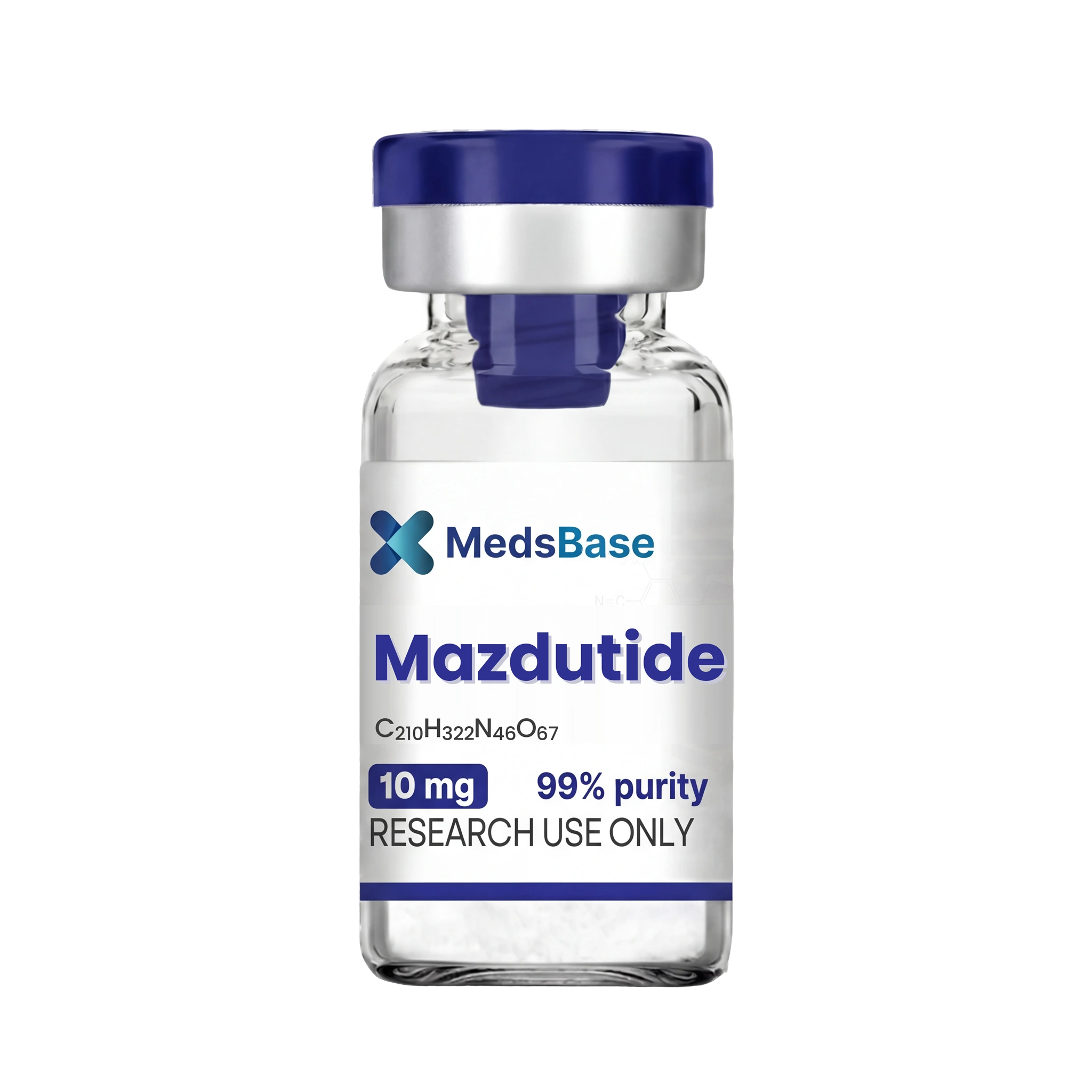
Mazdutide
✅ Duale GLP-1 + glucagon receptor co-agonist
✅ Oxyntomoduline-afgeleid scaffold (IBI362 / LY3305677)
✅ Voegt energie-uitgavemechanisme toe naast GLP-1 alleen
✅ Goedgekeurd in China; in onderzoek in het Westen
✅ Eénmaal per week doseren
Mazdutide bevat synthetisch peptideverbinding.
✓ Medisch beoordeeld door Morgan Ellis — Apotheekonderzoeker · 8 jaar ervaring · Laatst beoordeeld: mei 2026
Kort antwoord — Wat is Mazdutide?
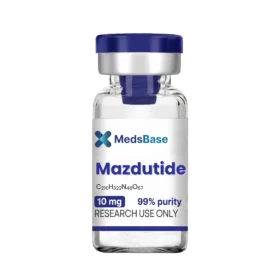
Mazdutide (ontwikkelingscodes IBI362 / LY3305677) is een langwerkend dubbel GLP-1- en glucagonreceptor-co-agonistpeptide ontwikkeld door Innovent Biologics (in licentie gegeven door Eli Lilly). Het is de eerste dubbele GLP-1/glucagon-agonist die fase 3-onderzoeken heeft bereikt voor obesitas en diabetes type 2, waarbij de glucagoncomponent een energieverbruiksmechanisme toevoegt dat verder gaat dan wat GLP-1-only en GLP-1/GIP-dubbele peptiden produceren. De plasmahalfwaardetijd ondersteunt eenmaal per week doseren. Leverbaar in 5 mg en 10 mg lyofilisatieflesjes uitsluitend voor laboratoriumonderzoek.
📦 Elke bestelling is gedekt door onze Reshipment Assurance-beleid — als uw pakket niet binnen 20 werkdagen arriveert, sturen wij het opnieuw.
| Specificatie | Detail |
|---|---|
| CAS-nummer | 2376247-09-1 (mazdutide; vaak geciteerd) |
| Type | Langwerkende dubbele GLP-1 / glucagonreceptor-co-agonist (geacyleerd synthetisch peptide; Innovent IBI362 / Eli Lilly LY3305677; oxyntomoduline-afgeleid skelet) |
| Moleculair gewicht | ~4.865 Da (met vetzurenacylering; gepubliceerde volwassen vorm) |
| Structuur | Synthetisch peptide gebaseerd op het natuurlijke oxyntomodulineskelet (de endogene dubbele GLP-1/glucagon-agonist), met ontworpen substituties voor DPP-4-resistentie en een vetzurenacylketen bevestigd aan een lysineresidu via een γ-Glu-koppeling. De acylketen zorgt voor omkeerbare serumalbuminebinding die de verlengde wekelijkse halfwaardetijd veroorzaakt. |
| Form | Lyofiliseerd poeder (wit tot off-white) |
| Zuiverheid | ≥99% (HPLC geverifieerd, COA op aanvraag) |
| Opslag | Lyofiliseerd: 2–8 °C (koelkast) voor werkvoorraad; −20 °C voor langdurige opslag van ongeopende flesjes. Gereconstitueerd: 2–8 °C, gebruik binnen ~30 dagen. Bescherm tegen licht. Vries de gereconstitueerde oplossing niet in en ontdooi deze niet. |
| Oplosbaarheid | Bacteriostatisch water (aanbevolen) of steriel water voor kortere gebruiksperioden. Acyleerde peptiden kunnen langzamer oplossen — zorg voor extra equilibratietijd. |
| Onderzoeksgebruik | Alleen voor laboratoriumonderzoek. Niet voor humaan of veterinair diagnostisch of therapeutisch gebruik. |
Wat Is Mazdutide?
Mazdutide is een langwerkend synthetisch dual GLP-1 en glucagonreceptor co-agonist ontwikkeld onder de ontwikkelingscodes IBI362 (Innovent Biologics, in licentie gegeven door Eli Lilly LY3305677). Het is een van de meest geavanceerde verbindingen in de hernieuwde golf van oxyntomoduline-afgeleide dual-agonist farmacologie — een benadering die verschilt van zowel het GLP-1-only programma (semaglutide) als het GLP-1/GIP dual-agonist programma (tirzepatide). De structurele inspiratie is oxyntomoduline zelf, een 37-aminozuur product van preproglucagonverwerking in intestinale L-cellen dat van nature zowel de GLP-1 als glucagonreceptoren activeert. Endogene oxyntomoduline heeft zeer korte farmacokinetiek; mazdutide omzeilt dit met een vetzuur-acyl-verankering op een lysineresidu die reversibele serumalbumine-binding veroorzaakt en de plasma-halfwaardetijd voldoende verlengt voor eenmaal per week subcutane toediening in klinisch onderzoek.
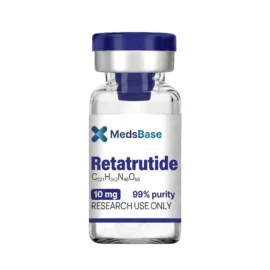
Mazdutide heeft een volwassen molecuulgewicht van ongeveer 4.865 Da inclusief de acylmodificatie. Het structurele skelet behoudt de dual-receptorfarmacologie van oxyntomoduline terwijl geëngineerde substituties resistentie bieden tegen DPP-4-gemedieerde proteolytische splitsing die anders snelle klaring zou veroorzaken. Mazdutide is het belangrijkste Chinese metabolische peptideprogramma, met fase 3-onderzoeken (GLORY-1 bij obesitas, DREAMS-1 en DREAMS-2 bij diabetes type 2) die gewichtsverminderingen van ongeveer 15–17% rapporteren op de hoogste dosisniveau over 48 weken. Buiten China is mazdutide niet goedgekeurd door de FDA, EMA, MHRA of enige andere grote westerse regulator. In China is mazdutide goedgekeurd door de NMPA onder zijn initiële commerciële merknaam — waardoor het een van de eerste dual-agonist incretinepeptiden is die overal ter wereld regulatoire goedkeuring heeft gekregen voor menselijk gebruik. Het onderzoeksgrade mazdutide dat hier wordt verkocht, is geleverd uitsluitend voor laboratoriumonderzoek en is niet bedoeld voor menselijke of veterinaire toediening. Voor de triple-agonist vergelijker die GIP toevoegt bovenop dezelfde GLP-1/glucagoncombinatie, zie onze Retatrutide productpagina.
Werkingsmechanisme — Dual GLP-1 / Glucagonreceptor Co-Agonisme
Wat mazdutide mechanistisch onderscheidend maakt onder de huidige dual-agonist metabolische peptiden, is dat het de canonieke GLP-1 verzadiging / glykemische as combineert met de glucagonreceptor energieverbruik-as — niet de GIP-receptoras die door tirzepatide wordt gebruikt. Het dual-receptorprofiel produceert complementaire effecten over drie hoofdcompartimenten die in gepubliceerd onderzoek zijn gedocumenteerd:
- GLP-1 receptor activatie — verzadiging, β-cel insulinesecretie, maaglediging — Mazdutide activeert de GLP-1-receptor op pancreatische bètacellen (glucose-afhankelijke insulinesecretie), hypothalamische arcuate-nucleus POMC-neuronen (centrale verzadigingssignalering) en gastrische vagale afferenten (vertraagde maaglediging). Deze arm overlapt met het mechanisme van semaglutide en de GLP-1-component van tirzepatide en retatrutide.
- Glucagonreceptoractivatie — energieverbruik, hepatische lipidenmobilisatie, bruin vetweefselactivatie — Het kenmerkende aspect van mazdutide is de gelijktijdige activering van de glucagonreceptor. Glucagonreceptoragonisme verhoogt het rustenergieverbruik enigszins, stimuleert hepatische vetzuuroxidatie en lipidenmobilisatie uit steatotische lever, en draagt bij aan activatie van bruin vetweefsel in gepubliceerd knaagdieronderzoek. De energieverbruikcomponent is wat glucagonbevattende multi-agonisten (mazdutide, retatrutide, survodutide) onderscheidt van het lichaamsgewichteffect van GLP-1-only en GLP-1/GIP-duale peptiden — de laatste veroorzaken gewichtsverlies bijna volledig door verminderde energie-inname, terwijl glucagonbevattende agonisten een metabolische-snelheidcomponent toevoegen.
- Receptoractiviteitsbalans en de “glucagonparadox” — De farmacologische uitdaging in glucagonreceptor co-agonisme is het bereiken van een gunstig netto-effect: glucagon alleen verhoogt glucose door stimulatie van hepatische glucoseproductie, wat de glykemische controle zou verslechteren in plaats van verbeteren. De GLP-1-component van mazdutide overstemt het glucagon-gestuurde glucose-effect door het dominante glucoseverlagende effect op insuline en glucagonsuppressie bij bètacellen en alfacellen, terwijl de glucagonarm de lipidenmobilisatie- en energieverbruikvoordelen behoudt. De relatieve GLP-1-tot-glucagonreceptorpotentie is zo ontworpen dat het een glucoseverlagend netto-effect bevordert — een belangrijk verschil met triple-agonisten zoals retatrutide waar GIP ook een bijdrage levert.
De vetzurenacylketting die aan een lysineresidu is gehecht, bindt reversibel aan circulerend serumalbumine, waardoor een plasmadepot ontstaat dat de effectieve halfwaardetijd verlengt om een eenmaal per week subcutane dosering in klinisch onderzoek te ondersteunen. Subcutane toediening is de standaard onderzoeksroute. Het mechanisme voor langdurige afgifte is vergelijkbaar met de C18-vetzuursystemen van semaglutide en de C20-vetzuursystemen van tirzepatide, maar met een andere ketenlengte en linkerchemie die is afgestemd op de dubbele receptorfarmacologie van mazdutide.
Gepubliceerde onderzoeksapplicaties
Mazdutide wordt gebruikt in laboratoriumonderzoeken die zich richten op:
- Onderzoek naar obesitas en lichaamssamenstelling — preklinische DIO-knaagdier modellen, lichaamssamenstelling (DEXA/MRI), voedselinname-assays, respiratoir quotiënt en ruststofwisseling; canoniek dubbel GLP-1/glucagon onderzoekspeptide
- Preklinisch onderzoek naar diabetes type 2 — glykemische controle, HbA1c-surrogaten, glucagononderdrukkingsdynamiek, insulinegevoeligheid in hoogvetdieet- en db/db-knaagdier modellen; directe vergelijking met enkelvoudige GLP-1-agonisten en dubbele GLP-1/GIP-vergelijkingen
- MASLD/MASH (metabool-dysfunctie-geassocieerde leverziekte) — hepatisch triglyceridegehalte, ALT/AST, fibrosestadiëring; bijzondere interesse vanwege de lipidenmobiliserende activiteit van de glucagoncomponent in een vervette lever
- Onderzoek naar energieverbruik — meting van ruststofwisseling, activering van bruin vetweefsel, thermogene genexpressie; mechanistische analyse van de glucagongedreven component van de stofwisselingssnelheid
- Vergelijkend onderzoek naar duale agonisten — directe vergelijking met de alternatieve dubbele agonist Tirzepatide (GLP-1/GIP) en de drievoudige agonist Retatrutide (GLP-1/GIP/glucagon); onderzoek naar receptor-stackingstrategieën
- Cardiovasculair en renaal onderzoek — effecten op bloeddruk, lipidenprofielen, atheroscleroseprogressie in ApoE-/- modellen; opkomende dataset gezien de fase 3-rijping van mazdutide
- Farmacologie van de glucagonas — geïsoleerde glucagonreceptor-farmacologische karakterisering, dynamiek van hepatische glucoseproductie, balans tussen glucagonsuppressie en glucagonagonisme in dual-agonistmoleculen
- Vergelijkend incretineonderzoek — benchmarken tegen enkelvoudige GLP-1-agonisten (Semaglutide), dual-agonist GLP-1/GIP (Tirzepatide), en drievoudige GLP-1/GIP/glucagon-agonisten (Retatrutide).
Voor een bredere context over waar mazdutide past binnen het landschap van metabolische peptiden met meerdere agonisten, zie Retatrutide als de triple-agonistvergelijker die GIP toevoegt, Tirzepatide als het alternatieve dual-agonistmiddel dat GIP gebruikt in plaats van glucagon, Semaglutide als de single-agonistbasislijn, en Cagrilintide als het amyline-ascombinatiefarmacologie-alternatief. Bekijk het volledige onderzoekspeptiden catalogus voor gerelateerde verbindingen.
Beschikbare sterktes en concentraties
MedsBase stocks Mazdutide in two lyophilized vial sizes calibrated to typical research protocol lengths. Each strength is available in 10-vial, 20-vial, or 30-vial pack formats with full reconstitution guidance:
| Vulsterkte | Typisch Onderzoeksgebruik | Verpakkingsgroottes |
|---|---|---|
| 5 mg | Standaard onderzoekssterkte — pilotdosering, protocollen met enkele cohorten, titratiegroepen | 10, 20 of 30 vialen |
| 10 mg | Langdurige protocollen, multi-cohortstudies, laagste kosten per mg | 10, 20 of 30 vialen |
Beide sterktes zijn dezelfde chemische vorm (lyofiliseerpoeder, 99%+ HPLC zuiverheid). Fase 3 klinische doseringen zijn 4–9 mg per week, dus onderzoeksflacons van 5 mg of 10 mg vertegenwoordigen enkelvoudige tot meerdere weken voorraad van klinisch-equivalente dosering voor in-vivo werk. Mazdutide is een relatief schaars onderzoekspeptide vanwege structurele complexiteit en actieve klinische ontwikkeling, wat zich weerspiegelt in de prijs per mg in vergelijking met volwassen kleine synthetische peptiden.
Hoe het zich verhoudt — Mazdutide vs Retatrutide
Mazdutide en Retatrutide zijn de twee klassieke glucagonreceptorbevattende multi-agonist metabolische peptiden in huidig onderzoek. Ze delen de GLP-1 + glucagon basis en verschillen in of ze ook de GIP-receptor activeren — Retatrutide doet dit (triple agonist), Mazdutide niet (dual agonist). De vergelijking is een van de meest zuivere in de huidige metabolische peptidefarmacologie omdat de GLP-1 en glucagon componenten gedeeld zijn, waardoor de bijdrage van de GIP-component geïsoleerd wordt.
| Criterium | Mazdutide | Retatrutide |
|---|---|---|
| Receptorprofiel | GLP-1 + glucagon (duaal) | GLP-1 + GIP + glucagon (drievoudig) |
| Scaffold | Oxyntomoduline-afgeleid | GIP-afgeleid |
| Lengte | ~39 aminozuren | 39 aminozuren |
| Halfwaardetijd | Eenmaal per week (geacyleerd) | ~6 dagen |
| Ontwikkelaar / oorsprong | Innovent (IBI362) / Eli Lilly (LY3305677) | Eli Lilly (LY3437943) |
| Regulatorische status | Goedgekeurd in China (NMPA); onder onderzoek elders | Onderzoek (fase 3) |
| Effect op lichaamsgewicht | ~15–17% (GLORY-1 fase 3, 48 wk) | ~24% (fase 2, 48 wk) |
| Typische wekelijkse onderzoeksdosis | 4–9 mg | 2–12 mg |
Het belangrijkste farmacologische verschil tussen de twee is de waarde van GIP-receptoractivatie bovenop GLP-1 + glucagon. Het effect van retatrutide op lichaamsgewicht in fase 2 is groter, wat suggereert dat GIP aanzienlijk voordeel toevoegt, maar het meer selectieve dual-agonistprofiel van mazdutide produceert een mogelijk schoner bijwerkingensignaal dat van belang kan zijn voor onderzoek naar langdurige tolerantie. Voor specifieke farmacologie van de glucagon-as is mazdutide het schonere onderzoeksinstrument omdat het de GLP-1 + glucagon-combinatie isoleert zonder de verwarring van GIP. Voor onderzoek naar maximaal effect op lichaamsgewicht blijft de triple-agonist retatrutide de standaardreferentie.
Opslag en Reconstituering
Voor reconstituering: bewaar lyofiliseerampullen gekoeld bij 2–8 °C in de originele verpakking voor kortetermijngebruik. Voor ongeopende langetermijnopslag, vries in bij −20 °C. Lyofiliseerde mazdutide is stabiel onder koeling tot 24 maanden en bij −20 °C tot 36 maanden. Vermijd vries-ontdooicycli van het lyofiliseerpoeder.
Reconstitueringsprocedure: spuit bacteriostatisch water langs de zijkant van de ampul (niet direct op de lyofiliseercake). Voor een 5 mg ampul levert 2,0 mL bacteriostatisch water een werkconcentratie van 2,5 mg/mL — 0,04 mL levert 100 mcg; 0,2 mL levert 500 mcg; ~1,6 mL levert een klinisch equivalente onderzoeksdosis van 4 mg. Draai zachtjes — schud niet — en laat 5–10 minuten staan voor volledige oplossing (geacyleerde peptiden lossen langzamer op dan kleinere ongewijzigde peptiden). Een correct gereconstitueerde oplossing moet helder en kleurloos zijn zonder zichtbare deeltjes. niet Schud — en laat 5–10 minuten staan voor volledige oplossing (geacyleerde peptiden lossen langzamer op dan kleinere ongewijzigde peptiden). Een correct gereconstitueerde oplossing moet helder en kleurloos zijn zonder zichtbare deeltjes.
Na reconstitutie: Bewaar gekoeld bij 2–8 °C en gebruik binnen 30 dagen voor optimale stabiliteit. Vries de gereconstitueerde oplossing niet in — vries-ontdooicycli tasten de peptide-integriteit aan. Gooi elk flesje weg dat troebelheid, neerslag of verkleuring vertoont.
Veelgestelde vragen
Waar wordt Mazdutide voor gebruikt in onderzoek?
Mazdutide wordt gebruikt in laboratoriumonderzoek naar de dubbele GLP-1 / glucagonreceptor co-agonist-as, obesitas en lichaamscompositie-regulatie, preklinische modellen van diabetes type 2, MASLD/MASH leverziekte, energieverbruik en thermogenese, en vergelijkende multi-agonist incretine-farmacologie tegen single-agonist GLP-1, dubbele GLP-1/GIP (tirzepatide), en triple GLP-1/GIP/glucagon (retatrutide) verbindingen. Het is het meest geciteerde Chinese metabolische peptide in de huidige literatuur. Het hier verkochte onderzoekskwaliteit mazdutide is niet FDA-goedgekeurd en wordt strikt geleverd voor laboratoriumonderzoek alleen.
Wat is het verschil tussen Mazdutide en Semaglutide?
Semaglutide is een enkele GLP-1-receptoragonist. Mazdutide voegt glucagonreceptoragonisme toe bovenop GLP-1. De toegevoegde glucagoncomponent draagt bij aan een energieverbruiksmechanisme — verhoogd rustmetabolisme, mobilisatie van leverlipiden en activering van bruin vetweefsel — dat GLP-1-alleen agonisten niet produceren. In vergelijkbare fase 3-onderzoeken produceert mazdutide een iets groter lichaamsgewichtseffect dan semaglutide alleen (15–17% vs ~15%), maar het belangrijkste praktische verschil is de mechanistische reden voor het gewichtsverlies: semaglutide voornamelijk door verminderde voedselinname, mazdutide door zowel verminderde inname als verhoogd energieverbruik.
Hoe verschilt Mazdutide van Tirzepatide?
Beide zijn duale incretine-agonisten, maar ze activeren verschillende secundaire receptoren. Tirzepatide is GLP-1 + GIP. Mazdutide is GLP-1 + glucagon. De twee receptorcombinaties produceren kwalitatief verschillende metabolische profielen: GIP (tirzepatide) voegt adipocytenlipolyse toe onder vastenomstandigheden en bescheiden effecten op het energieverbruik; glucagon (mazdutide) voegt aanzienlijk energieverbruik en hepatische lipidemobilisatie toe. Tirzepatide heeft de grotere fase 3-dataset en een groter effect op het lichaamsgewicht; mazdutide heeft het unieke mechanisme voor MASLD/MASH-onderzoek vanwege de glucagongedreven hepatische lipidcomponent.
Hoe verschilt Mazdutide van Retatrutide?
Retatrutide is een triple-agonist (GLP-1 + GIP + glucagon). Mazdutide is een duale agonist die de GLP-1 + glucagon-onderdelen deelt, maar het GIP-onderdeel mist. Het effect van Retatrutide op het lichaamsgewicht in fase 2 is groter dan het fase 3-resultaat van mazdutide, wat suggereert dat GIP-receptoractivatie aanzienlijke voordelen toevoegt bovenop GLP-1 + glucagon. Voor onderzoek dat specifiek de GLP-1 + glucagon-combinatie isoleert, is mazdutide het schonere instrument omdat het de GIP-verwarring vermijdt; voor maximaal effect op het lichaamsgewicht blijft retatrutide de canonieke referentie.
Wat is de typische onderzoeksdosis van Mazdutide?
Gepubliceerde preklinische en klinische onderzoeksprotocollen gebruiken wekelijkse subcutane dosering met een titratieschema dat begint bij 1,5–3 mg en oploopt tot onderhoudsdoseringen van 4–9 mg per week — het doseringsbereik dat werd gebruikt in de fase 3-studies GLORY-1 en DREAMS-1. Een flesje van 5 mg gereconstitueerd met 2,0 mL bacteriostatisch water levert 2,5 mg/mL op — ~1,6 mL komt overeen met een klinisch equivalente onderzoeksdosis van 4 mg.
Is Mazdutide goedgekeurd door de FDA?
Nee. Mazdutide is niet goedgekeurd door de FDA in de Verenigde Staten, noch door de EMA of MHRA. Het is goedgekeurd door China's NMPA voor menselijk gebruik (een van de eerste duale GLP-1/glucagon-agonisten die wereldwijd enige regelgevende goedkeuring heeft gekregen), maar westelijke regelgevende indiening is nog in behandeling of lopend volgens de huidige literatuur. Alle mazdutide die door leveranciers voor alleen onderzoeksgebruik buiten China wordt verkocht, is bedoeld voor laboratoriumonderzoek en mag niet aan mensen worden toegediend.
Hoe moet Mazdutide worden opgeslagen?
Gevriesdroogde flesjes: gekoeld bewaren bij 2–8 °C voor kortdurende werkvoorraad, of bij −20 °C voor langdurige opslag van ongeopende flesjes. Gereconstitueerde oplossing: gekoeld bewaren bij 2–8 °C, binnen 30 dagen gebruiken. Bevries de gereconstitueerde oplossing niet — vries-ontdooicycli degraderen het peptide. Bescherm te allen tijde tegen direct licht.
Hoe reconstitueer ik Mazdutide?
Volg de hierboven beschreven reconstitueringsprocedure. Voeg bacteriostatisch water langs de zijkant van het flesje toe (niet rechtstreeks op de lyofiliseerde cake), draai voorzichtig en laat 5-10 minuten staan voor volledige oplossing (geacyleerde peptiden lossen langzamer op dan kleinere ongewijzigde peptiden). Doe niet Schud het flesje. Een correct gereconstitueerde oplossing is helder en kleurloos. Voor een flesje van 5 mg + 2,0 mL verdunningsmiddel is de werkconcentratie 2,5 mg/mL.
Welke sterktes heeft MedsBase op voorraad?
MedsBase carries Mazdutide in 5 mg and 10 mg lyophilized vials. Each strength is available in 10-vial, 20-vial, or 30-vial pack sizes. All vials are supplied at 99%+ HPLC purity with a certificate of analysis available on request.
Waarom activeert Mazdutide ook de glucagonreceptor?
De structurele inspiratie voor mazdutide is oxyntomoduline, een endogeen 37-aminozuur product van preproglucagonverwerking in intestinale L-cellen dat van nature zowel de GLP-1- als glucagonreceptoren activeert. De dubbele farmacologie is daarom niet ontworpen — het erft van het natuurlijke oxyntomoduline-skelet. Wat wel ontworpen is, is de resistentie tegen DPP-4-splitsing en de vetzurenacylering die een halfwaardetijd van eenmaal per week produceert, naast het finetunen van de relatieve GLP-1 versus glucagonreceptorpotentie om een netto glucoseverlagend effect te bevorderen.
Veroorzaakt de glucagoncomponent hyperglykemie?
Dit is de klassieke “glucagonparadox” in onderzoek naar dubbele agonisten. Glucagon alleen verhoogt de glucose door stimulatie van hepatische glucoseproductie, wat diabetes zou verergeren in plaats van verbeteren. In mazdutide overstemt de GLP-1-component dit door een dominante glucoseverlagende werking op insuline en glucagonsuppressie in bèta- en alfacellen, terwijl de glucagonarm de voordelen van lipidenmobilisatie en energieverbruik behoudt. Gepubliceerd onderzoek bevestigt een netto glucoseverlaging ondanks glucagonreceptoractivatie, wat aantoont dat de ontworpen GLP-1 tot glucagonpotentieverhouding de gewenste balans bereikt.
Veroorzaakt Mazdutide bijwerkingen in onderzoek?
De meest consistente bevinding is gastro-intestinaal, vergelijkbaar met andere GLP-1-aspeptiden — misselijkheid, tijdelijke eetlustremming en vertraagde maaglediging zijn dosisafhankelijk en hebben de neiging af te nemen over 4–8 weken van continue dosering naarmate receptor-tachyphylaxie ontstaat. Bevindingen gerelateerd aan de glucagoncomponent omvatten bescheiden verhogingen van de rusthartslag en (zelden) tijdelijke bloeddrukeffecten. Langetermijnveiligheidsgegevens blijven zich opstapelen uit China Fase 3-onderzoeken en post-goedkeuringssurveillance.
Wat is de halfwaardetijd van Mazdutide?
Mazdutide heeft een plasmahalfwaardetijd die voldoende is om eenmaal per week subcutane dosering in klinisch onderzoek te ondersteunen, bereikt door reversibele binding aan serumalbumine via de vetzurenacyltether. De exacte halfwaardetijd is iets korter dan die van semaglutide (~165 uur) maar in hetzelfde eenmaal per week doseringsregime. Het doseringsschema en klinische onderzoeksopzet behandelen het als een volledig eenmaal per week compound.
Hoe lang duurt het voordat Mazdutide effecten laat zien in preklinisch onderzoek?
Acute farmacodynamische effecten op glucosetolerantie en maaglediging zijn binnen enkele uren na de eerste dosis detecteerbaar. Effecten op lichaamsgewicht in DIO-knaagdier modellen worden typisch statistisch significant na 1–2 weken van wekelijkse dosering en blijven toenemen gedurende 8–16 weken. Het maximale effect op lichaamssamenstelling ontwikkelt zich over 16–24 weken van continue dosering, wat de menselijke Fase 3-traject in GLORY-1 weerspiegelt.
Kan ik Mazdutide bestellen voor internationale verzending?
Ja. MedsBase verzendt Mazdutide wereldwijd vanuit ons toegewijde peptideverzendnetwerk. Bestellingen met alleen peptiden komen in aanmerking voor onze standalone peptideverzendservice. Alle bestellingen worden verzonden in temperatuurgecontroleerde verpakkingen met volledige tracking en zijn gedekt door onze Reshipment Assurance-beleid.
Andere peptiden voor metabolisch, lichaamssamenstellings- en multi-agonistonderzoek
- Retatrutide — Triple GLP-1/GIP/glucagonagonist — voegt GIP toe aan het receptorprofiel van mazdutide
- Tirzepatide — Dual GLP-1/GIP agonist — alternatieve dual-agonist die GIP gebruikt in plaats van glucagon
- Semaglutide — Single GLP-1 agonist — canonieke baseline comparator
- Cagrilintide — Amylin-analoog — alternatieve combinatie-farmacologiebenadering (CagriSema)
- Tesamorelin — GHRH-analoog — onderzoek naar viscerale adipositas
Verder lezen
📖 Verken het landschap van multi-agonistische metabolische peptiden
Bekijk het volledige onderzoekspeptiden catalogus, met verwante verbindingen inclusief Retatrutide (triple-agonist), Tirzepatide (dual GLP-1/GIP), en Semaglutide (enkelvoudige agonist). Directe vergelijkingsgids: Retatrutide vs Tirzepatide — triple versus dual agonist.
Meer opties in Peptiden
Gerangschikt op recente bestelvolumes van MedsBase — wat andere klanten in deze categorie kiezen.
| Sterkte | 5 mg, 10 mg |
|---|---|
| Hoeveelheid | 10 flacons, 20 flacons, 30 flacons |
 Mazdutide
Vragen & antwoorden
Mazdutide
Gerelateerde producten

Beoordelingen
Er zijn nog geen beoordelingen