







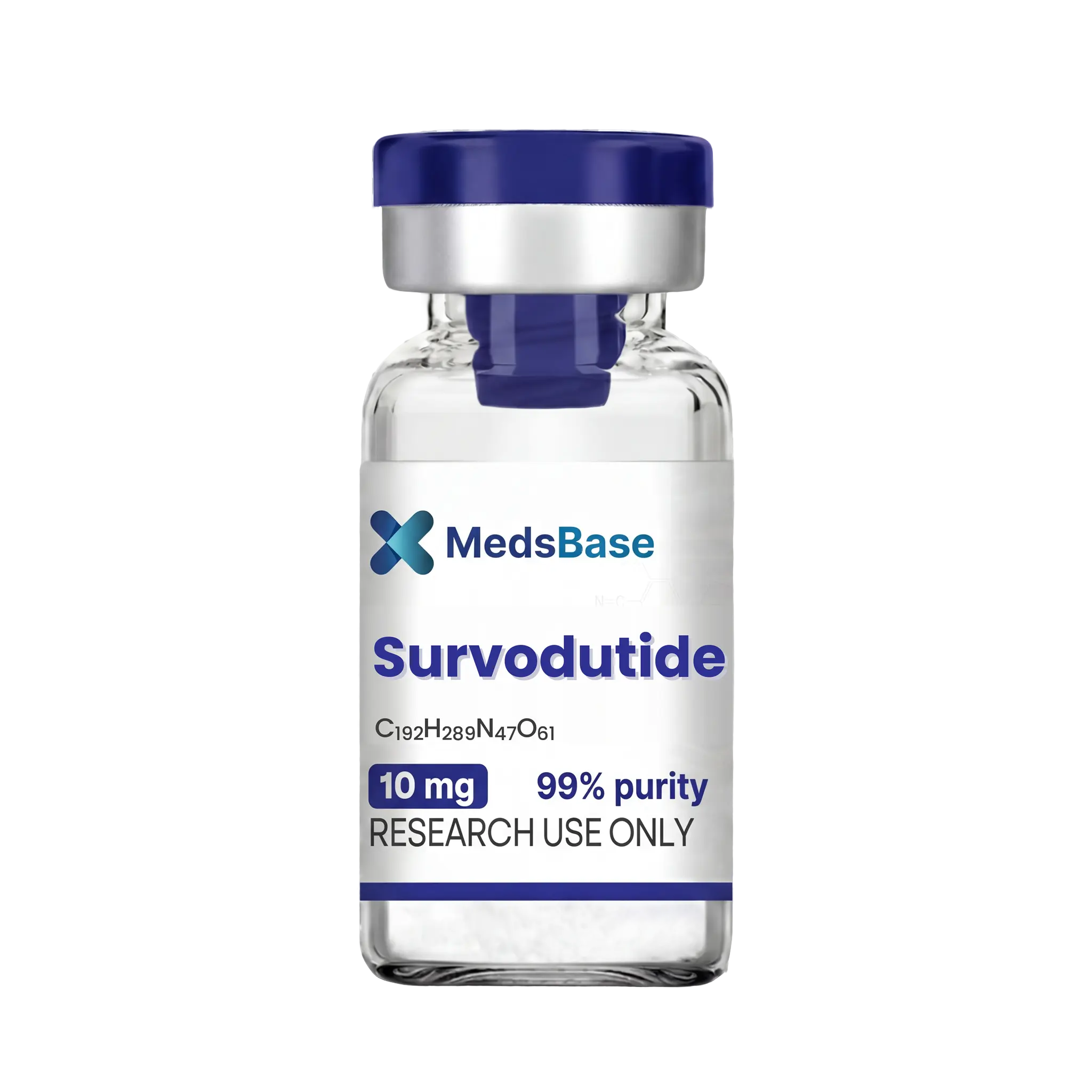
Survodutide
✅ Duale GLP-1 + glucagon receptor co-agonist
✅ Compact 29-aa Boehringer/Zealand peptide (BI 456906)
✅ Sterk MASH leverfibrose-signaal in Fase 2
✅ Glucagon-gebalanceerde receptorverhouding
✅ Eenmaal per week doseren (~6 dagen halfwaardetijd)
Survodutide bevat synthetisch peptideverbinding.
✓ Medisch beoordeeld door Morgan Ellis — Apotheekonderzoeker · 8 jaar ervaring · Laatst beoordeeld: mei 2026
Kort antwoord — Wat is Survodutide?
Survodutide (ontwikkelingscode BI 456906) is een 29-aminozuur langwerkend dual GLP-1- en glucagonreceptor-co-agonist, gezamenlijk ontwikkeld door Boehringer Ingelheim en Zealand Pharma. In gepubliceerd fase 2-onderzoek liet het opmerkelijke effecten zien bij MASH (metabole dysfunctie-geassocieerde steatohepatitis) leverfibrose, naast gewichtsverlies van ~19% over 46 weken. De plasmahalfwaardetijd ondersteunt eenmaal per week doseren. Leverbaar in 5 mg en 10 mg lyofilisatieflesjes, uitsluitend voor laboratoriumonderzoek.
📦 Elke bestelling is gedekt door onze Reshipment Assurance-beleid — als uw pakket niet binnen 20 werkdagen arriveert, sturen wij het opnieuw.
| Specificatie | Detail |
|---|---|
| CAS-nummer | 2230198-02-2 (survodutide; vaak geciteerd) |
| Type | Langwerkende duale GLP-1-/glucagonreceptor-co-agonist (geacyleerd synthetisch peptide; Boehringer Ingelheim BI 456906; co-ontwikkeld met Zealand Pharma) |
| Moleculair gewicht | ~3.800 Da (met vetzuuracylering; volwassen peptidevorm) |
| Structuur | 29-aminozuur synthetisch peptide co-agonist met geëngineerde Aib-substituties voor DPP-4-resistentie en een vetzuren-diacylketen gekoppeld aan een lysineresidu via een γ-Glu-linker. Aanzienlijk korter dan oxyntomoduline-afgeleide duale agonisten (mazdutide ~39 aa) met behoud van gebalanceerde duale GLP-1/glucagon receptoractiviteit. |
| Form | Lyofiliseerd poeder (wit tot off-white) |
| Zuiverheid | ≥99% (HPLC geverifieerd, COA op aanvraag) |
| Opslag | Lyofiliseerd: 2–8 °C (koelkast) voor werkvoorraad; −20 °C voor langdurige opslag van ongeopende flesjes. Gereconstitueerd: 2–8 °C, gebruik binnen ~30 dagen. Bescherm tegen licht. Vries de gereconstitueerde oplossing niet in en ontdooi deze niet. |
| Oplosbaarheid | Bacteriostatisch water (aanbevolen) of steriel water voor kortere gebruiksperioden. Acyleerde peptiden kunnen langzamer oplossen — zorg voor extra equilibratietijd. |
| Onderzoeksgebruik | Alleen voor laboratoriumonderzoek. Niet voor humaan of veterinair diagnostisch of therapeutisch gebruik. |
Wat Is Survodutide?
Survodutide (ontwikkelingscode BI 456906) is een langwerkende duale GLP-1- en glucagonreceptor co-agonist mede-ontwikkeld door Boehringer Ingelheim en Zealand Pharma. Het vertegenwoordigt het Westerse farmaceutische deel van het duale GLP-1/glucagon co-agonist onderzoeksprogramma, naast de parallelle programma's die mazdutide (Innovent Biologics, China) en de oudere Pegapamodutide / Cotadutide verbindingen hebben voortgebracht. Survodutide is structureel compact — slechts 29 aminozuren — aanzienlijk korter dan de oxyntomoduline-afgeleide duale agonisten, met behoud van gebalanceerde agonistactiviteit bij beide doelreceptoren door geëngineerde substituties en vetzurenacylering.
Survodutide heeft een moleculair gewicht van ongeveer 3.800 Da inclusief de acylmodificatie. De lengte van 29 residuen is een van de structurele kenmerken: kortere peptiden zijn doorgaans goedkoper om per eenheidsdosis te synthetiseren maar hebben minder oppervlakte voor fijnafstemming van receptorbalansfarmacologie. Boehringer-Zealand bereikte de duale-agonistbalans door een combinatie van strategische Aib-substituties op DPP-4 splitsingsplaatsen en zorgvuldige afstemming van receptor-bindingszakresiduen. De plasmahalfwaardetijd is ongeveer 6 dagen, wat eenmaal per week subcutane dosering ondersteunt.
Het huidige klinische kenmerk van survodutide is het opvallende MASH (metabole-dysfunctie-geassocieerde steatohepatitis) leverfibrose-effect gerapporteerd in de fase 2-studie — een resultaat dat het onderscheidde van andere duale en triple agonisten met vergelijkbare lichaamsgewichteffecten. Fase 2-obesitasgegevens toonden lichaamsgewichtsreducties van ongeveer 19% bij 4,8 mg wekelijks gedurende 46 weken, wat survodutide plaatst in dezelfde effectgrootte-categorie als tirzepatide en aan de grens van triple-agonist retatrutide. Survodutide bevindt zich momenteel in fase 3-studies voor obesitas (SURMOUNT-stijl studieopzet) en MASH. Survodutide is niet goedgekeurd door de FDA, EMA, MHRA of een andere belangrijke regelgevende instantie voor menselijk therapeutisch gebruik. Het onderzoeksgerichte survodutide dat hier wordt verkocht, wordt geleverd uitsluitend voor laboratoriumonderzoek en is niet bedoeld voor menselijke of veterinaire toediening. Voor het verwante dubbele GLP-1/glucagon co-agonist, zie onze Mazdutide productpagina; voor de triple-agonist die GIP toevoegt, zie Retatrutide.
Werkingsmechanisme — Dubbele GLP-1 / Glucagon Receptor Co-Agonisme met Hepatische Nadruk
Wat survodutide mechanistisch onderscheidend maakt onder dubbele agonist metabolische peptiden is de relatief gebalanceerde GLP-1-tot-glucagon potentieverhouding die zowel aanzienlijke energieverbruikseffecten (de glucagoncomponent) als de klassieke GLP-1 verzadigings-/glykemische effecten produceert, met bijzondere aandacht voor hepatische uitkomsten:
- GLP-1 receptor activatie — verzadiging, β-cel insulinesecretie, maaglediging — Survodutide activeert de GLP-1-receptor op pancreatische bètacellen (glucose-afhankelijke insulinesecretie, glucagonsuppressie van alfacellen), hypothalamische POMC-neuronen in de nucleus arcuatus (centrale eetlustregulatie) en gastrische vagale afferenten (vertraagde maaglediging). Dit aspect overlapt met het mechanisme van semaglutide en de GLP-1-component van alle multi-agonist incretinepeptiden.
- Glucagonreceptoractivatie — hepatische lipidenmobilisatie, energieverbruik, activering van bruin vetweefsel — Het kenmerkende aspect dat wordt gedeeld met mazdutide en retatrutide is glucagonreceptoragonisme. In survodutide-onderzoek produceert dit aspect bijzonder sterke hepatische lipidenmobilisatie — hepatocyten zijn sterk verrijkt met glucagonreceptoren, en directe activering van de glucagonroute stimuleert vetzuuroxidatie en triglyceride-export. Het gecombineerde effect met de indirecte levervoordelen van de GLP-1-component via verminderde insulineresistentie produceert het onderscheidende MASH-fibrosesignaal dat in Fase 2 is waargenomen.
- Receptorbalansengineering en de dubbele agonist potentieverhouding — De farmacologische uitdaging bij dubbele GLP-1/glucagon co-agonisme is het bereiken van de juiste relatieve potentie bij elke receptor. Glucagonagonisme alleen verhoogt glucose; GLP-1-agonisme alleen produceert sterke glucosereductie. Het netto-effect hangt af van de in-vivo verhouding van receptorbezetting op elke locatie. Survodutide is ontworpen voor een glucagon-bevooroordeelde balans ten opzichte van mazdutide, wat bijdraagt aan de sterkere hepatische effecten maar zorgvuldiger titratie vereist om netto-glucose-effecten te vermijden in vroege dosis-escalatie onderzoeksprotocollen.
De vetzuuracylering bij een lysineresidu (conceptueel analoog aan semaglutide's C18 acylketen) veroorzaakt reversibele serumalbuminebinding die de ~6-daagse plasmahalfwaardetijd produceert en eenmaal per week subcutane dosering ondersteunt in klinisch onderzoek. Subcutane toediening is de standaard onderzoeksroute en de enige route die wordt gebruikt in klinische ontwikkeling.
Gepubliceerde onderzoeksapplicaties
Survodutide wordt gebruikt in laboratoriumonderzoekcontexten die onderzoeken:
- MASLD/MASH (metabool-dysfunctie-geassocieerde leverziekte) — hepatisch triglyceridegehalte, normalisatie van ALT/AST, progressie van fibrosestadium in preklinische modellen en klinische fase 2-gegevens; het sterkste onderzoekssignaal van survodutide en de basis voor het toegewijde MASH fase 3-programma
- Onderzoek naar obesitas en lichaamssamenstelling — preklinische DIO-knaagdier modellen, lichaamssamenstelling (DEXA/MRI), voedselinname-assays, meting van energieverbruik
- Preklinisch onderzoek naar diabetes type 2 — glykemische controle, dynamiek van glucagonsuppressie, surrogaten voor HbA1c; de ontworpen receptorbalans bevordert een netto verlaging van glucose ondanks de glucagoncomponent
- Onderzoek naar energieverbruik en thermogenese — rustend energieverbruik, activering van bruin vetweefsel, expressie van thermogene genen; vooral relevant gezien de glucagoncomponent
- Vergelijkend onderzoek naar duale agonisten — directe vergelijking met de alternatieve duale GLP-1/glucagon co-agonist Mazdutide (afgeleid van oxyntomoduline, 39 aa), de duale GLP-1/GIP Tirzepatide, en de triple-agonist Retatrutide; onderzoek naar receptor-stackingstrategie
- Cardiovasculair onderzoek — effecten op bloeddruk, lipidenprofielen; cardiovasculaire uitkomstgegevens die zich opstapelen uit fase 2/3-programma's
- Farmacologie van de glucagonas — geïsoleerde glucagonreceptorfarmacologie, dynamiek van hepatische glucose-output, karakterisering van de potentiebalans tussen glucagon- en GLP-1-receptoren
- Vergelijkend incretineonderzoek — benchmarken tegen enkelvoudige GLP-1-agonisten (Semaglutide) en amylin-as combinatiefarmacologie (Cagrilintide + Semaglutide CagriSema).
Voor een bredere context over waar survodutide past binnen het landschap van metabole peptiden met meerdere agonisten, zie Mazdutide als de verwante duale GLP-1/glucagon co-agonist, Retatrutide als de triple-agonist die GIP toevoegt, Tirzepatide als het alternatieve duale middel dat GIP gebruikt in plaats van glucagon, en Semaglutide als de single-agonist basislijn. Bekijk het volledige onderzoekspeptiden catalogus voor gerelateerde verbindingen.
Beschikbare sterktes en concentraties
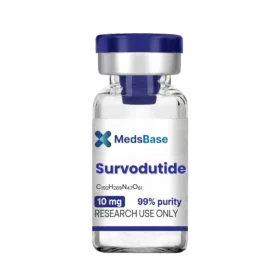
MedsBase stocks Survodutide in two lyophilized vial sizes calibrated to typical research protocol lengths. Each strength is available in 10-vial, 20-vial, or 30-vial pack formats with full reconstitution guidance:
| Vulsterkte | Typisch Onderzoeksgebruik | Verpakkingsgroottes |
|---|---|---|
| 5 mg | Standaard onderzoekssterkte — pilotdosering, protocollen met enkele cohorten, titratiegroepen | 10, 20 of 30 vialen |
| 10 mg | Langdurige protocollen, multi-cohortstudies, laagste kosten per mg | 10, 20 of 30 vialen |
Beide sterktes hebben dezelfde chemische vorm (lyofilisatiepoeder, 99%+ HPLC zuiverheid). Fase 2 klinische doseringen zijn 0,3–4,8 mg wekelijks met een titratieschema van 4–6 maanden, dus onderzoeksflacons van 5 mg of 10 mg vertegenwoordigen voorraden voor meerdere weken van klinisch-equivalente dosering voor in-vivo werk. Survodutide is een relatief schaars onderzoekspeptide vanwege actieve klinische ontwikkeling en Westerse farmaceutische toeleveringsketencontroles, wat terug te zien is in de prijs per mg ten opzichte van volwassen kleine synthetische peptiden.
Hoe het zich verhoudt — Survodutide versus Mazdutide
Survodutide en Mazdutide zijn de twee belangrijkste duale GLP-1/glucagon co-agonist onderzoekspeptiden in de huidige literatuur. Ze delen receptorfarmacologie — beide activeren de GLP-1- en glucagonreceptoren, beide hebben geen GIP-activiteit — maar verschillen in structurele oorsprong, lengte en ontworpen receptorbalansratio. De vergelijking is een van de meest heldere in de huidige duale-agonistfarmacologie omdat de receptor doelen identiek zijn en alleen de moleculaire implementatie verschilt.
| Criterium | Survodutide | Mazdutide |
|---|---|---|
| Receptorprofiel | GLP-1 + glucagon (duaal) | GLP-1 + glucagon (duaal) |
| Lengte | 29 aminozuren (compact) | ~39 aminozuren (oxyntomoduline-afgeleid) |
| Ontwikkelaar | Boehringer Ingelheim + Zealand Pharma | Innovent Biologics (gelicentieerd van Eli Lilly) |
| Ontwikkelingscode | BI 456906 | IBI362 / LY3305677 |
| Receptorbalans | Glucagon-bevooroordeeld (sterke hepatische effecten) | GLP-1-bevooroordeeld (schoner glykemisch profiel) |
| Halfwaardetijd | ~6 dagen (eenmaal per week) | Eenmaal per week (geacyleerd) |
| Onderscheidend klinisch signaal | Verbetering van leverfibrose bij MASH (Fase 2) | Eerste dubbele agonist goedgekeurd (China NMPA) |
| Effect op lichaamsgewicht | ~19% (Fase 2, 46 wk) | ~15–17% (Fase 3, 48 wk) |
| Typische wekelijkse onderzoeksdosis | 0.3–4.8 mg | 4–9 mg |
Voor onderzoek naar leverziekten bij MASH/MASLD is survodutide het vaker aangehaalde dubbele-agonist-hulpmiddel vanwege het onderscheidende Fase 2-signaal voor hepatische fibrose. Voor onderzoek gericht op de glykemische as met minimale interferentie van het glucagonpad is mazdutide's GLP-1-voorkeursbalans de schonere keuze. De twee peptiden samen vertegenwoordigen de belangrijkste westerse (Boehringer-Zealand) en oosterse (Innovent) benaderingen van dubbele GLP-1/glucagon co-agonist farmacologie — beide zullen waarschijnlijk dit decennium actief blijven in onderzoek en klinische ontwikkeling.
Opslag en Reconstituering
Voor reconstituering: Bewaar lyofiliseerde flesjes gekoeld bij 2–8 °C in de originele verpakking voor kortdurende werkvoorraad. Voor ongeopende langdurige opslag, vries in bij −20 °C. Lyofiliseerde survodutide is stabiel onder koeling tot 24 maanden en bij −20 °C tot 36 maanden. Vermijd vries-ontdooicycli van het lyofiliseerde poeder.
Reconstitueringsprocedure: Spuit bacteriostatisch water langs de zijkant van het flesje (niet rechtstreeks op de lyofiliseerde cake). Voor een flesje van 5 mg levert 2,0 mL bacteriostatisch water een werkconcentratie van 2,5 mg/mL op — 0,04 mL levert 100 mcg; 0,2 mL levert 500 mcg; ~1,9 mL levert een klinisch-equivalente onderzoeksdosis van 4,8 mg. Draai voorzichtig — schud niet — en laat 5–10 minuten staan voor volledige oplossing (geacyleerde peptiden lossen langzamer op dan kleinere ongewijzigde peptiden). Een correct gereconstitueerde oplossing moet helder en kleurloos zijn zonder zichtbare deeltjes. niet Schud — en laat 5–10 minuten staan voor volledige oplossing (geacyleerde peptiden lossen langzamer op dan kleinere ongewijzigde peptiden). Een correct gereconstitueerde oplossing moet helder en kleurloos zijn zonder zichtbare deeltjes.
Na reconstitutie: Bewaar gekoeld bij 2–8 °C en gebruik binnen 30 dagen voor optimale stabiliteit. Vries de gereconstitueerde oplossing niet in — vries-ontdooicycli tasten de peptide-integriteit aan. Gooi elk flesje weg dat troebelheid, neerslag of verkleuring vertoont.
Veelgestelde vragen
Waar wordt Survodutide voor gebruikt in onderzoek?
Survodutide wordt gebruikt in laboratoriumonderzoek naar MASLD/MASH leverziekte (het sterkste onderscheidende onderzoekssignaal), obesitas en lichaamscompositie-regulatie, preklinische modellen van diabetes type 2, energieverbruik en thermogenese, en vergelijkende multi-agonist incretine farmacologie tegenover enkele-agonist GLP-1, dubbele GLP-1/GIP (tirzepatide), de verwante dubbele GLP-1/glucagon mazdutide, en triple-agonist retatrutide. Het onderzoekskwaliteit survodutide dat hier wordt verkocht is niet FDA-goedgekeurd en wordt strikt geleverd voor laboratoriumonderzoek alleen.
Hoe verschilt Survodutide van Mazdutide?
Beide zijn dubbele GLP-1/glucagon co-agonisten met dezelfde receptor-doelen, maar ze verschillen in structurele oorsprong en ontworpen receptor-balansverhouding. Survodutide is een compact 29-aminozuur Boehringer-Zealand verbinding met een glucagon-bevooroordeelde potentiebalans die bijzonder sterke hepatische effecten produceert (de basis voor zijn fase 2 MASH-signaal). Mazdutide is een ~39-aminozuur oxyntomoduline-afgeleide Innovent verbinding met een GLP-1-bevooroordeelde balans die schonere glykemische effecten produceert. Voor MASH-onderzoek is survodutide de canonieke keuze; voor schoon glykemisch-as onderzoek met minimale glucagon-interferentie wordt mazdutide geprefereerd.
Hoe verschilt Survodutide van Tirzepatide?
Beide zijn dubbele incretine agonisten, maar ze activeren verschillende tweede receptoren. Tirzepatide is GLP-1 + GIP (~22% lichaamsgewichtseffect in SURMOUNT-1). Survodutide is GLP-1 + glucagon (~19% in fase 2). De twee receptorcombinaties produceren kwalitatief verschillende metabole profielen: GIP voegt adipocyten lipolyse toe onder vastende omstandigheden; glucagon voegt aanzienlijk energieverbruik en hepatische lipidemobilisatie toe. Survodutide heeft het unieke MASH-fibrosesignaal vanwege zijn glucagon-gestuurde hepatische lipide-effect.
Hoe verschilt Survodutide van Retatrutide?
Retatrutide voegt GIP-receptoractivatie toe bovenop GLP-1 + glucagon — het is een triple-agonist. Survodutide stopt bij de dubbele combinatie. Het fase 2 lichaamsgewichtseffect van retatrutide (~24%) is groter dan dat van survodutide (~19%), wat suggereert dat GIP aanzienlijk voordeel toevoegt. Survodutide heeft het sterkere MASH-signaal in zijn respectievelijke fase 2 trial. Voor onderzoek dat de dubbele GLP-1 + glucagon combinatie isoleert zonder de GIP-verwarring, zijn survodutide (en mazdutide) de schonere tools.
Wat is de typische onderzoeksdosis van Survodutide?
Gepubliceerde fase 2 klinische protocollen gebruiken wekelijkse subcutane dosering met een lang titratieschema beginnend bij 0,3 mg en oplopend via 0,9, 1,8, 2,4, 3,6 naar een onderhoudsdosis van 4,8 mg wekelijks over ongeveer 24 weken. Een flesje van 5 mg gereconstitueerd met 2,0 mL bacteriostatisch water levert 2,5 mg/mL — ~1,9 mL komt overeen met een 4,8 mg klinisch-equivalente onderzoeksdosis.
Is Survodutide goedgekeurd door de FDA?
Nee. Survodutide is niet goedgekeurd door de FDA, EMA, MHRA of enige andere grote regelgevende instantie voor therapeutisch gebruik bij mensen. Fase 3-onderzoeken voor obesitas en MASH zijn volgens de huidige literatuur nog gaande. Alle survodutide die wordt verkocht door leveranciers voor onderzoeksdoeleinden is bedoeld voor laboratoriumonderzoek en mag niet aan mensen worden toegediend.
Hoe moet Survodutide worden opgeslagen?
Gevriesdroogde flesjes: gekoeld bewaren bij 2–8 °C voor kortdurende werkvoorraad, of bij −20 °C voor langdurige opslag van ongeopende flesjes. Gereconstitueerde oplossing: gekoeld bewaren bij 2–8 °C, binnen 30 dagen gebruiken. Bevries de gereconstitueerde oplossing niet — vries-ontdooicycli degraderen het peptide. Bescherm te allen tijde tegen direct licht.
Hoe moet ik Survodutide reconstitueren?
Volg de hierboven beschreven reconstitueringsprocedure. Voeg bacteriostatisch water langs de zijkant van het flesje toe (niet rechtstreeks op de lyofiliseerde cake), draai voorzichtig en laat 5-10 minuten staan voor volledige oplossing (geacyleerde peptiden lossen langzamer op dan kleinere ongewijzigde peptiden). Doe niet Schud het flesje. Een correct gereconstitueerde oplossing is helder en kleurloos. Voor een flesje van 5 mg + 2,0 mL verdunningsmiddel is de werkconcentratie 2,5 mg/mL.
Welke sterktes heeft MedsBase op voorraad?
MedsBase carries Survodutide in 5 mg and 10 mg lyophilized vials. Each strength is available in 10-vial, 20-vial, or 30-vial pack sizes. All vials are supplied at 99%+ HPLC purity with a certificate of analysis available on request.
Waarom is Survodutide bijzonder relevant voor MASH-onderzoek?
De glucagon-georiënteerde dual-receptorbalans van Survodutide produceert volgens gepubliceerd onderzoek bijzonder sterke hepatische effecten. Hepatocyten zijn zeer rijk aan glucagonreceptoren, waardoor activering van het glucagonpad direct de oxidatie van vetzuren en de export van triglyceriden uit een vetlever stimuleert. Gecombineerd met de indirecte voordelen van het GLP-1-gedeelte via verminderde insulineresistentie, vertaalt het dubbele effect op de lever zich in de opvallende verbetering van het MASH-fibrosestadium zoals gerapporteerd in de fase 2-studie — een resultaat dat survodutide onderscheidde van andere duale en triple agonisten bij vergelijkbare effecten op lichaamsgewicht.
Veroorzaakt de glucagoncomponent hyperglykemie?
Het klassieke “glucagonparadox” geldt voor survodutide, net als voor andere duale GLP-1/glucagon co-agonisten: glucagon alleen verhoogt de glucose door stimulering van de hepatische glucoseproductie, maar de dominante glucoseverlagende werking van de GLP-1-component op insuline en glucagonsuppressie in bèta- en alfacellen overstijgt dit. De ontworpen receptorbalansratio van Survodutide bereikt een netto glucoseverlaging ondanks glucagonreceptoractivatie — gepubliceerde fase 2-gegevens bevestigen verbeterde glykemische controle bij T2DM-groepen bij onderhoudsdosering.
Veroorzaakt Survodutide bijwerkingen in onderzoek?
De meest consistente bevindingen zijn gastro-intestinaal, vergelijkbaar met andere GLP-1-peptiden — misselijkheid, tijdelijke eetlustremming en vertraagde maaglediging zijn dosisafhankelijk en nemen meestal af met het lange titratieschema dat in fase 2 wordt gebruikt. Bevindingen gerelateerd aan de glucagoncomponent omvatten bescheiden verhogingen van de rusthartslag en (zelden) tijdelijke bloeddrukeffecten. De lange titratie is deels ontworpen om deze effecten te minimaliseren.
Wat is de halfwaardetijd van Survodutide?
In preklinisch en klinisch onderzoek heeft survodutide een plasmahalfwaardetijd van ongeveer 6 dagen na subcutane toediening, vergelijkbaar met tirzepatide (~5 dagen) en iets korter dan semaglutide (~7 dagen). De halfwaardetijd wordt bereikt door reversibele binding aan circulerend serumalbumine via de vetzurenacylkoppeling aan een lysineresidu.
Hoe lang duurt het voordat Survodutide effecten laat zien in preklinisch onderzoek?
Acute farmacodynamische effecten op glucosetolerantie en maaglediging zijn binnen enkele uren na de eerste dosis detecteerbaar. Effecten op lichaamsgewicht in DIO-knaagdier-modellen worden meestal statistisch significant na 1–2 weken van wekelijkse dosering. MASLD/MASH-effecten op hepatisch triglyceridegehalte en ALT/AST-normalisatie accumuleren over 8–16 weken van regelmatige dosering. Het maximale effect op lichaamssamenstelling ontwikkelt zich over 24–46 weken, wat overeenkomt met de fase 2-trajectorie.
Kan ik Survodutide bestellen voor internationale verzending?
Ja. MedsBase verzendt Survodutide wereldwijd via ons toegewijde peptide-verzendnetwerk. Bestellingen die alleen peptiden bevatten, komen in aanmerking voor onze zelfstandige peptide-verzendservice. Alle bestellingen worden verzonden in temperatuurgecontroleerde verpakking met volledige tracking en vallen onder onze Reshipment Assurance-beleid.
Andere peptiden voor metabolisch, MASH en multi-agonist onderzoek
- Mazdutide — Broederlijke dual GLP-1/glucagon co-agonist — alternatieve receptor-balansverhouding
- Retatrutide — Triple GLP-1/GIP/glucagon agonist — voegt GIP toe aan het dual GLP-1/glucagon profiel
- Tirzepatide — Dual GLP-1/GIP agonist — alternatieve dual-agonist die GIP gebruikt in plaats van glucagon
- Semaglutide — Single GLP-1 agonist — canonieke baseline comparator
- Cagrilintide — Amylin analogon — alternatieve combinatie-farmacologiebenadering
Verder lezen
📖 Verken het landschap van dual GLP-1/glucagon co-agonisten
Bekijk het volledige onderzoekspeptiden catalogus, met gerelateerde multi-agonistverbindingen inclusief Mazdutide (broederlijke dual GLP-1/glucagon), Retatrutide (triple-agonist), en Tirzepatide (dual GLP-1/GIP). Head-to-head gids: Retatrutide vs Tirzepatide — triple versus dual agonist.
Meer opties in Peptiden
Gerangschikt op recente bestelvolumes van MedsBase — wat andere klanten in deze categorie kiezen.
| Sterkte | 5 mg, 10 mg |
|---|---|
| Hoeveelheid | 10 flacons, 20 flacons, 30 flacons |
 Survodutide
Vragen & antwoorden
Survodutide
Gerelateerde producten
Beoordelingen
Er zijn nog geen beoordelingen