









MOTS-c
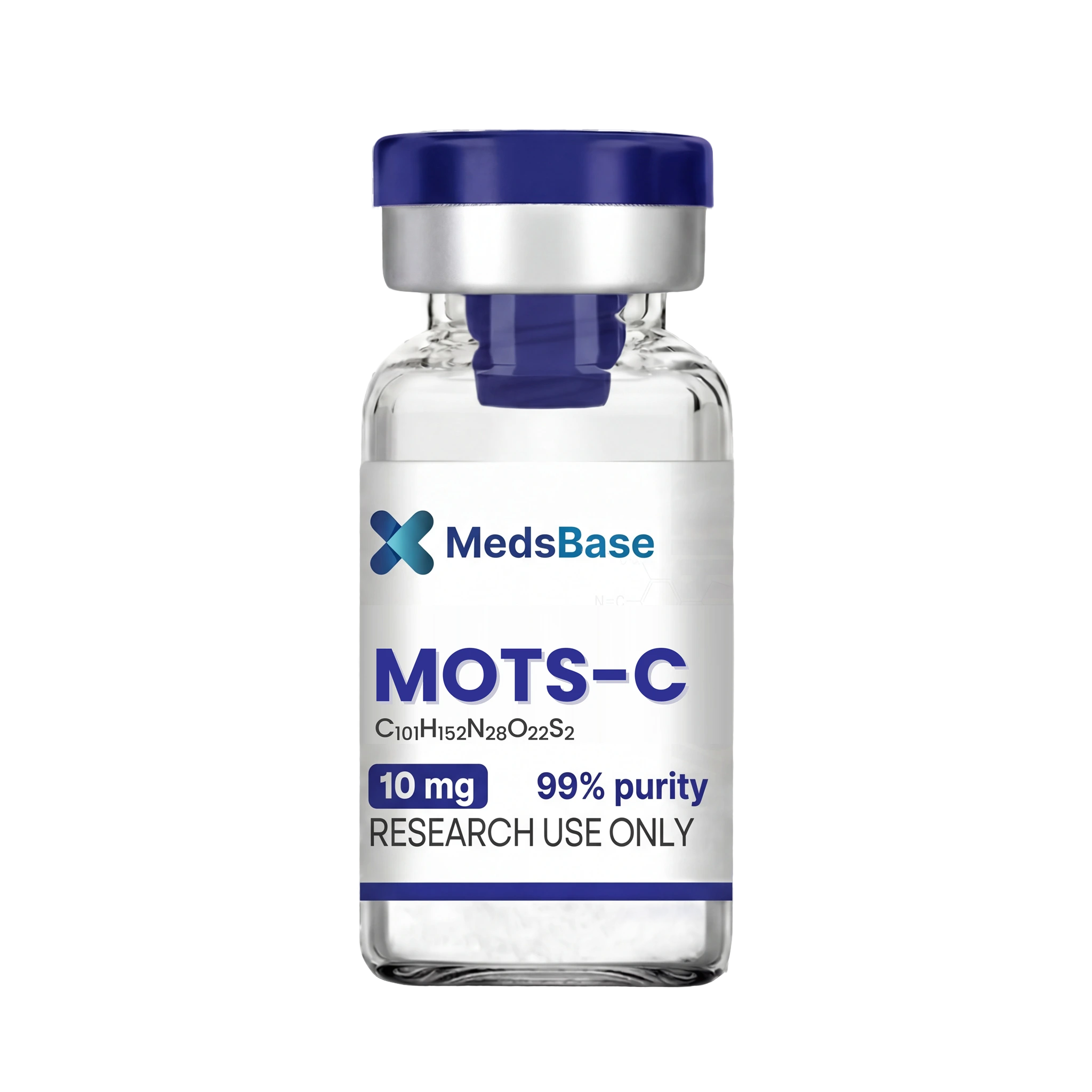
✅ Mitochondriaal gecodeerd signaalpeptide
✅ Activeert AMPK-metabolisch pad
✅ Ondersteunt onderzoek naar insulinegevoeligheid
✅ Oefening-mimetisch in preklinische modellen
✅ Verouderings- en geroscience onderzoeksstof
MOTS-c bevat synthetisch peptideverbinding.
✓ Medisch beoordeeld door Morgan Ellis — Apotheekonderzoeker · 8 jaar ervaring · Laatst beoordeeld: mei 2026

Kort antwoord — Wat is MOTS-c?
MOTS-c (Mitochondrial Open Reading frame of the Twelve S rRNA-c) is een 16-aminozuur peptide gecodeerd in het mitochondriaal DNA, voor het eerst geïdentificeerd in 2015. Volgens gepubliceerd preklinisch onderzoek fungeert het als een exercise-mimetic en metabolische regulator door activering van de AMPK-route, herstel van insulinegevoeligheid en modulatie van nucleaire genexpressie als reactie op mitochondriale stress. Leverbaar in 10 mg tot 40 mg lyofiliseerde flesjes, uitsluitend voor laboratoriumonderzoek.
📦 Elke bestelling is gedekt door onze Reshipment Assurance-beleid — als uw pakket niet binnen 20 werkdagen arriveert, sturen wij het opnieuw.
| Specificatie | Detail |
|---|---|
| CAS-nummer | 1627580-64-6 |
| Molecuulformule | C100H152N28O22S2 |
| Moleculair gewicht | 2174.62 Da |
| Sequentie | Met-Arg-Trp-Gln-Glu-Met-Gly-Tyr-Ile-Phe-Tyr-Pro-Arg-Lys-Leu-Arg (MRWQEMGYIFYPRKLR, 16 aminozuren; gecodeerd binnen het mitochondriale 12S rRNA-gen) |
| Form | Lyofiliseerd poeder (wit tot off-white) |
| Zuiverheid | ≥99% (HPLC geverifieerd, COA op aanvraag) |
| Opslag | Lyofiliseerd: 2–8 °C (koelkast) voor werkvoorraad; −20 °C voor langdurige opslag van ongeopende flesjes. Gereconstitueerd: 2–8 °C, gebruik binnen ~30 dagen. Bescherm tegen licht. Vries de gereconstitueerde oplossing niet in en ontdooi deze niet. |
| Oplosbaarheid | Bacteriostatisch water (aanbevolen) of steriel water voor kortere gebruiksperioden |
| Onderzoeksgebruik | Alleen voor laboratoriumonderzoek. Niet voor humaan of veterinair diagnostisch of therapeutisch gebruik. |
Wat is MOTS-c?
MOTS-c (Mitochondrial Open Reading frame of the Twelve S rRNA-c) is een peptide van 16 aminozuren dat voor het eerst werd geïdentificeerd door Lee et al. in Cell Metabolism (2015) als lid van de nieuw erkende klasse van mitochondrieel afgeleide peptiden (MDPs). In tegenstelling tot alle andere peptiden in het onderzoeksassortiment — die worden gecodeerd door nucleair DNA en gesynthetiseerd in het cytoplasma — wordt MOTS-c gecodeerd binnen het mitochondriale 12S rRNA-gen en vertaald door mitochondriale ribosomen. Deze ongebruikelijke biologische oorsprong maakt het tot een direct intracellulair signaal van de mitochondriale toestand, en het meest geciteerde lid van een peptideklasse die humanin en de SHLP-familie omvat.
De peptidevolgorde is MRWQEMGYIFYPRKLR, molecuulgewicht ongeveer 2.175 Da, empirische formule C100H152N28O22S2. Endogene MOTS-c verplaatst zich van mitochondriën naar de kern onder metabole en oxidatieve stress, waar het een folaatcyclus / methioninemetabolisme-genprogramma reguleert — een mechanisme zonder parallel onder nucleair gecodeerde peptiden. MOTS-c wordt geleverd als een hoogzuiver lyofiliseerbaar poeder voor reconstitutie met bacteriostatisch water en is uitsluitend voor laboratoriumonderzoek. Het is niet goedgekeurd door de FDA, EMA of MHRA voor humaan of veterinair therapeutisch gebruik. Voor gerelateerde metabole en levensduurpeptiden, zie ons volledige onderzoekspeptiden catalogus.
Werkingsmechanisme — AMPK, Glucosemetabolisme en Nucleaire Translocatie
Wat MOTS-c onderscheidt van oudere metabole peptiden is zijn driemodale werkingsmechanisme die zich uitstrekt over de mitochondriën, het cytoplasma en de kern — elk draagt bij aan het waargenomen metabole fenotype in gepubliceerd onderzoek:
- AMPK-signaalroute-activering — MOTS-c activeert AMP-geactiveerd proteïnekinase (AMPK), de belangrijkste cellulaire energiesensor, door de intracellulaire AMP:ATP-ratio te verhogen en via een foliumzuurcyclus-afhankelijk mechanisme. AMPK-activering verschuift het cellulaire metabolisme naar katabolisme: verhoogde glucoseopname via GLUT4-translocatie, vetzuuroxidatie, mitochondriale biogenese via PGC-1α en autofagie. Dit is dezelfde route die wordt beïnvloed door metformine en lichaamsbeweging, wat MOTS-c in de gepubliceerde literatuur de omschrijving “bewegingsmimetisch peptide” heeft opgeleverd.
- Insulinegevoeligheid en glucosedispositie — In hoogvetdieet-knaagdier-modellen herstelt MOTS-c-toediening de insulinegestimuleerde glucoseopname in skeletspieren en vetweefsel. Het effect is in sommige onderzoeksopzetten onafhankelijk van lichaamsgewichtsverandering, wat suggereert dat er een direct insulinesensibiliserend mechanisme is in plaats van een secundair effect van gewichtsverlies. MOTS-c-behandelde obese muizen vertonen genormaliseerde orale glucosetolerantie en verbeterde euglykemische-clampparameters in gepubliceerd onderzoek.
- Kernverplaatsing en adaptieve genexpressie — Onder metabole of oxidatieve stress verplaatst MOTS-c zich van de mitochondriën naar de kern, waar het mede een transcriptieprogramma reguleert dat gericht is op antioxidantrespons (NRF2), de foliumzuur-methioninecyclus en adaptieve metabole genen. Deze mitochondriale-naar-nucleaire retrograde signaaloverdracht is een van de eerste peptide-voorbeelden van intracellulaire communicatie tussen compartimenten en vormt de basis voor de bredere effecten van MOTS-c buiten directe AMPK-activering.
Het biologische aantrekkingspunt van MOTS-c in metabool onderzoek is de convergentie van deze drie mechanismen op routes waarvan al bekend is dat ze de voordelen van lichaamsbeweging en calorische restrictie mediëren. Omdat endogene MOTS-c aanzienlijk afneemt met de leeftijd in menselijk serum (~50% reductie over de volwassen levensduur in gepubliceerde cohorten), is het peptide een veelvoorkomend doelwit geworden in verouderings- en levensduuronderzoek, evenals in metabool syndroom.
Gepubliceerde onderzoeksapplicaties
MOTS-c wordt gebruikt in laboratoriumonderzoeken die zich richten op:
- Metabool syndroom en obesitasonderzoek — insulinegevoeligheid, glucosetolerantie, lichaamssamenstelling in hoogvetdieet-knaagdier-modellen; referentiepeptide voor AMPK-as-interventieonderzoek (Lee et al., Cell Metabolism 2015; Reynolds et al., Front Physiol 2021)
- Type 2 diabetes preklinische modellen — db/db, ZDF en streptozotocine-geïnduceerde diabetesmodellen; effecten op hepatische insulinegevoeligheid, bètacelfunctie en HbA1c-surrogaten
- Bewegingscapaciteit en mitochondriale biogenese — loopbanduithoudingsvermogen, VO2max surrogates, PGC-1α-expressie, mitochondriaal DNA-kopieaantal in skeletspieronderzoek
- Verouderings- en levensduuronderzoek — levensduurverlengingsmodellen, leeftijdsgerelateerde insulineresistentie, sarcopenie; MOTS-c-serumniveaus nemen af met de leeftijd, waardoor het een kandidaat-vervangend peptide is in geroscience-onderzoek
- Cardiovasculaire en renale bescherming — ischemie-reperfusieletsel, oxidatieve stressmarkers, mitochondriale dysfunctie in cardiale en renale weefselonderzoeksmodellen
- Botgezondheidsonderzoek — osteoblastdifferentiatie, botmineraaldichtheid, leeftijdsgerelateerde osteoporosemodellen
- Vergelijkend mitochondriaal peptideonderzoek — benchmarking tegen andere mitochondriaal gerichte peptiden zoals SS-31 (Elamipretide). Zie de vergelijkingssectie hieronder voor een methodologische vergelijking.
Voor een bredere context over waar MOTS-c past binnen het metabolische en levensduurpeptidelandschap, zie SS-31 (Elamipretide) als het canonieke cardiolipine-gerichte mitochondriale peptide, Epitalon voor telomeer/levensduuronderzoek, en NAD+ voor NAD-as metabolisch onderzoek. Bekijk het volledige onderzoekspeptiden catalogus voor gerelateerde verbindingen.
Beschikbare sterktes en concentraties
MedsBase stocks MOTS-c in three lyophilized vial sizes calibrated to typical research protocol lengths. Each strength is available in 10-vial, 20-vial, or 30-vial pack formats with full reconstitution guidance:
| Vulsterkte | Typisch Onderzoeksgebruik | Verpakkingsgroottes |
|---|---|---|
| 10 mg | Standaard onderzoekssterkte, kortcyclische protocollen | 10, 20 of 30 vialen |
| 20 mg | Middelgrote bulkfles, verminderd reconstitutievolume per dosis | 10, 20 of 30 vialen |
| 40 mg | Langcyclische protocollen, verouderingsonderzoek, laagste kosten per mg | 10, 20 of 30 vialen |
Alle drie de sterktes hebben dezelfde chemische vorm (gevriesdroogd poeder, 99%+ HPLC zuiverheid). Hogere mg-flessen bieden meer flexibiliteit per dosis per fles en lagere kosten per mg; het nadeel is dat de gereconstitueerde oplossing binnen 30 dagen gebruikt moet worden, dus protocollen van meerdere maanden profiteren alleen van grotere flessen wanneer de wekelijkse onderzoeksdosis overeenkomstig hoog is.
Hoe het zich verhoudt — MOTS-c vs SS-31 (Elamipretide)
MOTS-c en SS-31 zijn de twee meest aangehaalde mitochondrieel gerichte peptiden in huidig onderzoek. Ze zijn mechanistisch verschillend en complementair, niet redundant: MOTS-c is een signaalpeptide dat AMPK activeert en nucleair gecodeerde adaptieve programma's, terwijl SS-31 een structureel peptide is dat cardiolipine bindt in het binnenste mitochondriale membraan om de elektronentransportketen te stabiliseren. Onderzoekers combineren ze vaak in modellen van mitochondriale dysfunctie om deze reden.
| Criterium | MOTS-c | SS-31 (Elamipretide) |
|---|---|---|
| Lengte | 16 aminozuren | 4 aminozuren (tetrapeptide) |
| Oorsprong | Mitochondriaal DNA-gecodeerd (12S rRNA-gen) | Synthetisch Szeto-Schiller peptide |
| Primair werkingsmechanisme | AMPK-activering, nucleaire genexpressie | Cardiolipine-binding, ETC-stabilisatie |
| Celiair doelwit | Mitochondrion → cytoplasma → nucleus | Alleen binnenste mitochondriale membraan |
| Typische onderzoeksdosis | 5–15 mg, 1–3x per week | 2–5 mg, dagelijks |
| Sterkste onderzoekssignaal | Insulinegevoeligheid, inspanningscapaciteit, veroudering | Cardiale ischemie, renale mitochondriale dysfunctie |
| Stacking | Vaak samen toegediend met SS-31 in mitochondriaal onderzoek | Vaak samen toegediend met MOTS-c |
De twee peptiden werken op verschillende niveaus van mitochondriale biologie — MOTS-c reguleert metabole transcriptie, SS-31 stabiliseert membraanarchitectuur — waardoor ze niet-overlappende onderzoeksvragen behandelen. Voor metabool/insulinegevoeligheidsonderzoek is MOTS-c de standaard eerste keuze. Voor cardiale, renale of ischemie-reperfusie mitochondriale bescherming is SS-31 de canonieke vergelijker.
Opslag en Reconstituering
Voor reconstituering: Bewaar lyofiliseerde flesjes gekoeld bij 2–8 °C in de originele verpakking voor kortetermijnwerkvoorraad. Voor ongebruikte langetermijnopslag, vries in bij −20 °C. Lyofiliseerde MOTS-c is stabiel onder koeling tot 24 maanden en bij −20 °C tot 36 maanden. Vermijd vries-dooicycli op het lyofiliseerde poeder.
Reconstitueringsprocedure: Spuit bacteriostatisch water langs de zijkant van het peptideflesje (niet direct op de lyofiliseerde cake). Voor een flesje van 10 mg levert 2,0 ml bacteriostatisch water een werkconcentratie van 5 mg/ml op — 10 streepjes op een U-100-insulinespuit komt overeen met 500 mcg. Draai voorzichtig — schud niet — en laat 2–5 minuten staan voor volledige oplossing. Een correct gereconstitueerde oplossing moet helder en kleurloos zijn. niet Schud — en laat 2–5 minuten staan voor volledige oplossing. Een correct gereconstitueerde oplossing moet helder en kleurloos zijn.
Na reconstitutie: Bewaar gekoeld bij 2–8 °C en gebruik binnen 30 dagen voor optimale stabiliteit. Vries de gereconstitueerde oplossing niet in — vries-dooicycli tasten de peptide-integriteit aan. Gooi elk flesje weg dat troebelheid, neerslag of verkleuring vertoont. Omdat MOTS-c typisch 1–3 keer per week wordt gedoseerd in onderzoeksprotocollen, ondersteunt een enkele gereconstitueerd 10 mg flesje typisch 2–3 weken dosering, afhankelijk van de doeldosis en frequentie.
Veelgestelde vragen
Waar wordt MOTS-c voor gebruikt in onderzoek?
MOTS-c wordt gebruikt in laboratoriumonderzoek naar insulinegevoeligheid, modellen van diabetes type 2, trainingscapaciteit, mitochondriale biogenese, veroudering en levensduur, cardiovasculaire ischemie-reperfusieschade, renale mitochondriale dysfunctie en botgezondheid. Het is het meest geciteerde mitochondrieel gecodeerde signaalpeptide in de gepubliceerde literatuur en dient als referentie voor AMPK-as interventies. MOTS-c is niet FDA-goedgekeurd en wordt hier strikt geleverd voor alleen laboratoriumonderzoek.
Hoe verschilt MOTS-c van SS-31 (Elamipretide)?
MOTS-c is een 16-aminozuur signaalpeptide gecodeerd door mitochondriaal DNA dat AMPK activeert en nucleaire genexpressie reguleert. SS-31 is een 4-aminozuur synthetisch Szeto-Schiller peptide dat cardiolipine bindt in het binnenste mitochondriale membraan om de elektronentransportketen te stabiliseren. De twee richten zich op verschillende niveaus van mitochondriale biologie — MOTS-c op het metabolisch-transcriptieniveau, SS-31 op het membraan-architectuurniveau — en worden vaak samen toegediend in onderzoek naar mitochondriale dysfunctie.
Wat is de gebruikelijke onderzoeksdosis van MOTS-c?
Gepubliceerde preklinische protocollen gebruiken typisch 5–15 mg per toediening in knaagdier modellen, gegeven 1–3 keer per week voor cycli van 4–12 weken. Een flesje van 10 mg gereconstitueerd met 2,0 mL bacteriostatisch water levert 5 mg/mL — 10 streepjes op een U-100 spuit komt overeen met 500 mcg.
Is MOTS-c FDA-goedgekeurd?
Nee. MOTS-c is niet goedgekeurd door de FDA, EMA, MHRA of enige andere regelgevende instantie voor humaan therapeutisch gebruik. Alle MOTS-c die wordt verkocht door leveranciers voor onderzoeksgebruik is bedoeld voor laboratoriumonderzoek en mag niet worden toegediend aan mensen of dieren.
Hoe moet MOTS-c worden opgeslagen?
Gevriesdroogde flesjes: gekoeld bewaren bij 2–8 °C voor kortdurende werkvoorraad, of bij −20 °C voor langdurige opslag van ongeopende flesjes. Gereconstitueerde oplossing: gekoeld bewaren bij 2–8 °C, binnen 30 dagen gebruiken. Bevries de gereconstitueerde oplossing niet — vries-ontdooicycli degraderen het peptide. Bescherm te allen tijde tegen direct licht.
Hoe reconstitueer ik MOTS-c?
Volg de hierboven beschreven reconstitutieprocedure. Voeg bacteriostatisch water toe langs de zijkant van het flesje (niet rechtstreeks op het gevriesdroogde poeder), draai voorzichtig en laat 2–5 minuten staan voor volledige oplossing. Schud niet het flesje niet. Een correct gereconstitueerde oplossing is helder en kleurloos. Voor een flesje van 10 mg + 2,0 mL oplosmiddel is de werkconcentratie 5 mg/mL.
Welke sterktes heeft MedsBase op voorraad?
MedsBase carries MOTS-c in 10 mg, 20 mg, and 40 mg lyophilized vials. Each strength is available in 10-vial, 20-vial, or 30-vial pack sizes. All vials are supplied at 99%+ HPLC purity with a certificate of analysis available on request.
Waarom wordt MOTS-c een “oefening-mimetisch” peptide genoemd?
De term komt voort uit de activering van AMPK door MOTS-c en de downstream effecten op glucoseopname, vetzuuroxidatie en mitochondriale biogenese — hetzelfde intracellulaire pad dat verantwoordelijk is voor veel van de metabolische aanpassingen aan lichaamsbeweging. In gepubliceerd onderzoek bootst MOTS-c-toediening verschillende fenotypen van training na in sedentaire dieren: verbeterde insulinegevoeligheid, verhoogde loopbanduithoudingsvermogen en verhoogde PGC-1α-expressie in skeletspieren. De metafoor wordt veel gebruikt in gerowetenschap en literatuur over metabool syndroom.
Kunnen MOTS-c en SS-31 worden gecombineerd in onderzoek?
Ja. MOTS-c en SS-31 werken in op verschillende niveaus van mitochondriale biologie en worden vaak samen toegediend in preklinisch onderzoek naar mitochondriale dysfunctie. MOTS-c reguleert metabolische transcriptie via AMPK; SS-31 stabiliseert de lipidenomgeving van het binnenmembraan. Hun mechanismen zijn complementair in plaats van overlappend, wat de combinatie nuttig maakt in onderzoeksmodellen van multi-as mitochondriale achteruitgang.
Veroorzaakt MOTS-c bijwerkingen in onderzoek?
Gepubliceerd preklinisch onderzoek heeft een opmerkelijk goed veiligheidsprofiel gerapporteerd bij typische onderzoeksdoseringen in knaagdier modellen, zonder consistente off-target signalen en goede verdraagbaarheid over 4–12 weken durende doseringscycli. MOTS-c is structureel een endogeen humaan peptide, wat het risico op antilichaam-gemedieerde reacties zoals gezien bij ontworpen analogen vermindert. Langetermijn veiligheidsgegevens bij mensen zijn niet beschikbaar omdat humane trials nog in een vroeg stadium zijn.
Wat is de halfwaardetijd van MOTS-c?
In preklinisch onderzoek heeft MOTS-c een geschatte plasma halfwaardetijd van ongeveer 3–4 uur na subcutane toediening. De relatief korte systemische halfwaardetijd wordt gecompenseerd door intracellulaire accumulatie en de rol van het peptide als intracellulair signaalmolecuul in plaats van een circulerend hormoon — effecten blijven aanhouden buiten het plasma klaringvenster in onderzoeksmodellen.
Waarom neemt endogene MOTS-c af met de leeftijd?
Gepubliceerde cohortgegevens tonen ongeveer een 50% afname in humane serum MOTS-c niveaus tussen jonge en oudere volwassenen. Het mechanisme is niet volledig begrepen maar wordt verondersteld verband te houden met leeftijdsgerelateerde mitochondriale DNA mutaties, afnemende mitochondriale transcriptie en verminderde biosynthese van mitochondrieel gecodeerde peptiden in het algemeen. De leeftijdsgerelateerde afname is een van de redenen waarom MOTS-c sterke interesse heeft getrokken in verouderings- en gerowetenschappelijk onderzoek.
Hoe lang duurt het voordat MOTS-c effecten laat zien in preklinisch onderzoek?
Acute effecten op AMPK fosforylatie en glucoseopname zijn detecteerbaar binnen enkele uren na toediening. Insulinegevoeligheid en lichaamssamenstelling effecten in hoog-vetdieet knaagdier modellen worden typisch statistisch significant na 2–4 weken van regelmatige dosering. Verbeteringen in beweegcapaciteit (loopband uithoudingsvermogen, VO2max surrogaten) accumuleren over 4–8 weken van continu onderzoeksdosering.2max surrogaten) accumuleren gedurende 4–8 weken continue onderzoeksdosering.
Kan ik MOTS-c bestellen voor internationale verzending?
Ja. MedsBase verzendt MOTS-c wereldwijd via ons toegewijde peptide-verzendnetwerk. Bestellingen met alleen peptides komen in aanmerking voor onze aparte peptide-verzendservice. Alle bestellingen worden verzonden in temperatuurgecontroleerde verpakking met volledige tracking en zijn gedekt door onze Reshipment Assurance-beleid.
Andere peptiden voor metabolisch, mitochondriaal en verouderingsonderzoek
- SS-31 (Elamipretide) — Cardiolipine-bindend mitochondriaal tetrapeptide — canonieke binnenmembraanstabilisator
- NAD+ — Nicotinamide adenine dinucleotide — sirtuin/verouderingsas metabolisch onderzoek
- Epitalon — AEDG pijnappelklier tetrapeptide — telomerase-activatie en verouderingsonderzoek
- Semaglutide — Langwerkende GLP-1-agonist — glykemisch en lichaamsgewichtonderzoek
- Retatrutide — Triple GLP-1/GIP/glucagon-agonist — multi-as metabolisch onderzoek
Verder lezen
📖 Vergelijk mitochondriaal gerichte peptiden
Verken het bredere onderzoekspeptiden catalogus voor mitochondriale en metabolische peptiden inclusief SS-31 (Elamipretide) voor cardiolipine-gericht membraanonderzoek, NAD+ voor sirtuin-as verouderingsonderzoek, en Epitalon voor telomeer-as verouderingsonderzoek.
Meer opties in Peptiden
Gerangschikt op recente bestelvolumes van MedsBase — wat andere klanten in deze categorie kiezen.


| Sterkte | 10 mg, 20 mg, 40 mg |
|---|---|
| Hoeveelheid | 10 flacons, 20 flacons, 30 flacons |
 MOTS-c
Vragen & antwoorden
MOTS-c
Gerelateerde producten








Beoordelingen
Er zijn nog geen beoordelingen