







ARA-290 (Cibinetide)
✅ Niet-erytropoëtisch EPO-afgeleid 11-aminozuurpeptide
✅ Aangeboren reparatiereceptor (EPOR + CD131) agonist
✅ Ontstekingsremmend, neuroprotectief, weefselherstel-signalering
✅ Geen verhoging van hematocriet (belangrijk ontwerpkenmerk in vergelijking met volledig EPO)
✅ Weesgeneesmiddel-aanduiding voor sarcoïdose-geassocieerde kleine vezelneuropathie
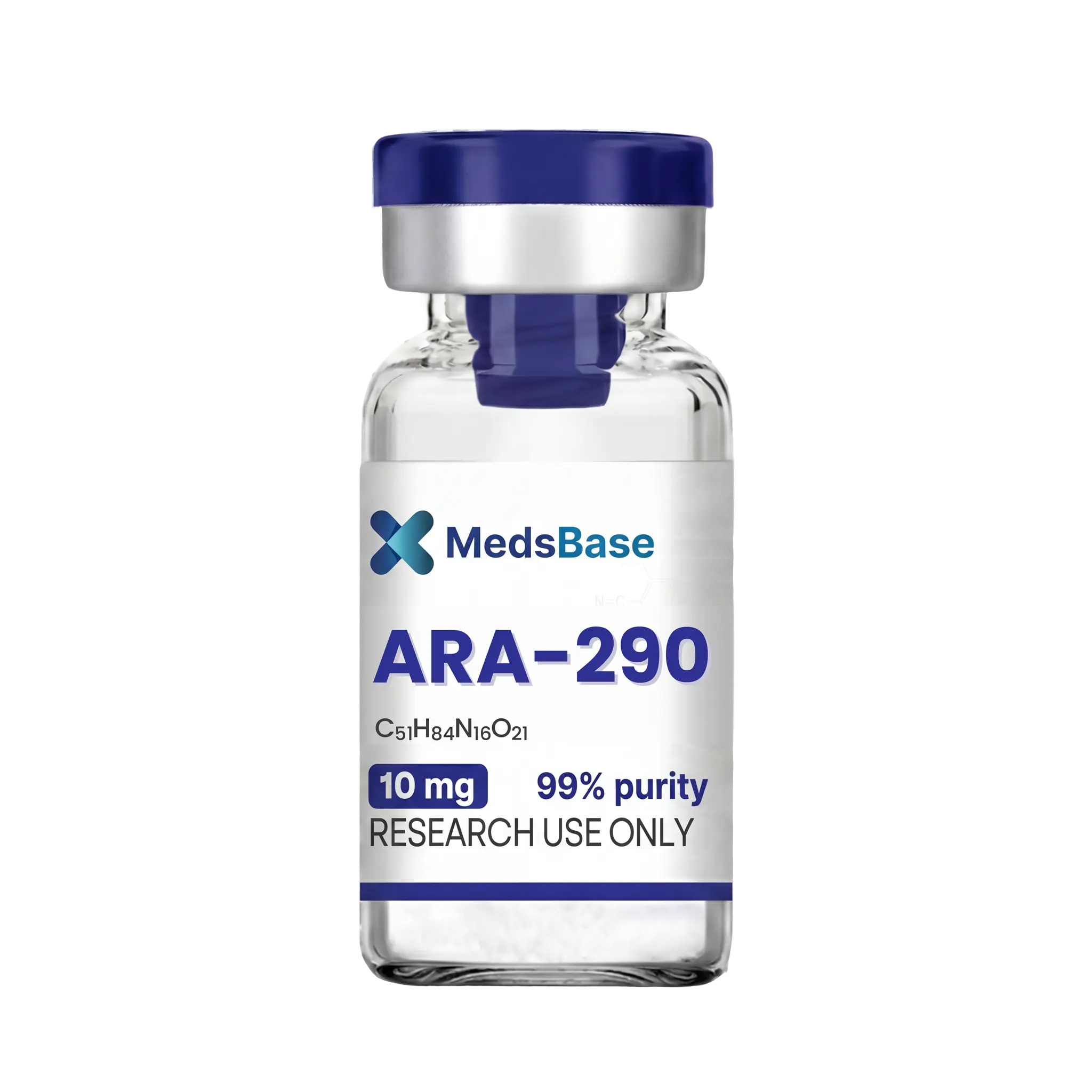
ARA-290 bevat synthetisch peptideverbinding.
✓ Medisch beoordeeld door Morgan Ellis — Apotheekonderzoeker · 8 jaar ervaring · Laatst beoordeeld: mei 2026
Snelle vraag — Wat is ARA-290?
ARA-290 (cibinetide; Helix B Surface Peptide, HBSP) is een synthetisch peptide van 11 aminozuren, afgeleid van helix B van erytropoëtine (EPO). Ontworpen door Brines & Cerami om de cytoprotectieve effecten van EPO te scheiden van de erytropoëtische effecten. ARA-290 bindt zich aan de innate repair receptor (IRR) — een heterocomplex van de EPO-receptor en de beta-common receptor (CD131) — en activeert ontstekingsremmende, anti-apoptotische en weefselherstel-signalering zonder de rode celmassa te verhogen. Ontwikkeld door Araim Pharmaceuticals; weesgeneesmiddel-aangewezen voor sarcoïdose-geassocieerde kleine vezelneuropathie. Leverbaar in 10 mg lyofilisatieflacons uitsluitend voor laboratoriumonderzoek.
📦 Elke bestelling is gedekt door onze Reshipment Assurance-beleid — als uw pakket niet binnen 20 werkdagen arriveert, sturen wij het opnieuw.
| Specificatie | Detail |
|---|---|
| CAS-nummer | 1208243-50-8 (cibinetide) |
| Type | Niet-erytropoëtisch synthetisch peptide van 11 aminozuren, afgeleid van helix B van menselijke erytropoëtine (Helix B Surface Peptide, HBSP); agonist van de innate repair receptor (IRR); ontwikkelingscodes ARA-290 / cibinetide (Araim Pharmaceuticals) |
| Molecuulformule | C51H84N16O21 |
| Moleculair gewicht | ~1.257,4 Da |
| Sequentie | H-pyroGlu-Glu-Gln-Leu-Glu-Arg-Ala-Leu-Asn-Ser-Ser-OH (pyrEEQLERALNSS) — lineaire sequentie van 11 residuen die overeenkomt met het water-blootgestelde oppervlak van helix B van menselijke erytropoëtine. Het N-terminale glutamine cycliseert spontaan tot pyroglutamaat (consistent met de gepubliceerde MW van 1.257,4 Da). C-terminus is een vrij zuur; geen disulfidebrug, geen vetzuuracetylering, geen PEGylering. |
| Form | Lyofiliseerd poeder (wit tot off-white) |
| Zuiverheid | ≥99% (HPLC geverifieerd, COA op aanvraag) |
| Opslag | Gevriesdroogd: 2–8 °C (koelkast) voor werkvoorraad; −20 °C voor langdurige opslag van ongeopende flacons. Gereconstitueerd: 2–8 °C, binnen ~14–28 dagen gebruiken. Beschermen tegen licht. Vermijd herhaalde vries-ontdooicycli van de gereconstitueerde oplossing. |
| Oplosbaarheid | Bacteriostatisch water (aanbevolen) of steriel water. Zeer oplosbaar; het ongemodificeerde 11-mer lost snel op bij zachtjes zwenken. |
| Onderzoeksgebruik | Alleen voor laboratoriumonderzoek. Niet voor humaan of veterinair diagnostisch of therapeutisch gebruik. |
Wat Is ARA-290?
ARA-290 (cibinetide) is een lineair synthetisch peptide van 11 aminozuren dat overeenkomt met het waterblootgestelde oppervlak van helix B van humaan erytropoëtine (EPO) — een regio van het EPO-molecuul die niet betrokken is bij de binding aan de klassieke homodimerische EPO-receptor (EPOR2) die de productie van rode bloedcellen aanstuurt. ARA-290 werd rationeel ontworpen door Michael Brines en Anthony Cerami bij Araim Pharmaceuticals om twee farmacologisch verschillende EPO-activiteiten te ontkoppelen die historisch verweven waren in een enkel molecuul: erytropoëse (het hematocrietverhogende effect dat het gebruik van EPO als weefselbeschermend middel beperkt vanwege het risico op trombo-embolie) en weefselbescherming (de ontstekingsremmende, anti-apoptotische en herstelbevorderende effecten die worden gemedieerd door een afzonderlijke heteromere receptor).
Door de peptidevolgorde te beperken tot het oppervlak van helix B, behoudt ARA-290 affiniteit voor de aangeboren herstelreceptor (IRR) — een heterocomplex bestaande uit de EPO-receptor (EPOR)-subeenheid en de beta-common receptor (βcR, CD131; de gedeelde signaalsubeenheid van de GM-CSF-, IL-3- en IL-5-receptoren) — terwijl de binding aan de EPOR2 homodimeer verantwoordelijk voor erytropoëse wordt opgeheven. Het netto-effect is een peptide dat de cytoprotectieve, ontstekingsremmende en neuroprotectieve effecten van EPO in weefsel produceert zonder het hematocriet te verhogen of de trombo-embolische en hypertensieve risico's met zich mee te brengen die het therapeutische gebruik van EPO beperken.
ARA-290 heeft een korte plasmahalfwaardetijd van ongeveer 2 minuten — het molecuul wordt snel opgeruimd — maar het biologische effect houdt 24–72 uur aan door downstream-activering van cytoprotectieve signaalcascades (JAK2/STAT3, PI3K/Akt, upregulatie van anti-apoptotische Bcl-2-familie). Dit farmacokinetische profiel is kenmerkend voor receptor-geactiveerde peptiden waarbij de effectduur wordt bepaald door de kinetiek van de signaalcascade en niet door aanhoudende plasmaspiegels. ARA-290 heeft weesgeneesmiddelstatus in de Verenigde Staten en de Europese Unie voor sarcoïdose-geassocieerde small-fiber neuropathie, en is geëvalueerd in meerdere fase 2 klinische onderzoeken voor diabetische neuropathie en sarcoïdose-geassocieerde neuropathische pijn. Het is niet goedgekeurd voor humaan therapeutisch gebruik door de FDA, EMA, MHRA of enige andere grote regelgever. Het onderzoeksgrade ARA-290 dat hier wordt verkocht, wordt geleverd uitsluitend voor laboratoriumonderzoek en is niet bedoeld voor menselijke of veterinaire toediening.
Werkingsmechanisme — Innate Repair Receptor Agonisme Zonder Erytropoëse
Wat ARA-290 farmacologisch onderscheidend maakt, is dat het de cytoprotectieve tak van erytropoëtinesignalering activeert terwijl het de erytropoëtische tak omzeilt. Drie mechanismen zijn gedocumenteerd in gepubliceerd onderzoek:
- Innate repair receptor (IRR) agonisme — EPOR + βcR / CD131 heterocomplex — Onder inflammatoire of hypoxie-gerelateerde letselomstandigheden reguleren weefselcellen de beta-common receptor (βcR, CD131) op en vormen ze een heterocomplex met de EPO-receptor (EPOR). Dit IRR-heterocomplex is het moleculaire doelwit van ARA-290. Binding triggert JAK2-fosforylering en downstream STAT3 / STAT5 / PI3K-Akt-activering, wat leidt tot upregulatie van anti-apoptotische eiwitten (Bcl-2, Bcl-xL), onderdrukking van pro-inflammatoire cytokineproductie (TNF-α, IL-1β, IL-6) en rekrutering van weefselherstelprogramma's. Omdat de IRR lokaal wordt opgereguleerd op plaatsen van letsel of ontsteking in plaats van constitutief tot expressie te komen, fungeert ARA-290 als een contextgebonden agonist die reparatiesignalering specifiek activeert waar dat nodig is.
- Geen binding aan homodimerische EPOR2 — geen erytropoëse — De klassieke erytropoëtische receptor op beenmerg-erytroïde voorlopercellen is een homodimeer van twee EPOR-subeenheden zonder betrokkenheid van CD131. ARA-290 heeft een verwaarloosbare affiniteit voor dit homodimeer, waardoor herhaalde dosering in klinische onderzoeken geen detecteerbare verandering in hemoglobine, hematocriet of reticulocytenaantal veroorzaakt. Dit is het centrale ontwerpkenmerk dat ARA-290 onderscheidt van volledige lengte EPO en van eerder ontwikkelde EPO-analogen (darbepoëtine, CERA) die erytropoëtische activiteit behielden.
- Downstream anti-inflammatoire en weefselherstel-effecten — In preklinisch en klinisch onderzoek vermindert ARA-290 de productie van pro-inflammatoire cytokines door geactiveerde macrofagen, verlaagt het neuropathische pijnscores in small-fiber neuropathiemodellen, versnelt het hoornvlieswondgenezing, vermindert het ischemie-reperfusieletsel in renale en cardiale modellen, en verbetert het de glykemische controle in preklinische modellen van diabetes type 2. De breedte van het effect weerspiegelt de brede weefseldistributie van de IRR onder inflammatoire omstandigheden in plaats van een weefselspecifiek mechanisme.
De korte plasmahalfwaardetijd (~2 minuten) gecombineerd met een aanhoudend biologisch effect (24–72 uur) betekent dat ARA-290-onderzoeksprotocollen typisch dagelijkse of om de dag dosering gebruiken ondanks de snelle moleculaire klaring — de farmacodynamische duur wordt bepaald door de downstream-signaalcascade, niet door plasmablijftijd. Subcutane toediening is de standaard onderzoeksroute en de route die wordt gebruikt in klinische ontwikkeling.
Gepubliceerde onderzoeksapplicaties
ARA-290 wordt gebruikt in laboratoriumonderzoekcontexten die onderzoeken:
- Onderzoek naar diabetische neuropathie en small-fiber neuropathie — beoordeling van de dichtheid van cornea-zenuwvezels, intra-epidermale zenuwvezeldichtheid (IENFD), scoring van neuropathische pijn; belangrijk klinisch onderzoeksgebied, met fase 2-studies bij type 2 diabetische neuropathie die verbetering laten zien in zenuwvezelregeneratie en pijnscores
- Small-fiber neuropathie geassocieerd met sarcoïdose — de indicatie waarvoor ARA-290 de status van weesgeneesmiddel heeft in de VS en EU; preklinisch en fase 2-onderzoek in granulomateuze ontstekingsmodellen
- Onderzoek naar neuropathische pijn — chemotherapie-geïnduceerde perifere neuropathie, postoperatieve neuropathie, mechanistische analyse van IRR-gemedieerde pijnpaden
- Onderzoek naar ischemie-reperfusieletsel — renale, cardiale en cerebrale ischemie-reperfusiemodellen; karakterisering van anti-apoptotische en anti-inflammatoire effecten
- Onderzoek naar ontsteking en aangeboren immuniteit — macrofaagpolarisatie, cytokine-onderdrukkingsassays, analyse van IRR-afhankelijke versus IRR-onafhankelijke signaalroutes
- Metabool onderzoek bij type 2 diabetes — glykemische controle, behoud van bètacellen, vergelijking met insuline-sensibiliserende mechanismen
- Onderzoek naar cornea-wondgenezing en oogheelkunde — snelheid van cornea-epitheelwondsluiting, zenuwvezelregeneratie in het hoornvlies (een van de meest dicht geïnnerveerde weefsels en een gevoelige parameter voor IRR-gemedieerd herstel)
Voor een bredere context over gerelateerde anti-inflammatoire en weefselherstel-peptiden, zie BPC-157 (maagpeptide-afgeleid MSK/GI-weefselherstel), TB-500 (Thymosine Beta-4 fragment, breed weefselherstel), en KPV (α-MSH-afgeleid ontstekingsremmend tripeptide). Bekijk het volledige onderzoekspeptiden catalogus voor gerelateerde verbindingen.
Beschikbare sterktes en concentraties
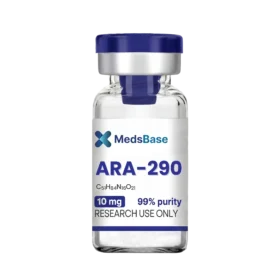
MedsBase stocks ARA-290 in 10 mg lyophilized vials calibrated to typical research protocol lengths. Available in 10-vial, 20-vial, or 30-vial pack formats with full reconstitution guidance:
| Vulsterkte | Typisch Onderzoeksgebruik | Verpakkingsgroottes |
|---|---|---|
| 10 mg | Standaard onderzoekssterkte — meerweekse protocollen voor diabetische neuropathie, ischemie-reperfusie, hoornvliesherstel en ontstekingsmodellen; laagste kosten per mg | 10, 20 of 30 vialen |
Klinische fase 2-doseringen in gepubliceerde onderzoeken zijn 4 mg subcutaan dagelijks voor diabetische neuropathie en sarcoïdose-geassocieerde neuropathie, dus een enkele 10 mg onderzoeksflacon vertegenwoordigt een meerdaagse voorraad van klinisch-equivalente dosering voor in-vivo werk. ARA-290 wordt geleverd als de ongemodificeerde lineaire 11-mer — er is geen acylketen, geen PEGylatie, geen disulfidebrug en reconstitutie is eenvoudig in vergelijking met langere of gemodificeerde peptiden.
Hoe het zich verhoudt — ARA-290 vs BPC-157
ARA-290 en BPC-157 worden beide gebruikt in onderzoek naar weefselherstel en ontstekingsremming, maar de twee peptiden richten zich op volledig verschillende moleculaire mechanismen. ARA-290 is een EPO-afgeleide agonist van de aangeboren reparatiereceptor die JAK2/STAT3 cytoprotectieve signalering stimuleert. BPC-157 is een synthetisch stabiel maagpentadecapeptide van 15 aminozuren, afgeleid van een fragment van het menselijke maagsapeiwit BPC, dat werkt via een complex multi-pathway mechanisme inclusief stikstofoxidesynthase-modulatie, VEGF-upregulatie en groeifactorreceptor-cross-talk.
| Criterium | ARA-290 | BPC-157 |
|---|---|---|
| Oorsprong | Helix B van humaan erytropoëtine (HBSP) | Fragment van humaan maagsapeiwit BPC |
| Lengte | 11 aminozuren | 15 aminozuren |
| Receptor / doelwit | Aangeboren reparatiereceptor (EPOR + βcR / CD131) | Multi-pathway: NO-synthase, VEGF, groeifactor-cross-talk |
| Primair onderzoeksweefsel | Perifere zenuw, hoornvlies, ischemisch weefsel, ontstoken weefsel | Pezen, ligamenten, darmslijmvlies, spieren |
| Erytropoëtisch effect | Geen (belangrijk ontwerpkenmerk) | N.v.t. (geen EPO-pathwaypeptide) |
| Plasma-halfwaardetijd | ~2 minuten (effect houdt 24–72 uur aan) | ~30 minuten (orale biologische beschikbaarheid beweerd in preklinisch onderzoek) |
| Klinische ontwikkeling | Fase 2 (diabetische neuropathie, sarcoïdose SFN); weesgeneesmiddelstatus | Alleen preklinisch (geen klinische onderzoeken door grote regelgevers) |
| Modificatie | Ongewijzigd lineair 11-mer | Ongewijzigd lineair 15-mer (stabiel acetaat of arginaat zout) |
Voor onderzoek gericht op neuropathische pijn, regeneratie van perifere zenuwen of IRR-gemedieerde cytoprotectie is ARA-290 het gerichte referentiepeptide. Voor onderzoek gericht op musculoskeletale pees-/ligamentherstel of gastro-intestinale mucosale genezing, BPC-157 blijft het meest bestudeerde optie. De twee peptiden worden soms gecombineerd in onderzoeksprotocollen die gericht zijn op het activeren van complementaire herstelroutes in zowel CNS/perifere zenuwweefsel als bindweefsel. Zie ook TB-500 (Thymosine Beta-4 fragment, brede benchmark voor weefselherstel) en KPV (α-MSH-afgeleid anti-inflammatoir tripeptide).
Opslag en Reconstituering
Voor reconstituering: bewaar lyofilisatieflacons gekoeld bij 2–8 °C in de originele verpakking voor kortdurende werkvoorraad. Voor ongebruikte langdurige opslag, vries in bij −20 °C. Lyofiliseerde ARA-290 is stabiel onder koeling tot 24 maanden en bij −20 °C tot 36 maanden. Vermijd vries-dooicycli op het lyofilisatiepoeder. ARA-290 is een ongewijzigd lineair peptide zonder disulfidebrug of acylketen, waardoor de omgang eenvoudiger is in vergelijking met structureel complexe peptiden zoals cagrilintide of semaglutide.
Reconstitueringsprocedure: injecteer bacteriostatisch water langs de zijkant van de flacon (niet direct op de lyofilisatiecake). Voor een 10 mg flacon levert 2,0 mL bacteriostatisch water een werkconcentratie van 5 mg/mL — 0,08 mL levert 400 mcg (een dosis van 1 mg vereist 0,2 mL); 0,8 mL levert een klinisch-equivalente onderzoeksdosis van 4 mg. Draai voorzichtig — schud niet krachtig, omdat schuimen lucht insluit en peptideketens kan denatureren. Laat het poeder volledig oplossen (meestal <1 minuut voor ARA-290) voordat u onttrekt. Na reconstitutie bewaart u de flacon bij 2–8 °C en gebruikt u deze binnen 14–28 dagen. Bescherm tegen licht. Gooi weg als troebelheid, deeltjes of kleurverandering optreedt.
Veelgestelde vragen
Is ARA-290 een EPO-analoog? Verhoogt het hematocriet?
ARA-290 is afgeleid van helix B van erytropoëtine, maar het is specifiek ontworpen om niet hematocriet te verhogen. Het klassieke erytropoëtische effect van EPO wordt gemedieerd door de homodimerische EPO-receptor (EPOR2) op beenmergerytroïde voorlopercellen. ARA-290 bindt in plaats daarvan aan de heteromere innate repair receptor (EPOR + βcR/CD131) en heeft verwaarloosbare affiniteit voor EPOR2. Gepubliceerde fase 2-onderzoeken tonen geen verandering in hemoglobine, hematocriet of reticulocytenaantal na herhaalde dosering.
Wat is de aangeboren reparatiereceptor (IRR)?
De aangeboren reparatiereceptor is een heterocomplex van de EPO-receptor (EPOR) subunit en de beta-common receptor (βcR, ook bekend als CD131 — de gedeelde signaal subunit van de GM-CSF, IL-3 en IL-5 receptoren). De IRR wordt lokaal opgereguleerd in gestresste, beschadigde of ontstoken weefsels in plaats van constitutief tot expressie te komen, wat verklaart waarom ARA-290 werkt als een context-gebonden weefselreparatiesignaal in plaats van een systemische agonist.
Waarom wordt ARA-290 ook wel cibinetide genoemd?
ARA-290 is de ontwikkelingscode toegekend door Araim Pharmaceuticals (de oorspronkelijke ontwikkelaar). Cibinetide is de INN (internationale niet-propriëtaire naam) die later is toegekend voor klinische studies en regelgevende contexten. De twee namen verwijzen naar hetzelfde 11-aminozuur peptide (CAS 1208243-50-8).
Waarom is de plasma-halfwaardetijd zo kort in verhouding tot de werkingsduur?
ARA-290 heeft een plasma-halfwaardetijd van ongeveer 2 minuten — het peptide wordt snel uit de circulatie verwijderd — maar het biologische effect houdt 24–72 uur aan door downstream activatie van JAK2/STAT3, PI3K/Akt en anti-apoptotische Bcl-2-familie signaalcascades. Dit farmacokinetische profiel is typisch voor receptor-geactiveerde peptiden waarbij de duur wordt bepaald door de kinetiek van de signaalcascade in plaats van door aanhoudende plasmaspiegels.
Hoe verhoudt ARA-290 zich tot BPC-157 voor onderzoek naar weefselherstel?
Beide peptiden worden gebruikt in onderzoek naar weefselherstel maar richten zich op verschillende mechanismen en verschillende weefsels. ARA-290 werkt via de aangeboren reparatiereceptor (EPOR + CD131) en is het best gekarakteriseerd in onderzoek naar perifere zenuwen, hoornvlies en ischemisch weefsel. BPC-157 werkt via een multi-pathway mechanisme dat betrokken is bij modulatie van stikstofoxidesynthase en upregulatie van VEGF, en is het best gekarakteriseerd in onderzoek naar pezen, ligamenten, darmslijmvlies en spieren. Sommige protocollen combineren de twee peptiden om complementaire reparatiepaden te activeren.
Wat is sarcoïdose-geassocieerde small-fiber neuropathie en waarom heeft ARA-290 een weesgeneesmiddelstatus hiervoor?
Sarcoïdose is een granulomateuze ontstekingsziekte die bij een aanzienlijk deel van de getroffen patiënten een invaliderende kleinevezelneuropathie (SFN) veroorzaakt. ARA-290 heeft een weesgeneesmiddelstatus van de Amerikaanse FDA en de Europese EMA voor SFN geassocieerd met sarcoïdose, wat de zeldzaamheid van de indicatie en het ontbreken van andere gerichte behandelingen weerspiegelt. De weesgeneesmiddelstatus ondersteunt klinisch onderzoek maar betekent geen goedkeuring — ARA-290 is op dit moment nog in onderzoeksfase.
Wat is de standaard onderzoeksdosis voor ARA-290?
Gepubliceerde fase 2-klinische onderzoeken hebben 2–4 mg subcutaan dagelijks gebruikt voor diabetische neuropathie en SFN geassocieerd met sarcoïdose. Preklinische dierstudies hebben bredere doseringsbereiken gebruikt, afhankelijk van het model en weefsel. Onderzoekers moeten doseringsbereiken bepalen op basis van peer-reviewed literatuur die passend is voor hun specifieke protocol.
Vereist ARA-290 speciale behandeling vanwege disulfide- of acylmodificaties?
Nee. ARA-290 is een ongemodificeerd lineair 11-aminozuurpeptide zonder disulfidebrug, zonder vetzureacylering en zonder PEGylering. Reconstituering en hantering zijn eenvoudig — voorzichtig zwenken lost het lyofiliseerde poeder op binnen ~1 minuut. Vergelijk dit met structureel complexe peptiden zoals cagrilintide (acylketen + disulfide), semaglutide (acylketen) of insulineklasse-peptiden waarbij reconstituering langere equilibritatie vereist.
Meer opties in Peptiden
Gerangschikt op recente bestelvolumes van MedsBase — wat andere klanten in deze categorie kiezen.
| Sterkte | 10 mg |
|---|---|
| Hoeveelheid | 10 flacons, 20 flacons, 30 flacons |
 ARA-290 (Cibinetide)
Vragen & antwoorden
ARA-290 (Cibinetide)
Gerelateerde producten
Beoordelingen
Er zijn nog geen beoordelingen