







HGH 191AA
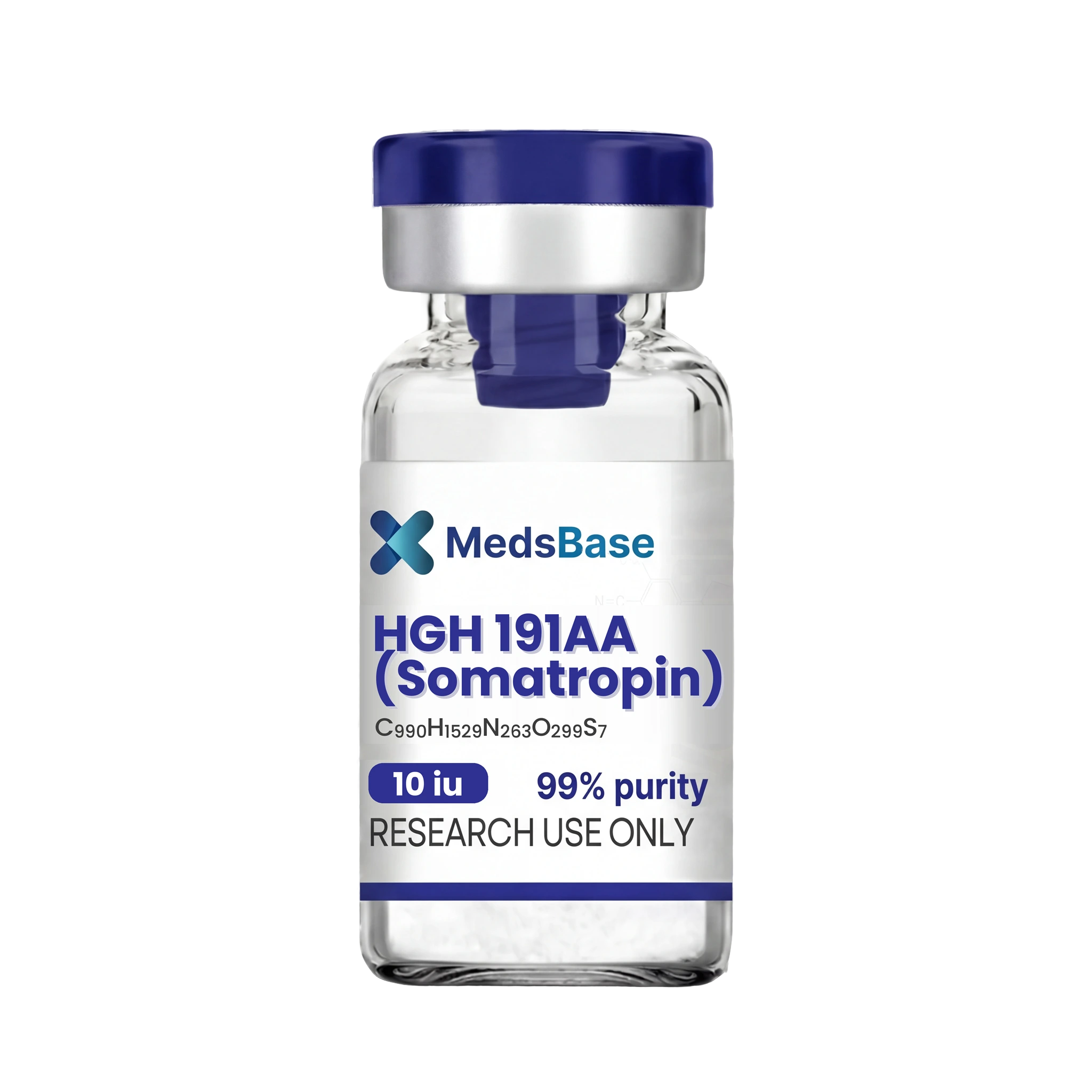
✅ Recombinant humaan groeihormoon met 191 aminozuren (somatropine)
✅ Menselijke oorspronkelijke sequentie — moderne farmaceutische kwaliteit
✅ Directe GH-receptoragonist (~22 kDa)
✅ Standaard ~3 IE per mg conversie
✅ ≥98% HPLC zuiverheid, COA op aanvraag
HGH 191AA is een recombinant eiwit.
✓ Medisch beoordeeld door Morgan Ellis — Apotheekonderzoeker · 8 jaar ervaring · Laatst beoordeeld: mei 2026
Snelle vraag — Wat is HGH 191AA?
HGH 191AA is recombinant humaan groeihormoon in zijn volledige 191-aminozuur native sequentievorm (somatropine), een 22-kDa hypofyse peptidehormoon geproduceerd door recombinant DNA-technologie om exact overeen te komen met het endogene humane GH-polypeptide. Het werkt direct in op de groeihormoonreceptor (GHR) om JAK2/STAT5-signalering te activeren en hepatische IGF-1-productie te stimuleren. Dit is de moderne farmaceutische kwaliteitsvorm (191AA) in tegenstelling tot de verouderde bacteriële 192AA recombinant variant. Leverbaar in 10–40 IU lyofiliseerbare flesjes uitsluitend voor laboratoriumonderzoek.
📦 Elke bestelling is gedekt door onze Reshipment Assurance-beleid — als uw pakket niet binnen 20 werkdagen arriveert, sturen wij het opnieuw.
| Specificatie | Detail |
|---|---|
| CAS-nummer | 12629-01-5 (somatropine) / 96827-07-5 (recombinant somatropine) |
| Type | Recombinant eiwit — 191-aminozuur native humane groeihormoonsequentie (somatropine); INN: somatropine |
| Moleculair gewicht | 22.124 Da (~22 kDa) |
| Structuur | 191-aminozuur enkele polypeptideketen gevouwen in een canonieke vier-helix bundel topologie, gestabiliseerd door twee intramoleculaire disulfidebruggen (Cys53–Cys165 en Cys182–Cys189). De 191AA-aanduiding onderscheidt de moderne farmaceutische kwaliteitsvorm van de verouderde 192AA bacteriële-recombinant variant die een extra N-terminale methionine bevatte. |
| Eenheidactiviteit | Ongeveer 3 IE per mg recombinant 191AA HGH (internationale eenheden, WHO-standaard) |
| Form | Gevriesdroogd recombinant eiwit (wit tot off-wit poeder) |
| Zuiverheid | ≥98% (HPLC-geverifieerd, COA op verzoek) |
| Opslag | Gevriesdroogd: 2–8 °C (koelkast) voor werkvoorraad; −20 °C voor langdurige opslag van ongeopende flesjes. Gereconstitueerd: 2–8 °C, gebruik binnen ~14 dagen. Bescherm tegen licht. Vries de gereconstitueerde oplossing niet in en ontdooi deze niet - recombinant eiwitten zijn bijzonder gevoelig voor denaturatie door vries-ontdooicycli. |
| Oplosbaarheid | Bacteriostatisch water (aanbevolen). Dragerproteïne (BSA, 0,1%) optioneel voor werkverdunningen om adsorptieverliezen te minimaliseren. |
| Onderzoeksgebruik | Alleen voor laboratoriumonderzoek. Niet voor humaan of veterinair diagnostisch of therapeutisch gebruik. |
Wat Is HGH 191AA?
HGH 191AA is recombinant humaan groeihormoon (somatropine) in de 191-aminozuur native humane sequentievorm. Het wordt geproduceerd met recombinant DNA-technologie en komt exact overeen met het endogene humane GH-polypeptide - dezelfde 191 aminozuren, dezelfde vier-helix bundel driedimensionale structuur, dezelfde twee intramoleculaire disulfidebindingen bij Cys53–Cys165 en Cys182–Cys189. De 191AA-aanduiding onderscheidt specifiek de moderne farmaceutische kwaliteit recombinant vorm van de oudere 192AA-variant geproduceerd in bacteriële expressiesystemen, die een extra N-terminale methionine bevatte die kleine antigeniciteitsverschillen introduceerde en grotendeels is uitgefaseerd in onderzoek en klinisch gebruik.
HGH is het belangrijkste peptidehormoon dat wordt uitgescheiden door somatotrofe cellen van de anterieure hypofyse in episodische pulsen, met piekamplitudes tijdens vroege slow-wave slaap en na intense inspanning. Endogene secretie wordt upstream gereguleerd door hypothalamische GHRH (positief) en somatostatine (negatief). De recombinant 191AA-vorm heeft een empirisch molecuulgewicht van 22.124 Da, INN somatropine, CAS-nummer 12629-01-5 voor het native eiwit en 96827-07-5 voor de recombinant vorm. Standaard eenheidactiviteit voor recombinant 191AA HGH is ongeveer 3 IE per mg volgens de WHO International Standard. De verbinding wordt geleverd als een hoogzuiver gevriesdroogd poeder voor reconstitutie met bacteriostatisch water. HGH is het strengst gereguleerde van alle peptiden in veel rechtsgebieden en is alleen op recept goedgekeurd voor specifieke medische indicaties (pediatrische GH-deficiëntie, volwassen GH-deficiëntie, Turner-syndroom, idiopathische kleine gestalte, AIDS-wasting, short bowel-syndroom). Het onderzoekskwaliteit HGH 191AA dat hier wordt verkocht is bedoeld uitsluitend voor laboratoriumonderzoek en is niet bedoeld voor menselijke of veterinaire toediening. Voor peptiden die endogene GH-afgifte stimuleren in plaats van exogene GH te leveren, zie onze Sermorelin, CJC-1295 met DAC, en Ipamorelin productpagina's.
Werkingsmechanisme - Groeihormoonreceptor Signalering en de GH/IGF-as
Wat HGH 191AA mechanistisch onderscheidend maakt onder onderzoekspeptiden is dat het de directe exogene ligand is voor de groeihormoonreceptor - geen analoog, geen secretagoog, maar het native polypeptide zelf. De downstream signaalcascade is gekarakteriseerd in decennia van gepubliceerd onderzoek:
- Groeihormoonreceptor (GHR) binding en homodimerisatie — HGH bindt met hoge affiniteit aan een enkele GHR-molecule en induceert homodimerisatie met een tweede receptorunit, waardoor het bioactieve 1:2 ligand-receptorcomplex wordt gevormd. De gedimeriseerde receptor recruteert het cytoplasmatische Janus kinase 2 (JAK2) naar het intracellulaire receptorboxmotief, wat leidt tot trans-fosforylering van JAK2 en de receptor zelf. Dit is het canonieke Type I cytokine-receptoractiveringsmechanisme.
- JAK2/STAT5 transcriptiefactoractivatie — Gefosforyleerd JAK2 fosforyleert Signal Transducer and Activator of Transcription 5 (STAT5), voornamelijk STAT5b, dat vervolgens dimeert en naar de kern translokeert waar het bindt aan GH-responsieve genpromotors. Het dominante transcriptionele resultaat is inductie van IGF-1 (Insulin-like Growth Factor 1) expressie in hepatocyten — de belangrijkste endocriene effector van GH’s perifere groeibevorderende effecten. Andere GH-responsieve genen omvatten SOCS-eiwitten (negatieve feedback), CIS, en een programma van lever-eiwitsynthesegenen.
- Directe en indirecte (IGF-1-gemedieerde) weefseleffecten — GH heeft twee hoofdwerkingsmechanismen. Directe effecten: lipolyse in adipocyten, glucose-tegenregulerende effecten die insuline tegenwerken in spier- en leverweefsel, en directe anabole signalering in GHR-exprimerende weefsels waaronder chondrocyten (in onderzoek naar groeischijven van lange botten) en immuuncellen. Indirecte effecten via IGF-1: hepatisch IGF-1 werkt in op de IGF-1-receptor op vrijwel elk celtype om Akt/mTOR-gemedieerde eiwitsynthese, celproliferatie en overlevingssignalering te stimuleren. De onderzoeksverbinding IGF-1 LR3 is het canonieke directe-IGF-receptorgereedschap dat wordt gebruikt om directe GH-effecten te onderscheiden van IGF-1-gemedieerde downstream-effecten.
HGH heeft een relatief korte plasmahalfwaardetijd (~3–5 uur na subcutane toediening van het native eiwit) vanwege renale filtratie en proteolytische klaring. Het pulserende patroon van endogene secretie is een kenmerkend aspect van de GH-as — continue blootstelling aan GH produceert andere downstream genexpressiepatronen dan pulserende blootstelling, een belangrijk aandachtspunt bij het ontwerpen van onderzoeksprotocollen. Subcutane toediening is de standaard onderzoeksroute. Voor onderzoek naar het endogene pulspatroon worden secretagogen zoals Sermorelin, CJC-1295, en Ipamorelin het natuurlijke pulserende signatuur behouden; voor directe GH-receptorfarmacologie biedt exogene HGH een schonere stimulus.
Gepubliceerde onderzoeksapplicaties
HGH 191AA wordt gebruikt in laboratoriumonderzoeken die zich richten op:
- Farmacologie van de groeihormoonas — directe GHR-signalering, JAK2/STAT5-fosforyleringskinetiek, downstream IGF-1-inductie; canoniek onderzoekspeptide voor de GH-kant van de GH/IGF-1-as
- IGF-1-inductieonderzoek — hepatische IGF-1-genexpressie, dynamiek van circulerend IGF-1, regulatie van IGF-bindende eiwitten (IGFBP); vergelijkingsmateriaal voor IGF-1 LR3-gebaseerd onderzoek dat de GH-stap omzeilt
- Anabole signaleringsonderzoek — skeletspiereiwitsynthese via Akt/mTOR (voornamelijk IGF-1-gemedieerd), signalering van chondrocyten in de botgroeiplaat, lipolyse in vetweefsel
- Hepatisch metabolismeonderzoek — leverglucose-output, lipidemetabolisme, hepatocytspecifieke transcriptierespons op GH-stimulatie
- Preklinische modellen van GH-deficiëntie — reddingsstudies bij hypofysectomiseerde knaagdieren, Snell dwerg- en Ames dwergmuismodellen, karakterisering van transgene GHR-knockout
- Slaap- en circadiaan onderzoek — relatie tussen slaaparchitectuur en pulserende GH-secretie, GH-afhankelijkheid van slow-wave-slaap
- Vergelijkend onderzoek naar de GH-as — benchmarken tegen GHRH-analogen (Sermorelin, CJC-1295) en groeihormoonsecretagogen (Ipamorelin, GHRP-6, GHRP-2) die endogene GH-pulsen produceren in plaats van exogene GH-vervanging
- Onderzoek naar weefselregeneratie en wondgenezing — gepubliceerde literatuur over GH-effecten in brandwondmodellen, chirurgisch herstel en weefselregeneratie; relatie met TB-500 en BPC-157 onderzoek naar genezende peptiden
- Endocrinologie en verouderingsonderzoek — somatopauze en leeftijdsgerelateerde GH-afname, vergelijkende studies van GH-vervanging versus GH-as-stimulatie in verouderingsonderzoeksmodellen.
Voor een bredere context over waar HGH 191AA past binnen het landschap van groeias-peptiden, zie Sermorelin en CJC-1295 met DAC als de GHRH-as-vergelijkingen, Ipamorelin als het selectieve GHS-vergelijkingselement, en IGF-1 LR3 als de downstream IGF-receptoragonist. Bekijk het volledige onderzoekspeptiden catalogus voor gerelateerde verbindingen.
Beschikbare sterktes en concentraties
MedsBase stocks HGH 191AA in five lyophilized vial sizes calibrated by international units (IU). Each strength is available in 10-vial, 20-vial, or 30-vial pack formats with full reconstitution guidance:
| Vialsterkte (IU) | Geschatte massa | Typisch Onderzoeksgebruik | Verpakkingsgroottes |
|---|---|---|---|
| 10 IU | ~3,3 mg | Pilotdosering, lage titratie, kortdurende protocollen | 10, 20 of 30 vialen |
| 15 IU | ~5 mg | Standaard onderzoekssterkte, middelmatige titratie-arm | 10, 20 of 30 vialen |
| 24 IU | ~8 mg | Onderzoek met verlengde cyclus, hogere dosis titratie-arm | 10, 20 of 30 vialen |
| 36 IU | ~12 mg | Meerweekse protocollen uit één flesje, lagere reconstitutievolume per dosis | 10, 20 of 30 vialen |
| 40 IE | ~13,3 mg | Onderzoeksfles in bulk, laagste kosten per IE, studies met meerdere cohorten | 10, 20 of 30 vialen |
Alle vijf sterktes hebben dezelfde chemische vorm (gevriesdroogd recombinant 191AA somatropine, ≥98% HPLC zuiverheid). De IE-labelingconventie is de standaard voor HGH-onderzoek en klinische literatuur; de geschatte mg-equivalenten worden verstrekt voor onderzoekers die de dosering afstemmen op mg-gebaseerde literatuur. Flesjes met hogere IE vereisen kleinere reconstitutievolumes per eenheidsdosis, wat nuttig is voor het minimaliseren van injectievolume bij knaagdierprotocollen of het uitvoeren van langdurige studies vanuit één flesje.
Vergelijking — HGH 191AA vs Sermorelin
HGH 191AA en Sermorelin vertegenwoordigen de twee tegenovergestelde farmacologische benaderingen van GH-asonderzoek: exogene GH-vervanging versus endogene GH-stimulatie. De vergelijking is een van de meest aangehaalde in het ontwerp van groei-asonderzoek omdat de twee benaderingen verschillende onderzoeksvragen beantwoorden en kwalitatief verschillende downstream fenotypes produceren.
| Criterium | HGH 191AA | Sermorelin |
|---|---|---|
| Wat het is | Exogene GH zelf (recombinant) | GHRH(1-29) analoog — stimuleert endogene GH |
| Lengte | 191 aminozuren (~22 kDa) | 29 aminozuren (~3 kDa) |
| Werkingsmechanisme | Directe GHR-agonisme (vervanging) | Hypothalamische GHRH-receptoragonisme (stimulatie) |
| GH-puls patroon | Tonische blootstelling na elke injectie | Pulsatieel (behoudt natuurlijk ritme) |
| Negatieve feedback | Omzeild (onderdrukt endogene somatotrofen) | Behouden (somatostatine blijft actief) |
| Plasma-halfwaardetijd | ~3–5 uur (SC) | ~10–20 minuten (zeer kort) |
| Goedgekeurd klinisch gebruik | Meerdere goedgekeurde indicaties (Genotropin, Humatrope, Norditropin, etc.) | Historische FDA-goedkeuring voor pediatrische GHD (Geref); stopgezet |
| Typische onderzoeksdosis | 1–8 IE per toediening | 100–500 mcg per toediening |
Voor onderzoek gericht op directe GHR-farmacologie, IGF-1 inductiekinetiek, of het vervangen van GH bij deficiëntiemodellen, is HGH 191AA het standaard onderzoeksinstrument omdat het de exogene ligand direct levert. Voor onderzoek gericht op fysiologische pulsatiele GH-dynamiek, hypothalamisch-hypofyse-asfarmacologie, of elk protocol waarbij het behoud van de natuurlijke somatostatine feedbackloop van belang is, Sermorelin (en de gerelateerde CJC-1295 met DAC) bieden de upstream-stimulatie-alternatief. Veel gepubliceerde onderzoeksopzetten gebruiken beide in parallelle armen om directe GH-effecten te onderscheiden van secretagoge-gestimuleerde endogene GH-effecten.
Opslag en Reconstituering
Voor reconstituering: bewaar lyofiliseerde flesjes gekoeld bij 2–8 °C in de originele verpakking voor kortdurende werkvoorraad. Voor ongebruikte langdurige opslag, vries in bij −20 °C. Lyofiliseerd recombinant HGH is stabiel onder koeling tot 24 maanden en bij −20 °C tot 36 maanden. De vier-helix-bundel vouwtoestand blijft behouden in de lyofiliseerde vorm. Vermijd vries-ontdooicycli met het lyofiliseerde poeder.
Reconstitueringsprocedure: spuit bacteriostatisch water langs de zijkant van het flesje (niet direct op de gevriesdroogde cake). Aanbevolen reconstitutievolumes variëren per flesjestrekking — voor een flesje van 10 IU levert 1,0 mL bacteriostatisch water een werkconcentratie van 10 IU/mL op; voor een flesje van 36 IU levert 1,5 mL een concentratie van 24 IU/mL op. Draai voorzichtig — doe niet Schud — en laat 5–10 minuten staan voor volledige oplossing. Recombinante eiwitten lossen langzamer op dan kleine peptiden; forceer het oplossingsproces niet. Krachtig schudden kan de vier-helix bundelstructuur verstoren en de activiteit verminderen. Een correct gereconstitueerde oplossing moet helder en kleurloos zijn zonder zichtbare deeltjes.
Na reconstitutie: Bewaar gekoeld bij 2–8 °C en gebruik binnen 14 dagen voor optimale stabiliteit — iets korter dan de 30-dagen termijn voor kleinere synthetische peptiden omdat het grotere vier-helix-bundel eiwit gevoeliger is voor verliezen door oppervlakte-adsorptie en langzame deamidering. Vries de gereconstitueerde oplossing niet in — vries-ontdooicyclus veroorzaakt aggregatie en verlies van biologische activiteit. Gooi elke fles weg die troebelheid, neerslag of verkleuring vertoont. Voor langdurige werkverdunningen onder 0,1 mg/mL (~0,3 IE/mL) minimaliseert dragerproteïne (BSA in een eindconcentratie van 0,1%) adsorptieverliezen.
Veelgestelde vragen
Waar wordt HGH 191AA voor gebruikt in onderzoek?
HGH 191AA wordt gebruikt in laboratoriumonderzoek naar directe groeihormoonreceptorfarmacologie, JAK2/STAT5-signalering, hepatische IGF-1-inductie, anabole signalering in spieren en botten, hepatisch metabolisme, relaties tussen slaap en groeihormoonas, preklinische modellen van groeihormoondeficiëntie, en vergelijkende farmacologie van de groeihormoonas met GHRH-analogen en groeihormoonsecretagogen. Het is het standaard exogene GH-onderzoeksmiddel. De onderzoekskwaliteit HGH 191AA die hier wordt verkocht is niet FDA-goedgekeurd voor niet-klinisch menselijk gebruik en wordt uitsluitend geleverd voor laboratoriumonderzoek.
Wat is het verschil tussen HGH 191AA en 192AA?
De 191AA-vorm is de moderne farmaceutische kwaliteit van recombinant humaan groeihormoon dat exact overeenkomt met de natuurlijke menselijke sequentie (191 aminozuren). De 192AA-vorm was een oudere bacterieel-recombinante variant met een extra N-terminale methioninerest (192 aminozuren in totaal) die werd gebruikt in de vroege farmaceutische ontwikkeling voordat zoogdiercel-expressiesystemen standaard werden. Het extra methionine veroorzaakte geringe antigeniciteit bij sommige patiëntenpopulaties en de 192AA-vorm is grotendeels uitgefaseerd in zowel onderzoek als klinisch gebruik. Alle onderzoekskwaliteit HGH van MedsBase is de 191AA-vorm met de natuurlijke sequentie.
Hoe verschilt HGH 191AA van Sermorelin?
HGH 191AA is exogeen groeihormoon zelf — de actieve receptorligand. Sermorelin is een 29-aminozuuranaloog van GHRH (groeihormoonvrijmakend hormoon) dat de hypofyse stimuleert om ENDOGENE GH vrij te geven. De downstream-effecten zijn vergelijkbaar in richting maar kwalitatief verschillend: HGH produceert een tonische GHR-blootstelling na elke injectie en omzeilt de hypofysefeedback, terwijl sermorelin een pulserend GH-vrijgavepatroon produceert en de natuurlijke somatostatinefeedbackregulatie behoudt. Onderzoeksontwerpen gebruiken typisch één van beide, afhankelijk van of de vraag gaat over directe GHR-farmacologie (HGH) of hypothalamisch-hypofyse-as-dynamiek (sermorelin).
Hoe verschilt HGH 191AA van IGF-1 LR3?
HGH 191AA werkt in op de GH-receptor, wat de IGF-1-productie door de lever aandrijft als de belangrijkste downstream-effector. IGF-1 LR3 omzeilt deze stap en werkt direct in op de IGF-1-receptor. Onderzoek met HGH bestudeert de volledige GH/IGF-1-as, inclusief de upstream lever-gemedieerde IGF-1-inductie; onderzoek met IGF-1 LR3 isoleert de IGF-receptorfarmacologie en de directe downstream Akt/mTOR-anabole signalering. Beide verbindingen worden vaak gebruikt in parallelle armen van hetzelfde onderzoeksontwerp om directe GH-effecten te onderscheiden van IGF-1-gemedieerde effecten.
Wat is de typische onderzoeksdosis van HGH 191AA?
Gepubliceerde preklinische onderzoeksdoseringen variëren typisch van 1–8 IE per toediening in knaagdier- en primatenmodellen, subcutaan toegediend eenmaal daags of gepulseerd om endogene secretiepatronen na te bootsen. Een flesje van 10 IE gereconstitueerd met 1,0 mL bacteriostatisch water levert 10 IE/mL — 0,1 mL is gelijk aan 1 IE, 0,2 mL is gelijk aan 2 IE. De conversiefactor is ongeveer 3 IE per mg recombinant 191AA HGH (WHO internationale standaard).
Is HGH 191AA goedgekeurd door de FDA?
Farmaceutisch recombinant 191AA HGH (somatropine) is FDA-goedgekeurd onder meerdere merknamen (Genotropin, Humatrope, Norditropin, Saizen, Omnitrope, Nutropin en anderen) voor specifieke medische indicaties, waaronder pediatrische groeihormoondeficiëntie, volwassen GH-deficiëntie, Turner-syndroom, idiopathische kleine gestalte, AIDS-gerelateerde wasting en short bowel-syndroom — alleen op recept en onder toezicht van een endocrinoloog. De onderzoekskwaliteit HGH 191AA die hier wordt verkocht, is een apart product dat uitsluitend wordt geleverd voor laboratoriumonderzoek en is niet niet door de FDA goedgekeurd voor menselijk of veterinair gebruik. Het is het meest strikt gereguleerde van alle peptiden in veel rechtsgebieden.
Hoe moet HGH 191AA worden opgeslagen?
Gevriesdroogde flesjes: gekoeld bewaren bij 2–8 °C voor kortetermijnwerkvoorraad, of −20 °C voor langdurige opslag van ongeopende flesjes. Gereconstitueerde oplossing: gekoeld bewaren bij 2–8 °C, binnen 14 dagen gebruiken (korter dan typische kleine peptiden omdat de grotere vier-helixbundel gevoeliger is voor oppervlakteadsorptie en langzame deamidatie). Vries de gereconstitueerde oplossing niet in — vries-ontdooicycli veroorzaken aggregatie en verlies van activiteit. Bescherm te allen tijde tegen direct licht.
Hoe moet ik HGH 191AA reconstitueren?
Volg de bovenstaande reconstitueringsprocedure. Voeg bacteriostatisch water langs de zijkant van het flesje toe (niet direct op het lyofilisatiepoeder), draai voorzichtig en laat het 5–10 minuten staan voor volledige oplossing. Schud niet Schud de fles — krachtig schudden kan de vier-helix bundelstructuur verstoren en de biologische activiteit verminderen. Een correct gereconstitueerde oplossing is helder en kleurloos zonder zichtbare deeltjes.
Welke sterktes heeft MedsBase op voorraad?
MedsBase carries HGH 191AA in 10 IU, 15 IU, 24 IU, 36 IU, and 40 IU lyophilized vials. Each strength is available in 10-vial, 20-vial, or 30-vial pack sizes. All vials are supplied at ≥98% HPLC purity with a certificate of analysis available on request.
Waarom wordt HGH gemeten in IU in plaats van mg?
Internationale Eenheden (IU) zijn de standaardmaat voor biologische-activiteitsgebaseerde etikettering van proteïnehormonen, vastgesteld door de WHO International Standard. Voor recombinant 191AA HGH is de conversiefactor ongeveer 3 IU per mg. De IU-etiketteringsconventie heeft de voorkeur omdat het direct verwijst naar biologische potentie in plaats van massa, wat reproduceerbaarder is over verschillende recombinant productiebatches die licht kunnen variëren in glycosyleringsstatus, deamidatieprofiel en vouwtoestandheterogeniteit. Zowel IU als mg zijn geldig; de IU is de dominante eenheid in klinische en onderzoeksliteratuur.
Waarom is de zuiverheidsspecificatie 98% in plaats van 99%?
Recombinante eiwitten zoals HGH kunnen niet altijd de ≥99% HPLC-zuiverheidsstandaard bereiken die typisch is voor kleine synthetische peptiden vanwege inherente heterogeniteit in elk recombinant expressiesysteem — kleine varianten in vouwtoestand, deamidatie-isovormen en andere gerelateerde soorten verschijnen als gerelateerde pieken op HPLC die geen onzuiverheden zijn maar isovormen van het doeleiwit. ≥98% HPLC-zuiverheid is een sterke onderzoeksgraad specificatie voor recombinant 191AA HGH, tussen de 95% die gebruikelijk is voor grotere glycoproteïnen zoals Follistatin 344 en de 99% die gebruikelijk is voor kleine synthetische peptiden.
Veroorzaakt HGH 191AA bijwerkingen in onderzoek?
De belangrijkste doelgerichte effecten van HGH in onderzoeksmodellen zijn anabool en metabool: verhoogde IGF-1-niveaus, toename van vetvrije massa, afname van adipositas, tijdelijke insulineresistentie, natrium- en waterretentie en verhoogde mitogene signalering. Bij suprafysiologische blootstellingen omvatten off-target effecten carpaal tunnelsyndroom in primatenmodellen, glucoseregulatiestoornissen en (bij chronische blootstelling) overgroei van gewrichten en zachte weefsels. Het zeer strikte regelgevende kader rond HGH voor menselijk gebruik weerspiegelt deze doelgerichte risico's bij niet-fysiologische doses.
Wat is de halfwaardetijd van HGH 191AA?
In preklinisch onderzoek heeft recombinant HGH een plasmahalfwaardetijd van ongeveer 3–5 uur na subcutane toediening. De relatief korte halfwaardetijd weerspiegelt renale filtratie (een 22-kDa eiwit bevindt zich op de grens van de glomerulaire filtratiedrempel) en proteolytische klaring. De weefselhalfwaardetijd is langer omdat GHR-gebonden HGH enige tijd aan het celoppervlak blijft voordat het wordt geïnternaliseerd. Voor onderzoeksprotocollen die langdurige blootstelling vereisen, zouden herhaalde dagelijkse doseringen of gespecialiseerde langwerkende formuleringen nodig zijn; de standaard recombinant 191AA-vorm biedt geen meerdaagse blootstelling na een enkele injectie.
Hoe lang duurt het voordat HGH 191AA effecten laat zien in preklinisch onderzoek?
Acute effecten op JAK2/STAT5-fosforylering en het directe GH-responsieve transcriptieprogramma zijn binnen enkele uren na toediening detecteerbaar. Hepatische IGF-1-inductie piekt binnen 24 uur. Effecten op lichaamssamenstelling (vetvrije massa, vetmassa) worden meestal statistisch significant na 2–4 weken van regelmatige dosering in knaagdierenmodellen en blijven toenemen gedurende 8–12 weken van continue toediening.
Kan ik HGH 191AA bestellen voor internationale verzending?
Ja, waar lokale regelgeving dit toestaat. MedsBase verzendt HGH 191AA wereldwijd vanuit ons toegewijde peptideverzendnetwerk. Bestellingen met alleen peptiden komen in aanmerking voor onze standalone peptideverzendservice. Alle bestellingen worden verzonden in temperatuurgecontroleerde verpakkingen met volledige tracking en vallen onder onze Reshipment Assurance-beleid. Houd er rekening mee dat HGH in veel rechtsgebieden het strengst gereguleerde peptide is — controleer vooraf of de lokale wetgeving de aankoop voor onderzoeksdoeleinden toestaat in uw bestemmingsland voordat u bestelt.
Andere peptides voor groei-as, GH-afgifte en anabool onderzoek
- Sermorelin — GHRH(1-29)-analoog — stimuleert de endogene GH-afgifte
- CJC-1295 met DAC — Langwerkende GHRH-analoog — canoniek onderzoek naar GHRH met lange halfwaardetijd
- Ipamorelin — Selectieve groeihormoonsecretagoog — schone GH-puls zonder cortisol/prolactine
- IGF-1 LR3 — Lang-arginine recombinant IGF-1-analoog — omzeilt de GH-stap
- GHRP-6 — Eerste generatie hexapeptide GHS — onderzoek naar GH-afgifte via de ghreline-as
Verder lezen
📖 Verken de groeihormoonas
Bekijk het volledige onderzoekspeptiden catalogus, met gerelateerde GH-as-compounds inclusief Sermorelin en CJC-1295 met DAC voor onderzoek naar endogene pulsen, Ipamorelin voor selectief GHS-onderzoek, en IGF-1 LR3 voor de downstream IGF-as-arm.
Meer opties in Peptiden
Gerangschikt op recente bestelvolumes van MedsBase — wat andere klanten in deze categorie kiezen.
| Sterkte | 10 iu, 15 iu, 24 iu, 36 iu, 40 iu |
|---|---|
| Hoeveelheid | 10 flacons, 20 flacons, 30 flacons |
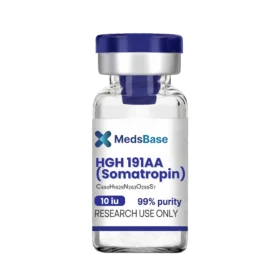 HGH 191AA
Vragen & antwoorden
HGH 191AA
Gerelateerde producten
Beoordelingen
Er zijn nog geen beoordelingen